Is Lofi Girl AI-generated?
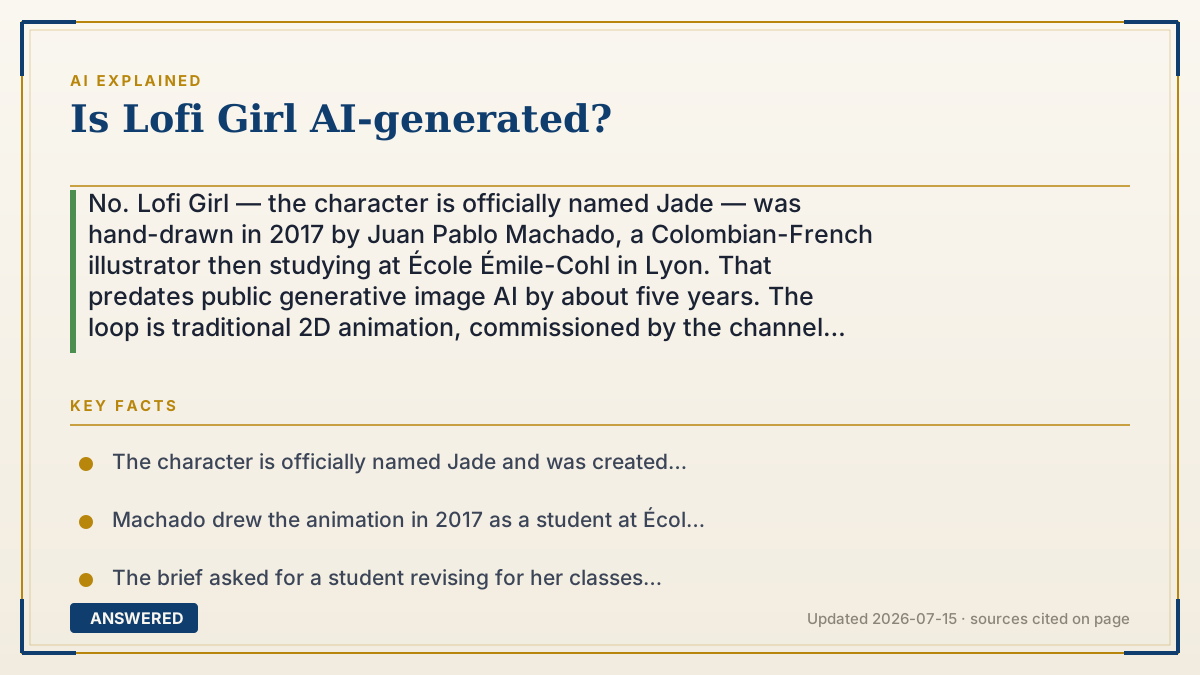
No. Lofi Girl — the character is officially named Jade — was hand-drawn in 2017 by Juan Pablo Machado, a Colombian-French illustrator then studying at École Émile-Cohl in Lyon. That predates public generative image AI by about five years. The loop is traditional 2D animation, commissioned by the channel then called ChilledCow.
Why — the first-principles explanation
The question exists because of a timeline illusion. Lofi Girl streams 24 hours a day, forever, with a girl who writes but never finishes, a cat that never moves, and a window whose light never changes. Endless, cheap, and slightly uncanny is exactly the signature people have learned to read as "machine-made" since 2022. But the loop is not endless because a computer keeps inventing it. It is endless because a short animation is played on repeat under a music playlist — the same trick a digital picture frame uses. Infinite runtime costs nothing once you have one good loop.
The hard constraint is chronology. Machado drew the character in 2017 and published a making-of post about the animation in March 2018. Publicly usable text-to-image generators did not arrive until roughly 2022. In 2017 the state of the art in image generation produced blurry 64-pixel faces, not a coherent character with consistent hands, a legible spiral notebook, and a specific real skyline out the window. No 2017 system could have produced this image, which means the only available explanation is the one the artist documented: he drew it.
The visual cues that read as "AI" are actually the fingerprints of the opposite process — human budget limits. Traditional 2D animation is expensive per frame, so an artist working to a brief animates the cheapest possible motion: a pen hand, a hair strand, a blinking eye, everything else locked. Generative video has the reverse failure mode. It struggles to hold a character identical across time; things drift, morph, and flicker. Lofi Girl's rock-solid consistency is evidence of hand-drawn cels, not evidence against them.
The brief itself is also documented and very human: the founder asked for a student revising for her classes, drawn Miyazaki-style. Machado, who says he was not even familiar with the lo-fi scene at the time, sketched several poses before settling on the studying one, and drew the view out the window from La Croix-Rousse hill in Lyon, where he was living. That is a specific person making specific choices about a specific real place — the kind of detail a prompt does not generate.
An example that makes it click
Think of a music box with a little dancer on top. She spins for hours and never gets tired, never varies, never stops. Nobody watching concludes a robot is inventing a new dancer every second. Someone carved one dancer, once, and the box just turns her around and around. Lofi Girl is that dancer. One artist drew a few seconds of motion in 2017, and a computer has been pressing "play again" ever since.
The giveaway runs backwards from what people assume. If a machine were truly redrawing her every second, she would not look this stable — her fingers would wander, the notebook text would scramble, the cat would slowly become a different cat. The fact that she is exactly the same girl at 3 a.m. as at noon is the strongest proof a human drew her once and locked her in.
Key facts
- The character is officially named Jade and was created by Juan Pablo Machado, a Colombian-French artist from Cali, Colombia.
- Machado drew the animation in 2017 as a student at École Émile-Cohl in Lyon, responding to a call for artists sent to his school.
- The brief asked for a student revising for her classes with Miyazaki-style visuals; the window view depicts La Croix-Rousse hill in Lyon.
- The YouTube channel was created on March 18, 2015 as 'ChilledCow', began streaming lo-fi hip hop on February 25, 2017, and rebranded to 'Lofi Girl' on March 18, 2021.
- Public text-to-image generative AI did not reach usable quality until roughly 2022 — about five years after the artwork was made.
- Lofi Girl today runs multiple continuous streams, including lofi hip hop, synthwave, jazz lofi, a Pomodoro study stream and a sleep stream.
▶ The 60-second explainer (script)
No — Lofi Girl is not AI-generated. She was drawn by hand, by a person, in 2017. The artist is Juan Pablo Machado, a Colombian-French illustrator who was then a student at École Émile-Cohl in Lyon, France. The channel — back when it was called ChilledCow — put out a call for artists, asking for a student revising for her classes, in a Miyazaki-like style. Machado sketched several poses, picked the studying one, and even drew the view out her window from La Croix-Rousse hill in Lyon, the neighborhood where he lived. The character has an official name: Jade. Now, why do people ask? Because she loops forever, and forever-content feels machine-made. But that loop is just a short animation on repeat under a playlist — the same idea as a music box. And look at the dates: usable image generators didn't show up until around 2022, roughly five years after this art existed. In 2017, AI could barely produce a blurry face, let alone a consistent character with readable notebook pages. Here's the twist: her perfect consistency is actually proof against AI. Generative video drifts and morphs. Jade never does. She's the same girl at 3 a.m. as at noon — because a human drew her once, and locked her in.
What authoritative sources say
People also ask
Who drew Lofi Girl?
Juan Pablo Machado, a Colombian-French illustrator from Cali, Colombia, who was studying at École Émile-Cohl in Lyon when he made the animation in 2017. He published a making-of blog post about it in March 2018.
Does Lofi Girl have a name?
Yes — the character is officially named Jade. She has also been widely called the Lofi Study Girl or the '24/7 lofi hip hop beats' girl.
Why does the animation look so repetitive if a human made it?
Because hand-drawn animation costs money per frame. An artist on a commission animates only the cheapest essential motion — a writing hand, some hair, a blink — and locks everything else. The repetition is a budget decision, not a machine.
Is the music AI-generated?
The character and animation are hand-drawn, and Lofi Girl has historically built its catalog around tracks from human lo-fi producers and its own label. Whether any individual track on any given stream involved AI tools is a separate question the artwork's origin doesn't settle.
Was the window view a real place?
Yes. The scene outside her window depicts La Croix-Rousse hill in Lyon, France, the area where Machado was studying at the time.