Is originality AI too sensitive?
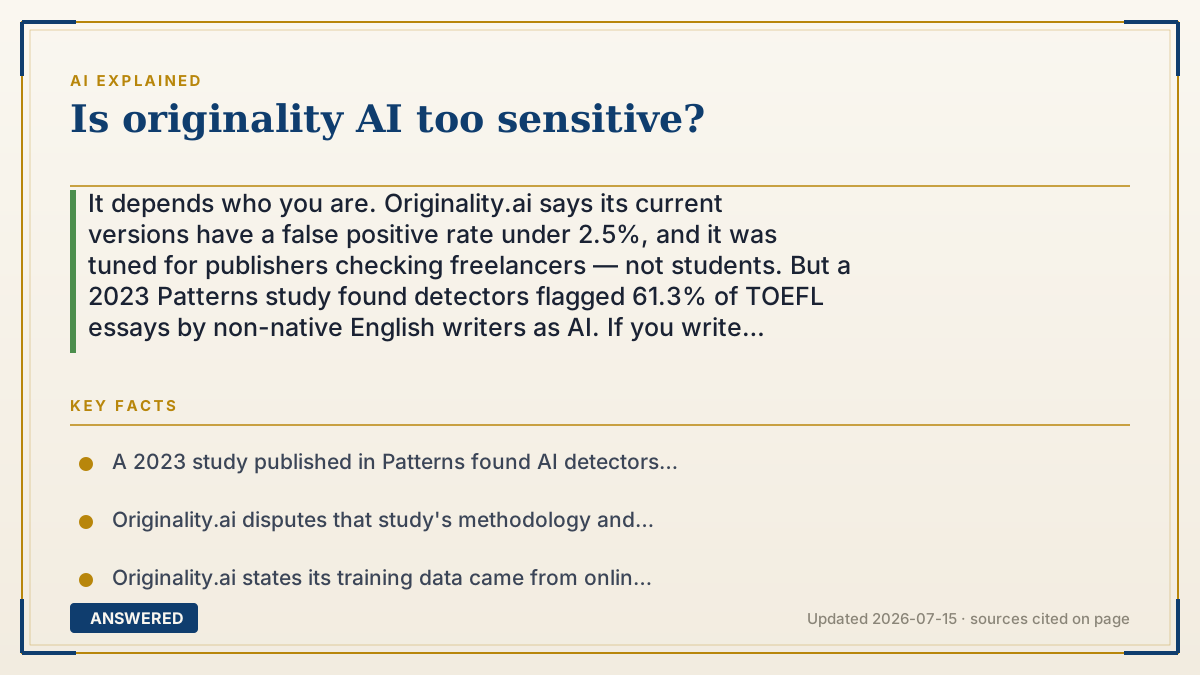
It depends who you are. Originality.ai says its current versions have a false positive rate under 2.5%, and it was tuned for publishers checking freelancers — not students. But a 2023 Patterns study found detectors flagged 61.3% of TOEFL essays by non-native English writers as AI. If you write plainly or in a second language, yes — it's too sensitive for you.
Why — the first-principles explanation
"Too sensitive" isn't a property of the tool. It's a property of the tool plus who's being scanned plus what happens when it's wrong — and confusing those three is why this argument never resolves.
Start with the mechanism, because it explains everything else. AI detectors don't detect AI. They detect statistical ordinariness. A language model picks each next word by choosing from high-probability options, so its output has low perplexity (few surprising word choices) and low burstiness (little variation in sentence length and rhythm). Human writing is normally spikier — you throw in a weird word, you follow a 30-word sentence with a 4-word one. Detectors score text on those signals.
Now look at what that necessarily implies. Which humans write with low perplexity and low burstiness? People writing in a second language, who reach for the common word because it's the one they're sure of. People taught to write plainly — technical writers, scientists, anyone trained out of flourish. People writing formulaically because the format demands it. The bias isn't a bug someone forgot to fix. It is the detection signal, working correctly, on people who happen to write like the thing it's looking for.
The evidence bears this out. The landmark study — Liang et al., published in Patterns in 2023 — found detectors flagged 61.3% of TOEFL essays by non-native English writers as AI-generated, and 97.8% were flagged by at least one detector, while essays by US-born eighth graders were classified accurately. That's not a rounding error. That's a coin flip weighted against people for whom English is a second language.
Originality.ai's response is worth reading fairly, because it's partly reasonable and partly a dodge. Their reasonable point: they built the tool for publishers and content marketers vetting freelance writers, not for professors grading students. Their training data came from online content aimed at search ranking, not academic writing. That's a real scope argument — a smoke detector isn't defective because it's bad at finding carbon monoxide. Their claim that newer versions achieve a false positive rate under 2.5% may well be true. But it's a vendor measuring its own product on its own test set. Independent evaluations of AI detectors in academic contexts keep finding meaningful error rates, and comparative testing shows enormous spread between tools — Originality.ai's false negative rate has been measured as high as 40% in some comparisons while other detectors stayed under 4%.
So do the arithmetic that matters. Suppose 2.5% false positives is exactly right. A professor scanning 500 essays a semester wrongly accuses about 12 innocent students a year. Whether that's "too sensitive" depends entirely on what an accusation costs. For a marketer deciding whether to re-hire a freelancer, a false positive costs a little awkwardness. For a student facing an academic integrity board, it can cost the degree. Same number. Completely different verdict.
An example that makes it click
Think about a metal detector at an airport that beeps at anything metal. It works exactly as designed. But it beeps at your grandmother's hip replacement every single time — not because it's broken, but because a titanium hip is metal. The detector isn't wrong. It's answering "is there metal" when everyone's pretending it answers "is there a weapon."
AI detectors beep at statistical ordinariness. If you write in your second language, you have a titanium hip. You'll beep forever, and no amount of not-carrying-a-weapon will stop it.
How to do it
- Know what it measures. Originality.ai scores statistical ordinariness — low perplexity and low burstiness — not AI authorship. It cannot see whether you used a tool; it can only see whether your prose looks predictable.
- Check the intended scope. Originality.ai states it was built for publishers and content marketers vetting freelance writers, and trained on online content aimed at search ranking — not on academic writing by students.
- Weigh the accuracy claim honestly. The company reports under 2.5% false positives on current versions; that's a vendor claim about its own product. Independent academic evaluations continue to find meaningful error rates, and false negative rates vary hugely between detectors.
- Do the volume math. At even 2.5%, scanning 500 essays produces about 12 false accusations. Multiply by whatever a wrongful accusation costs in your setting — that product, not the percentage, is what "too sensitive" means.
- If you're being scanned, build a paper trail before you need it: version history in Google Docs or Word, saved drafts, notes, timestamps. This is real evidence; a detector score is not.
- If you're accused, ask for the specific evidence beyond the score, note the documented false-positive problem for non-native English writers, and offer your version history. Ask whether the institution's policy actually permits a detector score as sole evidence — most now say it does not.
- If you're the one scanning: never use a score as a verdict. Use it as a prompt to look closer, and never at all if your writers include non-native English speakers, because you'll be systematically wrong about that group.
Key facts
- A 2023 study published in Patterns found AI detectors flagged 61.3% of TOEFL essays by non-native English writers as AI-generated, with 97.8% flagged by at least one detector, while US eighth-grade essays were classified accurately.
- Originality.ai disputes that study's methodology and states its updated versions achieve a false positive rate below 2.5% — a vendor claim about its own product.
- Originality.ai states its training data came from online content oriented toward search ranking, and that the tool is built for publishers and writers rather than students.
- Comparative testing has measured Originality.ai's false negative rate as high as 40% in some cases, while other detectors stayed below 4% — showing wide performance spread across tools and text types.
- Detectors work by scoring perplexity (word-choice predictability) and burstiness (sentence-length variation), which are also characteristic of second-language and plain-style human writing.
- At a 2.5% false positive rate, scanning 500 essays yields roughly 12 false accusations.
- Independent academic evaluation continues to document meaningful accuracy and reliability limitations in AI content detectors as of 2026.
▶ The 60-second explainer (script)
Is Originality.ai too sensitive? Depends who you are — and here's why that's the real answer. Detectors don't detect AI. They detect statistical ordinariness. A language model picks each word from high-probability options, so its writing has low perplexity — few surprising word choices — and low burstiness — little variation in sentence rhythm. Humans are normally spikier. Weird word here, thirty-word sentence followed by a four-word one. Detectors score that. Now think about what that necessarily implies. Which humans write with low perplexity? People writing in a second language, reaching for the common word because it's the one they're sure of. Technical writers trained out of flourish. Anyone writing to a formula. The bias isn't a bug someone forgot to fix. It IS the detection signal, working correctly, on people who happen to write like the thing it's hunting. The landmark study — Liang et al., Patterns, 2023 — found detectors flagged sixty-one percent of TOEFL essays by non-native English writers as AI. Ninety-eight percent got flagged by at least one detector. Meanwhile US eighth-graders were classified fine. Originality.ai's response is half fair: they built this for publishers vetting freelancers, not professors grading students, and trained it on SEO content, not academic writing. That's a real scope argument. They also say newer versions are under two and a half percent false positives. Maybe. That's a vendor grading its own homework. But do the math that matters. Even at two point five percent, a professor scanning five hundred essays wrongly accuses twelve innocent students a year. For a marketer, a false positive costs an awkward email. For a student, it can cost the degree. Same number. Different verdict.
What authoritative sources say
People also ask
Why did Originality.ai flag my writing when I wrote it myself?
Because it scores statistical predictability, not authorship. If you write plainly, follow a formula, or write in a second language, your prose looks statistically similar to model output — and the detector cannot tell the difference in principle.
Is the 2.5% false positive claim true?
It may be accurate for the text types Originality.ai was built and tested for. It's a vendor claim measured on its own test set, and independent academic evaluations continue to find meaningful error rates on other kinds of writing.
Can I lower my AI score by rewriting?
Somewhat — adding sentence-length variation and less predictable word choices raises perplexity and burstiness. Which is a perverse outcome: you're being asked to write worse to prove you're human.
Should schools use Originality.ai?
The company itself says the tool is built for publishers and writers, not students, and that its training data came from SEO-oriented web content. Given the documented false-positive problem for non-native English writers, a score should never be sole evidence.
What should I do if I'm falsely accused?
Produce your version history and drafts, cite the documented 61.3% false-positive rate for non-native English writers from the 2023 Patterns study, and ask whether your institution's policy permits a detector score as sole evidence — most now say it does not.