Is Manus AI considered a local AI?
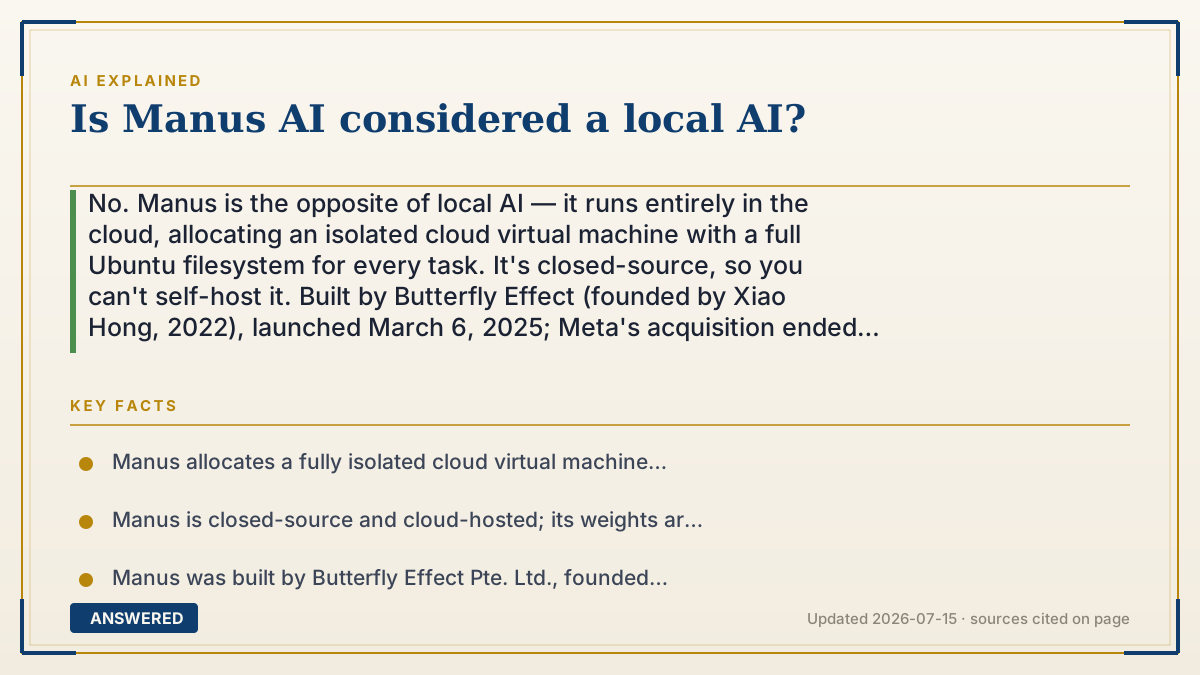
No. Manus is the opposite of local AI — it runs entirely in the cloud, allocating an isolated cloud virtual machine with a full Ubuntu filesystem for every task. It's closed-source, so you can't self-host it. Built by Butterfly Effect (founded by Xiao Hong, 2022), launched March 6, 2025; Meta's acquisition ended June 15, 2026 after Chinese regulators blocked it.
Why — the first-principles explanation
The confusion here is worth untangling, because "local AI" means something specific and Manus fails the test on two separate counts.
Local AI means the model weights run on hardware you control — your laptop, your server, your GPU. Nothing leaves the machine. That's the entire point: privacy, no API bill, no vendor able to change or discontinue it. It requires two things: the weights must be available to you (open weights), and you must have hardware that can run them.
Manus fails the first test outright. It's closed-source. The weights aren't yours to download, so "running it locally" isn't a configuration choice you got wrong — the option doesn't exist. And there's a deeper reason: Manus reportedly doesn't train its own foundation models. Butterfly Effect's outside counsel concluded an investment fell outside US outbound-investment rules partly on the grounds that Manus doesn't train foundation models. It's an orchestration layer over other companies' models — models it relies on which were themselves unavailable in China. You can't localize a product whose intelligence it doesn't own.
It fails the second test by design, and this is the more interesting part. Manus allocates a fully isolated cloud virtual machine for every user task — a real Ubuntu box with shell access, where it browses, writes code, creates files, and runs scripts autonomously. That architecture is the product. An agent that executes arbitrary code needs a sandbox it can safely trash, spun up in seconds and destroyed after. Doing that on your laptop means letting an AI run shell commands on your actual machine — which is precisely what the cloud VM exists to avoid. Manus is cloud-native not incidentally but because agentic execution demands disposable, isolated compute.
So what is local AI, then? Tools like OpenClaw run open-source on your own hardware and cost only API credits. That's the genuine alternative, and the tradeoff is honest: you get privacy and control, you give up the managed sandbox and pay in setup and hardware.
One thing worth knowing about Manus's stability: Meta announced an acquisition in December 2025 valued at $2-3 billion. China's National Development and Reform Commission blocked it on April 27, 2026, and Meta formally ended the deal on June 15, 2026. If your interest in "local" is about not depending on someone else's decisions, that history is instructive.
An example that makes it click
Think about a rental workshop versus a garage.
Manus is the rental workshop. You describe the job, and somewhere across town they open a fully equipped bay just for you — every tool, a lift, a floor you can cover in oil. When you're done, they hose it out and it's gone. You never owned a wrench. And crucially, you want the mess to happen there, because the whole job involves making a mess.
Local AI is your own garage. Your tools, your floor, nobody else sees the car. But you had to buy the lift, and if you spill the oil you're cleaning it up.
Asking whether Manus is local AI is like asking whether the rental workshop is your garage. It isn't — and the reason it isn't is the reason you'd use it.
Key facts
- Manus allocates a fully isolated cloud virtual machine for every user task, with full Ubuntu filesystem access and shell execution — it browses, codes, creates files, and runs scripts entirely in the cloud.
- Manus is closed-source and cloud-hosted; its weights are not available for self-hosting, and pricing runs roughly $20-$200 per month.
- Manus was built by Butterfly Effect Pte. Ltd., founded by Xiao Hong in 2022, with co-founders Ji Yichao (chief scientist) and Zhang Tao (product director).
- Manus launched March 6, 2025 as an invitation-only beta.
- Manus does not train its own foundation models — a conclusion cited by Benchmark's outside counsel regarding US outbound investment rules — and relied on American AI models unavailable in China.
- Meta announced an acquisition of Manus in December 2025 valued at $2-3 billion; China's National Development and Reform Commission blocked the deal on April 27, 2026, and Meta formally ended it on June 15, 2026.
▶ The 60-second explainer (script)
Is Manus AI local? No — it's about as far from local as an AI product gets. And the reasons are worth understanding. Local AI means the model weights run on hardware you control. Your laptop, your server. Nothing leaves the machine. That's the whole point: privacy, no API bill, no vendor who can change or kill it. It needs two things — the weights have to be available to you, and you need hardware that can run them. Manus fails the first one outright. It's closed-source. The weights aren't yours to download, so running it locally isn't a setting you missed — the option doesn't exist. And there's a deeper reason: Manus reportedly doesn't train its own foundation models. It's an orchestration layer over other companies' models. You can't localize a product whose intelligence it doesn't own. It fails the second test by design, and this part is more interesting. Manus allocates a fully isolated cloud virtual machine for every single task — a real Ubuntu box with shell access, where it browses, writes code, creates files, runs scripts. That architecture is the product. An agent executing arbitrary code needs a sandbox it can safely trash, spun up in seconds and destroyed after. Doing that on your laptop means letting an AI run shell commands on your actual machine — which is exactly what the cloud VM exists to prevent. Think rental workshop versus garage. Manus is the workshop: they open a fully equipped bay just for you, you cover the floor in oil, they hose it out, it's gone. You never owned a wrench — and you want the mess to happen there. Asking if Manus is local is like asking if the rental workshop is your garage. If you want actually local, look at open-source tools like OpenClaw that run on your own hardware for the cost of API credits. And one footnote on depending on other people's decisions: Meta announced a two-to-three-billion-dollar acquisition of Manus in December 2025. Chinese regulators blocked it in April 2026, and Meta formally ended the deal on June 15, 2026.
What authoritative sources say
People also ask
Can I run Manus on my own computer?
No. Manus is closed-source and cloud-hosted — the weights aren't available to download, so self-hosting isn't possible. Every task runs in an isolated cloud virtual machine on the company's infrastructure.
Why does Manus need a cloud VM for every task?
Because it executes real code. An autonomous agent that browses, writes files, and runs shell commands needs a disposable sandbox it can safely trash — spun up per task, destroyed after. Doing that on your laptop would mean giving an AI shell access to your actual machine.
What are genuinely local alternatives?
Open-source agents like OpenClaw run on your own hardware and cost only API credits. The tradeoff is real: you get privacy and control, you give up the managed sandbox and handle setup and hardware yourself.
Does Manus have its own AI model?
No. It doesn't train its own foundation models — it orchestrates other companies' models. That was cited in legal analysis of whether investment in it fell under US outbound-investment rules.
Did Meta buy Manus?
No, the deal died. Meta announced a $2-3 billion acquisition in December 2025, but China's NDRC blocked it on April 27, 2026, and Meta formally ended the acquisition on June 15, 2026.