Is Walter Writes AI any good?
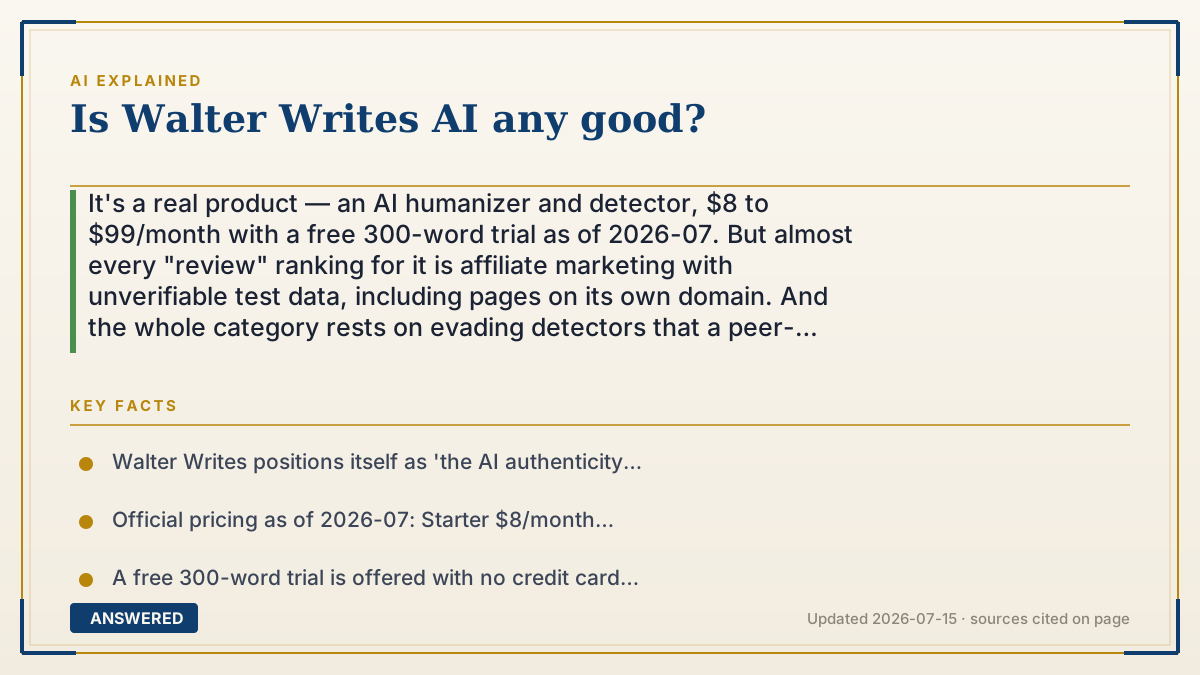
It's a real product — an AI humanizer and detector, $8 to $99/month with a free 300-word trial as of 2026-07. But almost every "review" ranking for it is affiliate marketing with unverifiable test data, including pages on its own domain. And the whole category rests on evading detectors that a peer-reviewed study showed are unreliable in the first place.
Why — the first-principles explanation
Two things are worth separating: whether the product works, and whether the thing it does is worth doing.
On the first, the honest answer is that you cannot find out from the internet, and that's the most useful fact here. Search this product and you'll get a wall of confident reviews quoting precise-sounding figures — "87.6% average bypass rate across five detectors," "79.7% on Turnitin." Those numbers look like evidence. They're almost entirely from affiliate sites earning commission on signups, running unpublished methodology on undisclosed samples. Some of the highest-ranking "Walter Writes review" pages are hosted on Walter Writes' own domain. This isn't unique to this company — the entire AI-humanizer category is a commission-driven content ecosystem — but it means the confident numbers you'll find are decoration, not data. A precise figure with no published method is just a vibe wearing a lab coat.
What's verifiable comes from the vendor: it offers an AI humanizer that rewrites AI drafts and an AI detector that estimates whether text is machine-written, marketing itself as "the AI authenticity platform." Pricing as of 2026-07 runs Starter $8/month for 30,000 words, Pro $13 for 70,000, Elite $26 for 200,000, and Teams $99 for 500,000, with a free 300-word trial and no credit card. It claims "detection-proof" output while also giving you an authenticity score before you publish.
The second question is more important, and it undermines the category. The product's value depends on AI detectors being meaningful adversaries. They largely aren't. A 2023 study in Patterns by Liang and colleagues at Stanford found GPT detectors "consistently misclassify non-native English writing samples as AI-generated, whereas native writing samples are accurately identified." Read that closely: the detectors weren't measuring whether a machine wrote something. They were measuring simple, plain prose — and flagging it. That's why a humanizer "works." It adds complexity and irregularity, which is what the detector was actually scoring all along. You're not defeating a lie detector; you're feeding a bad thermometer warmer air.
Which sets up the real problem. If detectors are unreliable, then no vendor can promise you safety, because your risk isn't determined by whether the detector is correct — it's determined by whether your professor believes it. A false positive convicts you whether or not you used AI. A false negative clears you whether or not you did. Buying a humanizer to manage that is paying to influence a coin flip you don't control. And for schoolwork, submitting AI text with the detection filed off is academic misconduct on its own terms — the tool's success is exactly what makes it a problem, since the institution's rule is about authorship, not about what the software concluded.
So: probably it does roughly what it says, at a modest price, in a category where nobody's claims can be checked and the underlying premise is shaky. If you want the legitimate use — making AI drafts read less robotically for your own writing — that's real, and any good model will do it if you ask.
An example that makes it click
Imagine a store selling sprays that beat a metal detector, and the metal detector goes off for anyone wearing a belt. The spray "works" — people walk through clean. But look at what actually happened: the detector was never finding weapons. It was finding belts. And the spray just removes belts.
Now the guy without a belt still gets stopped sometimes, because the machine is unreliable in both directions. So what did you buy? Not safety. You bought a nudge on a machine that was never measuring the thing everyone thinks it measures.
That's the AI humanizer category. Stanford researchers found detectors flag plain, simple English — which is why they wrongly accuse non-native speakers constantly. Humanizers add complexity and irregularity. They score better because they're feeding the thermometer what it actually reads. And meanwhile the honest student who wrote every word themselves can still get flagged, and no product can fix that.
Key facts
- Walter Writes positions itself as 'the AI authenticity platform', offering an AI Humanizer that rewrites AI drafts to sound human, and an AI Detector that estimates whether text is machine-generated.
- Official pricing as of 2026-07: Starter $8/month ($96/year) for 30,000 words and 750 words per request; Pro $13/month ($156/year) for 70,000 words; Elite $26/month ($312/year) for 200,000 words; Teams $99/month ($1,188/year) for 500,000 words.
- A free 300-word trial is offered with no credit card required.
- The platform claims 'detection-proof' output while also providing an authenticity score after rewriting so users can assess text before publishing.
- Independent verification is effectively unavailable: the visible review landscape is dominated by affiliate content with unpublished methodology, and some top-ranking 'Walter Writes review' pages are hosted on the vendor's own domain.
- A 2023 study in Patterns (Liang, Yuksekgonul, Mao, Wu & Zou) found GPT detectors 'consistently misclassify non-native English writing samples as AI-generated, whereas native writing samples are accurately identified' — evidence detectors track prose simplicity rather than authorship.
- Because detectors produce both false positives and false negatives, no humanizer can guarantee an outcome — the risk depends on an unreliable tool and the human reading its output.
- Submitting AI-written work as your own is academic misconduct on the institution's own terms, independent of whether any detector flags it.
▶ The 60-second explainer (script)
Is Walter Writes AI any good? Let's split that into two questions, because the second one matters more. First: does it work? The honest answer is that you cannot find out from the internet — and that's the most useful thing I can tell you. Search this product and you'll hit a wall of confident reviews quoting precise numbers. Eighty-seven point six percent average bypass rate. Seventy-nine point seven on Turnitin. Those look like evidence. They're almost all from affiliate sites earning commission on signups, running unpublished methodology on undisclosed samples. Some of the top-ranking 'Walter Writes reviews' are hosted on Walter Writes' own domain. A precise figure with no published method is just a vibe wearing a lab coat. What IS verifiable comes from the vendor: it's a humanizer plus a detector. Starter's eight dollars a month for thirty thousand words, Pro thirteen, Elite twenty-six, Teams ninety-nine. Free three-hundred-word trial, no credit card. That's real, as of July 2026. Now the second question, which undermines the whole category. This product's value depends on AI detectors being meaningful adversaries. They largely aren't. A 2023 study in the journal Patterns, from Stanford researchers, found GPT detectors consistently misclassify non-native English writing as AI-generated, while correctly clearing native writing. Read that again. The detectors weren't measuring whether a machine wrote something. They were measuring plain, simple prose — and flagging it. Which explains why humanizers 'work.' They add complexity and irregularity, which is what the detector was scoring all along. You're not beating a lie detector. You're feeding a bad thermometer warmer air. It's a store selling spray that beats a metal detector — when the metal detector goes off for anyone wearing a belt. The spray works! But the detector was never finding weapons. It was finding belts. And here's the kicker: the guy with no belt still gets stopped, because the machine is unreliable both directions. So no vendor can sell you safety. Your risk isn't whether the detector is right — it's whether your professor believes it. A false positive convicts you either way. And for schoolwork, submitting AI text with the detection filed off is misconduct on its own terms. The tool succeeding is exactly what makes it a problem.
What authoritative sources say
People also ask
Does Walter Writes actually bypass AI detectors?
Probably often, but no published independent testing exists. Every bypass percentage you'll find comes from affiliate sites with unstated methodology. The vendor itself claims 'detection-proof' output while also shipping a score to check before you publish.
How much does Walter Writes cost?
As of 2026-07: Starter $8/month for 30,000 words, Pro $13 for 70,000, Elite $26 for 200,000, and Teams $99 for 500,000. There's a free 300-word trial with no credit card required.
Why can't I trust the reviews?
The AI-humanizer category runs on affiliate commission. Reviews quote precise bypass rates without publishing methodology or samples, and several top-ranking 'reviews' sit on the vendor's own domain.
Are AI detectors even accurate?
Not reliably. A 2023 Patterns study found detectors consistently flag non-native English writing as AI-generated while clearing native writing — they measure prose simplicity, not authorship. That's the shaky foundation the whole category is built on.
Is using a humanizer for schoolwork safe?
No. Submitting AI text as your own is academic misconduct regardless of whether a detector catches it — the rule is about authorship. And since detectors produce false positives too, no product can actually guarantee your outcome.