Should you use AI for writing?
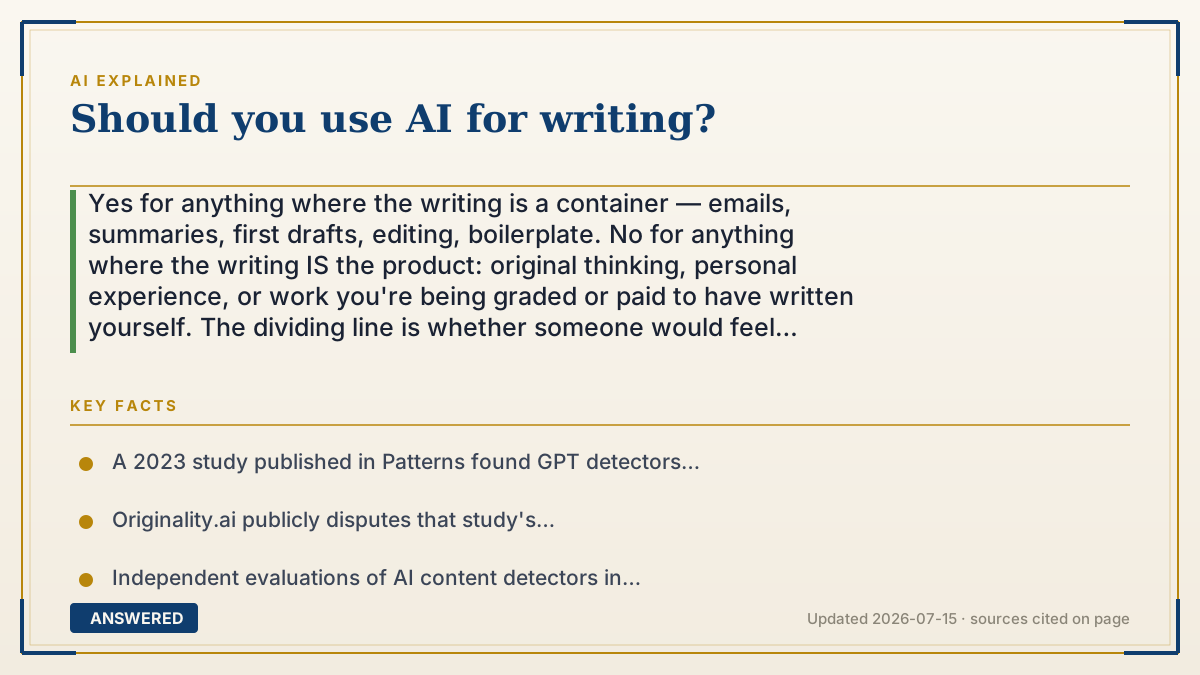
Yes for anything where the writing is a container — emails, summaries, first drafts, editing, boilerplate. No for anything where the writing IS the product: original thinking, personal experience, or work you're being graded or paid to have written yourself. The dividing line is whether someone would feel deceived learning AI wrote it.
Why — the first-principles explanation
The useful question isn't "is AI writing good or bad" — it's what is the writing for. Most writing is a container: you have information, it needs to reach someone, prose is the delivery mechanism. Nobody reads your meeting recap for the prose. For containers, AI is straightforwardly good, and refusing it is like refusing a calculator because arithmetic builds character.
But some writing isn't a container. It's the thinking itself. When you write an argument, you discover where it breaks — the paragraph that won't come out right is usually a thought that isn't finished. Writing is how you find out what you don't know. Outsource that and you don't get the thinking done faster; you get a fluent artifact and a hole where the understanding should be. That's not a moral claim, it's a mechanical one. This is exactly why homework is assigned. The essay isn't the point. The essay is the byproduct.
Then there's what the model actually does, which sets a hard ceiling. A language model predicts the next token based on patterns in training data. It's optimizing for plausible, not true. So it produces confident, well-formed sentences that are sometimes simply wrong — and the fluency is what makes them dangerous, because we use fluency as a proxy for competence. It also can't know things absent from its training data: what happened at your meeting, how your surgery felt, what your customer said. Those are exactly the parts of your writing worth reading.
Finally, the enforcement reality, which is messier than either side admits. AI detectors are unreliable in a specific, documented, and unfair way. A 2023 study in Patterns found detectors flagged 61.3% of TOEFL essays by non-native English writers as AI-generated, with 97.8% flagged by at least one detector — while essays by US-born eighth graders were classified accurately. The mechanism is grimly logical: detectors partly key on low lexical variety and simple sentence structure, which is also what second-language writing looks like. Originality.ai, one of the major vendors, publicly disputed that study and says its newer versions have a false positive rate under 2.5% — but that's a vendor claim about its own product, and independent evaluations continue to find real error rates. So: an accusation can land on you whether or not you used AI, and clearing your name is your problem. Keep your drafts.
An example that makes it click
Think about a wedding toast. Nobody minds if you Google "how to structure a toast" or use a template for the opening. That's the container. But if you asked AI to write "a heartfelt story about my brother," it would produce something warm, well-shaped, and about nobody. It doesn't know he got food poisoning at your graduation and drove four hours anyway. That story is the entire toast. Everything else is scaffolding around it.
So use the machine for the scaffolding. The scaffolding is genuinely tedious and nobody will ever thank you for it. Just don't hand over the thing people actually came to hear.
How to do it
- Ask one question before every use: is the writing the container, or the product? Container — meeting notes, boilerplate emails, summaries, formatting, translation — use AI freely. Product — an argument, a personal account, graded or attributed work — write it yourself.
- Check the rules where the work lands. Schools, publishers, and employers have wildly different policies, and "nobody said I couldn't" is not a defense when the syllabus says otherwise.
- Use AI at the edges of the process, where it's strongest and least risky: brainstorm angles before you start, then critique and tighten after you've drafted. Both are real leverage without hollowing out the middle.
- Never let it supply facts, numbers, dates, quotes, or citations unverified. Models generate plausible-looking sources that don't exist. Every factual claim needs a real source you personally opened.
- Write the parts only you can write first — what you saw, what you decided, what surprised you. Then let AI help with transitions and structure around them. This ordering keeps the irreplaceable content in.
- Keep your drafts, version history, and notes. Given documented false-positive rates against non-native English writers in particular, your process record is the only defense against a wrongful AI accusation.
- Read every sentence aloud before sending. AI prose fails in a specific way — it's smooth, generic, and slightly over-hedged. Reading aloud catches it instantly.
Key facts
- A 2023 study published in Patterns found GPT detectors flagged 61.3% of TOEFL essays by non-native English writers as AI-generated, with 97.8% flagged by at least one detector, while US eighth-grade essays were classified accurately.
- Originality.ai publicly disputes that study's methodology and states its updated versions achieve a false positive rate under 2.5% — a vendor claim about its own product, not an independent finding.
- Independent evaluations of AI content detectors in academic contexts continue to document meaningful false positive and false negative rates; detector accuracy varies widely between tools.
- Language models predict the next token by pattern-matching against training data, optimizing for plausibility rather than truth — which is why they generate confident, fluent, factually wrong statements.
- Amazon KDP requires disclosure of AI-generated text, images, and translations, but does not require disclosure of AI-assisted work such as brainstorming or grammar checking.
- Platform disclosure rules differ by venue: Amazon KDP, Etsy, academic institutions, and employers each set their own thresholds as of 2026-07.
▶ The 60-second explainer (script)
Should you use AI for writing? The answer isn't yes or no — it's: what is the writing for? Most writing is a container. You have information, it needs to reach someone, prose is the delivery truck. Nobody reads your meeting recap for the prose. For containers, use AI. Refusing is like refusing a calculator because arithmetic builds character. But some writing isn't a container — it's the thinking itself. When you write an argument, you find out where it breaks. The paragraph that won't come out right is usually a thought that isn't finished. Writing is how you discover what you don't know. Outsource that and you don't think faster, you get a fluent artifact and a hole where the understanding should be. That's why homework exists. The essay isn't the point. The essay is the byproduct. Now, the hard ceiling: a language model predicts the next token from patterns. It optimizes for plausible, not true. So it writes confident sentences that are sometimes just wrong — and the fluency is what makes that dangerous, because we read fluency as competence. It also can't know what happened at your meeting or how your surgery felt. Those are the parts worth reading. One more thing, and it's ugly. AI detectors are unreliable in an unfair way. A 2023 study in Patterns found detectors flagged sixty-one percent of TOEFL essays by non-native English writers as AI — while US eighth-graders got classified correctly. The mechanism is grim: detectors key on simple sentence structure, which is what second-language writing looks like. So keep your drafts. An accusation can land whether or not you used anything.
What authoritative sources say
People also ask
Is using AI for writing cheating?
It depends on what was promised. If the assignment or job is to demonstrate your own thinking, yes. If the deliverable is information that happens to be in sentences, no. The rules of the specific venue decide, not a general principle.
Will my writing get flagged as AI even if I wrote it?
Possibly. A 2023 Patterns study found detectors flagged 61.3% of TOEFL essays by non-native English writers as AI-generated. If you write in simple, clear prose or English isn't your first language, you're at elevated risk. Keep drafts and version history.
Does AI writing hurt my skills?
It can, for the specific skill of constructing arguments — because that skill is built by struggling through the draft. It's much less of a concern for formatting, summarizing, and boilerplate, which teach you nothing anyway.
Can AI do research for me?
It can point you at topics and terminology. It cannot be trusted for facts, dates, numbers, quotes, or citations — models generate plausible sources that don't exist. Open every source yourself.
Do I have to disclose that I used AI?
Depends where. Amazon KDP requires disclosure of AI-generated content but not AI-assisted work. Schools and employers set their own rules. Check before, not after.