Is youtube still using AI to determine age?
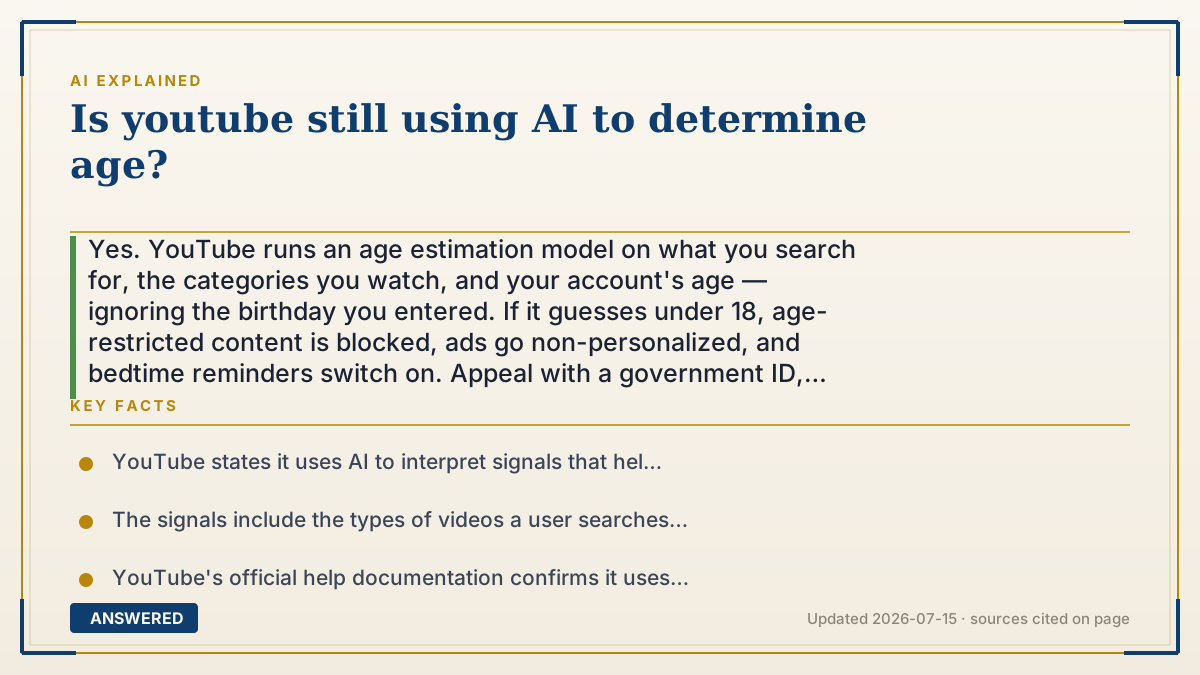
Yes. YouTube runs an age estimation model on what you search for, the categories you watch, and your account's age — ignoring the birthday you entered. If it guesses under 18, age-restricted content is blocked, ads go non-personalized, and bedtime reminders switch on. Appeal with a government ID, credit card, or selfie.
Why — the first-principles explanation
The system exists because the birthday field is a lie and everyone knows it. Every platform has known for two decades that a 12-year-old types 1985. Regulators increasingly hold platforms responsible for protecting minors anyway. That leaves exactly two options: verify everyone's identity — enormously invasive, kills signups — or guess from behavior. YouTube chose guessing, and the same approach was already deployed in other markets before it came to the US.
The signals are the giveaway to how it works. YouTube says it interprets the types of videos a user searches for, the categories of videos they've watched, and the longevity of the account. Notice: no face scan, no photo, no ID. It's a behavioral classifier. An account that's eleven years old was almost certainly not opened by a current 14-year-old. Watch patterns cluster by age, and clustering is exactly what these models are for.
What happens on a hit is mostly soft-edged, and that's the key design decision. Your account keeps working. YouTube disables personalized advertising (and excludes sensitive categories like gambling), turns on break and bedtime reminders by default, and applies recommendation and search safety protections. The one hard edge: age-restricted content is blocked. So it's a restriction on ads, nudges, and a slice of the catalog — not an eviction. The logic is that a classifier which is wrong some percentage of the time would be intolerable if it locked people out entirely, and merely annoying if it turns off targeted ads. The consequence was sized to fit the error rate.
If it's wrong about you, YouTube's stated remedy is to verify you're 18 or over by submitting a government ID, a credit card, or a selfie through your Google Account. And here's the tension worth naming honestly: the fix for a privacy-adjacent guess is handing over strictly more identifying information than the guess ever used — a document or your face, versus your watch history. A Change.org petition against the rollout gathered over 68,000 signatures, with critics framing it as surveillance, since the model reads viewing behavior to score you.
Both things are true at once. The system uses less data than an ID check would. And it uses your watch history in a way you didn't opt into.
An example that makes it click
A bartender doesn't card everyone. They glance at you and guess.
If you clearly look forty, you get served. If you look borderline, they ask for ID. And when they're unsure, they don't throw you out — they just don't offer you the fancy stuff.
YouTube's classifier is that glance. But instead of your face, it's looking at what you watch and how long you've had the account. And instead of refusing service, it quietly turns off targeted ads and stops feeding you the same clip forty times.
The catch is the same as the bar's: if the bartender guesses wrong, the only way to prove your age is to hand over your actual driver's license — which tells them far more than your face ever did.
How to do it
- Know the trigger: YouTube estimates your age from what you search for, the categories you watch, and how long your account has existed — not from the birthday you entered.
- Watch for the symptoms of a flag: age-restricted videos blocked, personalized ads disappearing, bedtime and break reminders appearing, and recommendations getting more restrictive.
- If you're an adult and got flagged, use YouTube's verification path — a government ID, credit card, or selfie through your Google Account — to confirm you're 18 or over.
- Weigh that trade honestly: verifying hands over more identifying information than the estimate ever used. Some people prefer the restrictions.
- If you share an account with a child, expect the estimate to skew younger — the model is reading the account's behavior, not the account holder.
- For real separation, use separate accounts or profiles rather than trying to influence the classifier.
- Understand the ceiling: this is age estimation, not age verification. It's a probability, and it will sometimes be wrong.
Key facts
- YouTube states it uses AI to interpret signals that help determine whether a user is over or under 18.
- The signals include the types of videos a user searches for, the categories of videos they have watched, and the longevity of the account.
- YouTube's official help documentation confirms it uses an age estimation model to determine if a user is over or under 18 regardless of the birthdate on the account.
- Users estimated to be under 18 have age-restricted content blocked, break and bedtime reminders enabled by default, recommendation and search safety protections applied, and receive only non-personalized ads with sensitive categories such as gambling excluded.
- Users incorrectly flagged can challenge the estimate by submitting a government ID, credit card, or selfie through a verification process in their Google Account.
- A Change.org petition opposing the rollout collected over 68,000 signatures, with critics citing surveillance concerns over the use of viewing behavior and watch history.
Choosing a tool for your creative workflow?
The answer above explains the concept; this next step helps you choose by job, limits and current terms.
▶ The 60-second explainer (script)
Yes — YouTube is still using AI to guess your age. And it's not looking at your face. Here's why this exists: the birthday field is a lie, and everyone has always known it. A twelve-year-old types nineteen eighty-five. But regulators hold platforms responsible for protecting minors anyway. So there are only two options. Verify everyone's ID — invasive, kills signups. Or guess from behavior. YouTube guesses. What does it look at? Its own words: the types of videos you search for, the categories you've watched, and how long your account has existed. No face scan. No photo. And it ignores the birthday you typed entirely. An account that's eleven years old probably wasn't opened by a current fourteen-year-old. Now the clever part. If it thinks you're under eighteen, your account keeps working. Age-restricted videos get blocked, personalized ads switch off, bedtime and break reminders turn on, and recommendations tighten up. That's it. And that's deliberate. A classifier that's wrong some percentage of the time is a disaster if it locks people out entirely, and merely annoying if it turns off targeted ads. They sized the consequence to fit the error rate. It's a bartender's glance. They don't card everyone. If you look borderline, they ask. And if they're unsure, they just don't offer you the fancy stuff. Wrongly flagged? You can verify with a government ID, a credit card, or a selfie. Which is the uncomfortable part — the fix for a privacy-adjacent guess is handing over a document or your face, when the guess only ever used your watch history. A petition against it gathered over sixty-eight thousand signatures. Both things are true.
What authoritative sources say
People also ask
Does YouTube scan my face to guess my age?
No. YouTube's stated signals are behavioral: what you search for, the categories of videos you watch, and how long your account has existed. No photo or face scan is involved in the estimate.
Does it use the birthday I entered?
No — that's the point. The estimate runs regardless of the birthday on your account, because self-reported birthdays have never been reliable.
What actually changes if it thinks I'm under 18?
Age-restricted content is blocked, personalized ads are turned off with sensitive categories like gambling excluded, break and bedtime reminders switch on by default, and recommendation and search safety protections apply.
How do I fix it if I'm an adult?
Submit a government ID, a credit card, or a selfie through the verification process in your Google Account. It's worth noting this reveals more about you than the estimate ever used.
Can I opt out of age estimation?
Not directly. The estimate runs on account behavior. Your options are to accept the teen protections or verify your age with a government ID, credit card, or selfie.