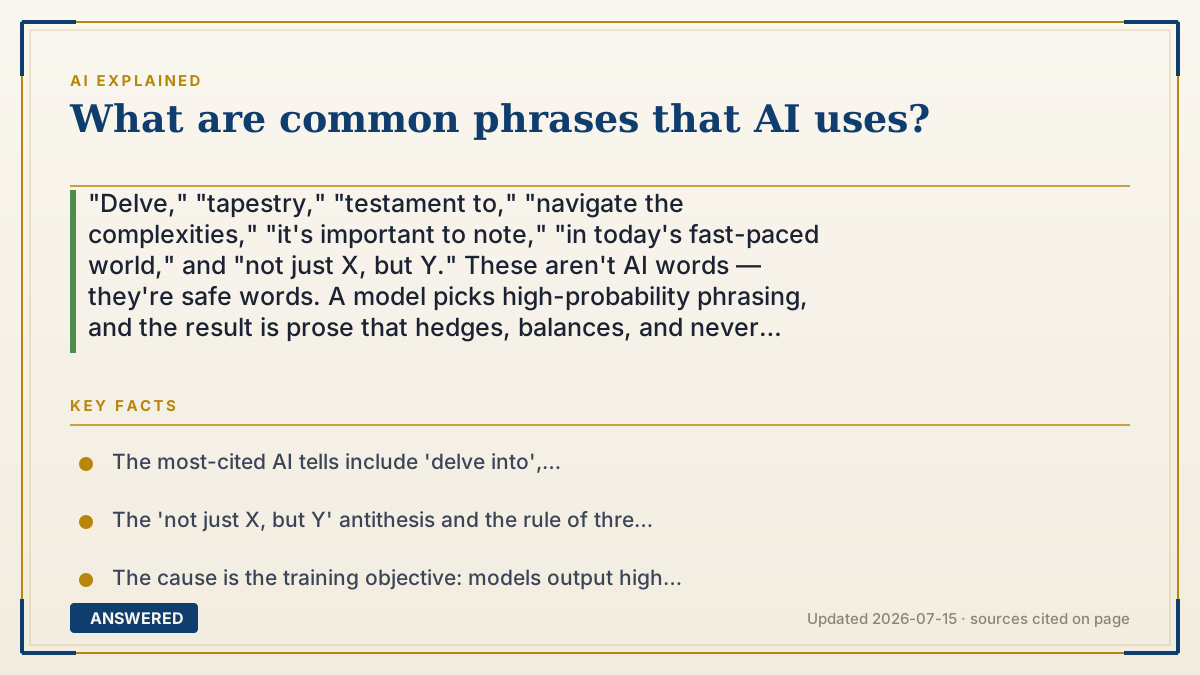
What are common phrases that AI uses?
"Delve," "tapestry," "testament to," "navigate the complexities," "it's important to note," "in today's fast-paced world," and "not just X, but Y." These aren't AI words — they're safe words. A model picks high-probability phrasing, and the result is prose that hedges, balances, and never commits. That's the real tell, not any single word.
Why — the first-principles explanation
The tics come from the training objective, not from a style guide. A language model is built to output likely text. Averaged over everything humans have written, the likeliest sentence is the unsurprising one — and unsurprising is exactly what these phrases are. "Delve into" is a slightly formal, entirely safe way to say "look at." "Tapestry" is the safe metaphor for anything complicated. Human writers pick words for specific effect; a model picks words for low risk. The result is prose optimized to be inoffensive, which reads as flavorless.
A second layer comes from fine-tuning on human feedback. Raters reward answers that seem balanced, cautious, and complete. So the model learns to hedge ("it's important to note"), to acknowledge complexity ("navigate the complexities"), to gesture at both sides ("while X, it's also true that Y"), and to wrap up tidily ("in conclusion, by understanding..."). That's not a vocabulary problem — it's a structural one. The giveaway isn't "delve." It's a paragraph that carefully arrives nowhere, and an essay whose conclusion adds nothing the introduction didn't already say.
Third, models default to a specific rhythm: the rule of three ("clear, concise, and compelling"), the antithesis ("not just a tool, but a partner"), and heavy scaffolding — headers, bullets, bold. Real writing has irregular rhythm because a person is chasing a point. Models produce even rhythm because nothing is pulling them off balance.
Now the crucial caveat, and it's why word-spotting fails as a detection method. These are also normal human words. "Delve" appears throughout academic English. Non-native English writers often favor exactly this kind of clear, formal, slightly generic phrasing — which is precisely why AI detectors are so unreliable. A 2023 study in Patterns found detectors "consistently misclassify non-native English writing samples as AI-generated, whereas native writing samples are accurately identified." The detectors weren't finding machines. They were finding plain prose and calling it a machine. If you use a phrase list to judge writing, you'll reproduce that bias by hand.
And all of it is moving. These patterns are so widely mocked that labs tune against them, and the tells of 2024 are already dated. Word lists describe the last generation of models, permanently. The durable signal isn't vocabulary — it's the absence of a specific person with a specific stake making a specific claim.
An example that makes it click
Think about the difference between a friend describing a restaurant and a Yelp page describing it. Your friend says "the noodles are great, skip the appetizers, and it's loud." The page says "this establishment offers a diverse array of culinary options that cater to a wide range of palates in a vibrant atmosphere."
Both are English. Only one of them told you anything. Your friend risked something — a real opinion you could disagree with. The page said whatever couldn't get it in trouble.
That's the AI voice. Not any particular word — the safety. A model is trained to output the most likely, least surprising next words, and the most likely words are the ones nobody objects to. So you get "a rich tapestry of flavors" instead of "skip the appetizers." When you're trying to spot AI writing, don't hunt for "delve." Ask whether anyone risked anything.
Key facts
- The most-cited AI tells include 'delve into', 'tapestry', 'testament to', 'navigate the complexities', 'it's important to note', 'in today's fast-paced world', 'unlock the potential', and 'in the ever-evolving landscape of'.
- The 'not just X, but Y' antithesis and the rule of three ('clear, concise, and compelling') are structural tics that persist even when specific vocabulary is avoided.
- The cause is the training objective: models output high-probability text, and the highest-probability phrasing is the least surprising, most inoffensive option available.
- Human-feedback fine-tuning rewards balance, caution, and completeness, producing hedging ('it's important to note') and conclusions that restate rather than resolve.
- Word lists are unreliable as detection: a 2023 study in Patterns found GPT detectors 'consistently misclassify non-native English writing samples as AI-generated, whereas native writing samples are accurately identified' — they flag plain prose, not machine authorship.
- The tells shift over time because labs tune against widely-mocked patterns, so any phrase list describes the previous generation of models rather than the current one.
- The durable signal is structural, not lexical: writing that hedges, balances, and concludes without committing to a specific claim by a specific person.
▶ The 60-second explainer (script)
What phrases does AI use? Delve. Tapestry. Testament to. Navigate the complexities. It's important to note. In today's fast-paced world. Not just X, but Y. But here's the thing — these aren't AI words. They're SAFE words. And understanding that is worth more than the whole list. A language model is built to output likely text. And averaged across everything humans have ever written, the likeliest sentence is the unsurprising one. Which is exactly what these phrases are. 'Delve into' is a slightly formal, perfectly safe way to say 'look at.' 'Tapestry' is the safe metaphor for anything complicated. A human writer picks words for effect. A model picks words for low risk. The result is prose optimized to be inoffensive — which reads as flavorless. Then fine-tuning makes it worse. Human raters reward answers that seem balanced and cautious and complete. So the model learns to hedge, to acknowledge complexity, to gesture at both sides, and to wrap up tidily. That's not a vocabulary problem. It's structural. The real giveaway isn't 'delve.' It's a paragraph that carefully arrives nowhere, and a conclusion that adds nothing the intro didn't say. Think about a friend describing a restaurant versus a Yelp page. Your friend says 'the noodles are great, skip the appetizers, it's loud.' The page says 'this establishment offers a diverse array of culinary options catering to a wide range of palates.' Both are English. One told you something. Your friend risked a real opinion you could disagree with. The page said whatever couldn't get it in trouble. Now — the important warning. These are also completely normal human words. 'Delve' is everywhere in academic English. And non-native English speakers often write in exactly this clear, formal, slightly generic register. That's why AI detectors are so bad: a 2023 study in the journal Patterns found they consistently misclassify non-native English writing as AI-generated while clearing native writers. The detectors weren't finding machines. They were finding plain prose. So if you use a word list to judge someone's writing, you're reproducing that bias by hand. And all of this is moving — labs tune against these tics as fast as they get mocked. Word lists describe the last generation of models, permanently. The durable signal is simpler: did a specific person, with a specific stake, make a specific claim?
What authoritative sources say
People also ask
What's the single most common AI word?
'Delve' is the most-mocked, along with 'tapestry' and 'testament to'. But no single word proves anything — they're ordinary English words that happen to be safe, unsurprising choices.
Can I detect AI writing by looking for these phrases?
Not reliably, and it's risky. A 2023 Patterns study found detectors consistently flag non-native English writing as AI-generated. Word-spotting reproduces that bias manually — you'll accuse careful, plain writers.
Why does AI writing all sound the same?
Because it's all optimizing the same thing: the most probable next word. The most probable word is the least surprising one, so every model converges on the same inoffensive middle of the language.
What's a better tell than vocabulary?
Structure. Look for hedging, both-sides balancing, even rhythm, and a conclusion that restates the introduction. Real writing is irregular because a person is chasing a point and risking a claim.
Will these phrases stop being AI tells?
They already are, partly. Labs tune against patterns as soon as they're widely mocked, so any list describes the previous generation of models. Vocabulary tells have a short shelf life; structural ones last longer.