What is Anthropic AI?
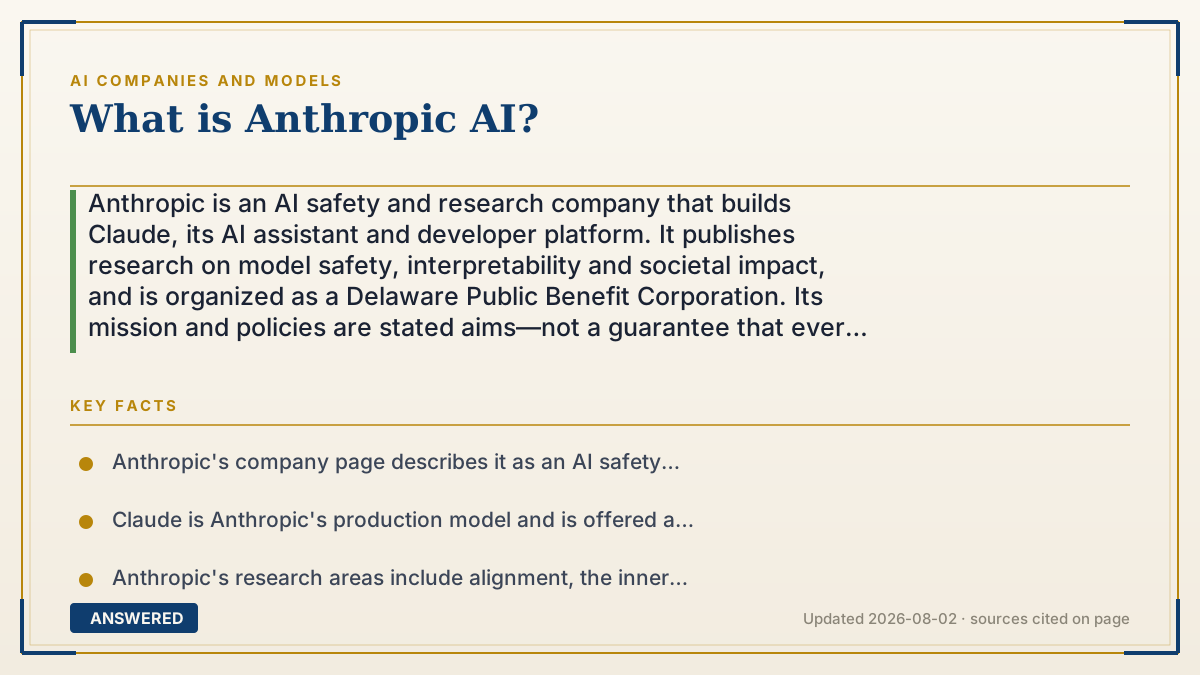
Anthropic is an AI safety and research company that builds Claude, its AI assistant and developer platform. It publishes research on model safety, interpretability and societal impact, and is organized as a Delaware Public Benefit Corporation. Its mission and policies are stated aims—not a guarantee that every Claude output is correct or safe—so evaluate the product, controls and evidence for your own use case.
Why — the first-principles explanation
It helps to separate four layers that are often collapsed into the phrase “Anthropic AI.”
1. The company: Anthropic describes itself as an AI safety and research company. Its research areas include alignment, the inner workings of models, and the societal impacts of AI. 2. The product: Claude is Anthropic's production model and assistant. People can use it through a chat product or developer interfaces such as the Messages API; the exact model names, capabilities, limits and prices change, so the current documentation is the source of truth. 3. The safety approach: Anthropic publishes a Constitution and a Responsible Scaling Policy describing how it wants Claude to behave and how it plans to respond as capabilities and risks change. These documents make the approach inspectable, but they are not independent certification and cannot eliminate model errors. 4. The governance experiment: Anthropic is a Public Benefit Corporation. Its Long-Term Benefit Trust is an independent body intended to gain increasing authority over board selection and removal, alongside the public-benefit purpose. Anthropic itself calls the arrangement an experiment; that is more precise than treating governance language as proof of outcomes.
The useful question is therefore not “Is Anthropic good?” It is “What does Claude do for this task, what data and permissions does it require, what failure modes remain, and how will a human detect and recover from them?”
An example that makes it click
Imagine choosing a contractor for a sensitive research workflow. Anthropic's company page is the contractor's mission statement, Claude is the tool you would actually use, the Constitution and Responsible Scaling Policy are parts of its operating philosophy, and your evaluation set is the inspection. A credible decision checks the tool on representative inputs, verifies data handling and retention, limits permissions, records failures and keeps a fallback. The mission statement is useful context, but it is not the inspection result.
How to do it
- Name the job you want Claude to do and the cost of a wrong answer. Separate drafting, analysis, coding, retrieval and actions that affect external systems.
- Read the current Claude product and model documentation. Record the exact model ID, context/output limits, supported inputs, pricing and deprecation policy for the route you plan to use.
- Build a small baseline with representative prompts and approved reference material. Do not judge a model from one impressive demonstration.
- Create an evaluation set before tuning the workflow. Include normal cases, ambiguous cases, rare cases, adversarial inputs and the languages or formats your users actually send.
- Check data governance. Confirm what may be sent, retention and training choices, regional routing, access controls, auditability and how secrets or personal data are redacted.
- Choose the delivery path—consumer chat, first-party API or a cloud marketplace—based on control, latency, procurement and data-location requirements, not branding alone.
- Add safety boundaries: least-privilege tools, allow-lists, output validation, refusal handling, prompt-injection defenses and a human approval step for consequential actions.
- Compare Claude with at least one alternative on the same task set. Track quality, latency, cost, failure severity and operational effort rather than a single benchmark score.
- Deploy with logging that protects sensitive content. Monitor drift, hallucinations, policy incidents, user overrides and changes in model behavior or terms.
- Re-review the decision when the model snapshot, API, policy, price, data flow or business risk changes. A vendor's current documentation outranks an old review or social-media claim.
Key facts
- Anthropic's company page describes it as an AI safety and research company building reliable, interpretable and steerable AI systems.
- Claude is Anthropic's production model and is offered as a user-facing assistant and through developer products; exact model availability changes over time.
- Anthropic's research areas include alignment, the inner workings of models and societal impacts of AI.
- Anthropic is a Delaware Public Benefit Corporation whose stated purpose is the responsible development and maintenance of advanced AI for the long-term benefit of humanity.
- Anthropic's Long-Term Benefit Trust is described as an independent body with authority to select and remove a portion of the board, growing over time toward a majority.
- Anthropic describes the Trust structure as an experiment; governance design is not the same as evidence that all deployed outputs are safe or accurate.
- Claude's Constitution explains the values Anthropic wants Claude to balance, including safety, ethical behavior, compliance with guidelines and helpfulness.
- Anthropic's Responsible Scaling Policy is a living document and has a changelog; policy versions and safeguards can change as the company learns.
- A provider's safety claims should be tested against the workflow's own error costs, data controls, permissions and human oversight.
- Model names, context limits, pricing, APIs and availability are time-sensitive; pin the exact model and record the date when making a technical or procurement decision.
Evaluate Claude as a system, not a slogan
Separate Anthropic's stated mission from Claude's measured behavior, then compare model capability, data controls, permissions and operational risk for your task.
▶ The 60-second explainer (script)
What is Anthropic AI? Anthropic is an AI safety and research company, and Claude is its production AI assistant and developer platform. The company researches alignment, model interpretability and the social effects of AI. It is also a Delaware Public Benefit Corporation and has a Long-Term Benefit Trust designed to add long-term public-interest accountability to board governance. Those facts explain the company's structure and stated approach; they do not guarantee that every Claude answer is correct or safe. For a real decision, test the exact model on representative inputs, verify data handling and limits, restrict tools and permissions, compare alternatives, and keep human review for high-cost actions. Treat the current product documentation, not an old model comparison, as the source of truth.
What authoritative sources say
People also ask
Is Anthropic the same company as OpenAI or Google?
No. Anthropic is a separate AI company. It builds Claude and operates its own research, products and governance; compare the current terms and capabilities rather than assuming products from different companies are interchangeable.
What is Claude?
Claude is Anthropic's family of AI models and assistant products. It can be accessed through a user-facing app and developer services, subject to the current model and product documentation.
Is Anthropic an AI safety company?
Anthropic describes itself that way and publishes safety research and policies. That is a statement of mission and approach; users should still measure accuracy, misuse resistance and recovery controls in their own workflow.
What is the Long-Term Benefit Trust?
It is an independent governance body Anthropic says can select and remove part of the board, with that authority designed to grow over time. Anthropic calls the structure an experiment rather than a proven guarantee.
Is Anthropic a nonprofit?
Anthropic is a Delaware Public Benefit Corporation, not a nonprofit. Its chartered public-benefit purpose allows the board to balance financial interests with the stated long-term benefit of humanity.
Is Claude better than ChatGPT?
There is no universal winner. Test the exact current models on your inputs, required tools, languages, latency, cost, data policy and failure severity.
Can I use Claude for coding?
Yes, coding is a documented Claude use case. Start with a small repository-safe evaluation, restrict write or deployment permissions, require tests and review, and verify the current product and API limits.
Does Anthropic train Claude on my data?
The answer depends on the product, account type, settings and current terms. Check the applicable privacy and data-use documentation before sending confidential material; do not rely on a generic statement about the company.
Is Claude safe to use?
It can be useful, but no general-purpose model is error-free. Use least-privilege access, validation, monitoring and human approval for decisions with legal, financial, medical, security or reputational consequences.
Can I buy Anthropic stock?
Do not infer public trading status from old articles or funding news. Verify the current company disclosures and regulated-market filings; this page is not investment advice.
Why do Anthropic's model names and limits change?
AI providers release snapshots, aliases and new interfaces over time. Pin the exact model ID, record the date, and re-run your evaluation when a model, API, price or policy changes.
The same question, asked other ways
- What is Anthropic's AI?