What is responsible AI?
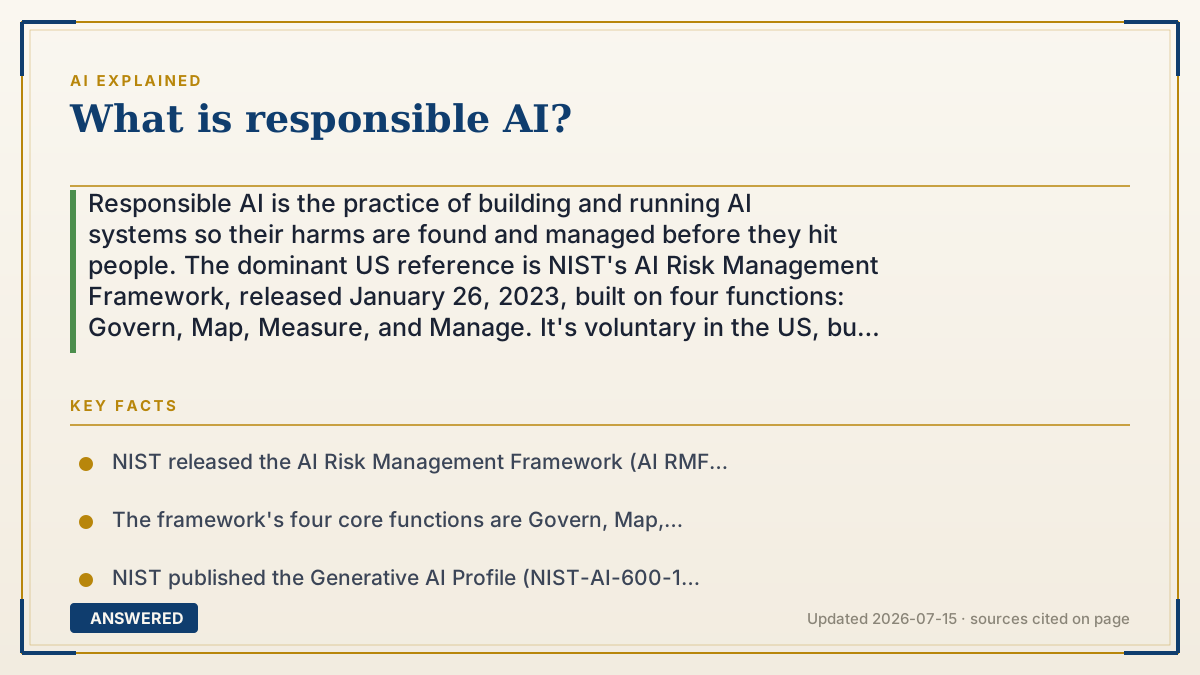
Responsible AI is the practice of building and running AI systems so their harms are found and managed before they hit people. The dominant US reference is NIST's AI Risk Management Framework, released January 26, 2023, built on four functions: Govern, Map, Measure, and Manage. It's voluntary in the US, but the EU AI Act makes similar duties legally binding.
Why — the first-principles explanation
Every engineering discipline eventually gets a safety practice, and it's always written after something breaks. Bridges got load codes after bridges fell. Drugs got trials after drugs killed people. AI is at that stage now. "Responsible AI" is what the field calls its version — the accumulated answer to how do you catch the harm before it ships?
The reason it needs a special practice is that AI fails differently from normal software. Normal software fails loudly: it crashes, throws an error, returns nothing. AI fails quietly and confidently. A model that's wrong 8% of the time gives you an answer in the same fluent tone as when it's right. Worse, it can be right on average and systematically wrong for one group of people, because it learned from data where that group was underrepresented or badly labeled. Nothing crashes. There's no stack trace for unfairness. So you can't rely on the failures announcing themselves — you have to go looking.
That's why NIST structures its framework around four functions rather than a checklist of rules. Govern means somebody is actually accountable and there's a process, not just good intentions. Map means you work out the context — who could this hurt, in what setting, and what does failure look like here specifically. Measure means you test for those things with real metrics, not vibes. Manage means you act on what you found and keep watching after launch, because a model that was fine in testing can drift as the world changes around it.
The honest tension: responsible AI is voluntary in the US and mandatory in the EU, so it can look like paperwork to companies racing to ship. The counter-argument is not moral, it's practical — the harms that get caught late get caught by regulators, journalists, or courts, and that costs vastly more than catching them in the Map phase.
An example that makes it click
Think about a restaurant kitchen. Nobody writes a rule saying "don't poison customers" and calls it food safety. What actually works is boring structure: a named person responsible for the walk-in cooler, a list of which dishes have the highest risk, a thermometer that gets read and written down, and a rule about what happens when the number is wrong.
Responsible AI is the same four moves. Someone's accountable. You figure out which dishes are risky. You take the temperature. You throw the chicken out when the number is bad. Skip any one of those and "we take safety seriously" is a poster on the wall, not a practice.
How to do it
- GOVERN — assign real accountability: name who owns the system's risk, write the policy, and make sure someone can stop a launch.
- MAP — establish context: identify who the system affects, in what setting, what a failure looks like for them, and what's in scope.
- MEASURE — test for the risks you mapped using concrete metrics: accuracy broken out by subgroup, robustness, and known failure modes.
- MANAGE — act on the findings, prioritize by severity, and keep monitoring after deployment, since models drift as the world changes.
- If you're building with generative AI specifically, work through NIST's Generative AI Profile (NIST-AI-600-1), published July 26 2024, which adapts the framework to generative risks.
Key facts
- NIST released the AI Risk Management Framework (AI RMF 1.0) on 2023-01-26; it is intended for voluntary use and was developed through an open, consensus-driven process.
- The framework's four core functions are Govern, Map, Measure, and Manage.
- NIST published the Generative AI Profile (NIST-AI-600-1) on 2024-07-26, extending the framework to generative AI risks.
- NIST launched a companion Trustworthy and Responsible AI Resource Center on 2023-03-30 to support implementation and international alignment.
- A NIST AI RMF Profile on Trustworthy AI in Critical Infrastructure reached concept note stage on 2026-04-07; AI RMF 1.0 is currently undergoing revision as of 2026-07.
- Unlike the voluntary US framework, the EU AI Act imposes legally binding obligations, with requirements scaling by risk tier.
▶ The 60-second explainer (script)
Responsible AI is the practice of catching an AI system's harms before they reach people. In the US the main reference is NIST's AI Risk Management Framework, released January 26th, 2023. It's voluntary — and it's built on four functions: Govern, Map, Measure, Manage. Here's why AI needs its own safety practice. Normal software fails loudly. It crashes, it throws an error, you get a stack trace. AI fails quietly and confidently. A model that's wrong eight percent of the time delivers those wrong answers in exactly the same fluent tone as the right ones. And it can be right on average while being systematically wrong for one group of people, because of who was underrepresented in its training data. Nothing crashes. There's no error message for unfairness. So you have to go looking. That's what the four functions do. Govern means somebody is actually accountable and can stop a launch. Map means working out who this could hurt and what failure looks like in this specific setting. Measure means testing with real metrics — accuracy broken out by subgroup, not vibes. Manage means acting on what you found and watching after launch, because models drift. In the US this is all voluntary. Under the EU AI Act, similar duties are legally binding. And the practical argument is simple: harms you don't catch early get caught by regulators, reporters, or courts instead — and that's the expensive version.
What authoritative sources say
People also ask
Is responsible AI legally required?
It depends where you operate. The NIST framework is voluntary in the US. The EU AI Act creates binding obligations, with the strictest duties on high-risk systems, so companies serving EU users face real legal requirements.
What's the difference between responsible AI and AI ethics?
AI ethics asks what the right thing to do is. Responsible AI is the operational machinery — the process, testing, and accountability that turns those answers into something a team can actually execute and audit.
Where do I start if I'm a small team?
Start with Map. Write down who your system affects and what a bad outcome looks like for them. Most teams skip straight to measuring accuracy and never define what harm they're actually trying to prevent.
Does responsible AI mean the model has to be perfect?
No. It means you know the error rate, you know who bears the errors, and you've decided that's acceptable on purpose rather than by accident.