What is scale AI?
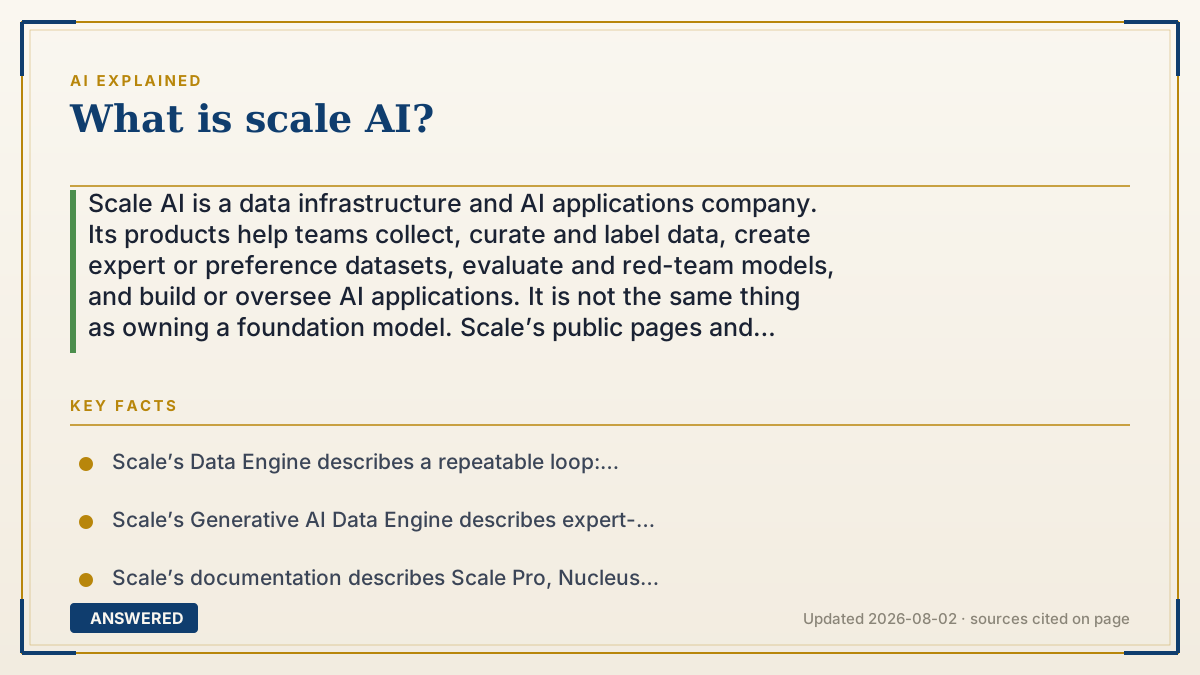
Scale AI is a data infrastructure and AI applications company. Its products help teams collect, curate and label data, create expert or preference datasets, evaluate and red-team models, and build or oversee AI applications. It is not the same thing as owning a foundation model. Scale’s public pages and announcements are the safest source for its current product and corporate claims; customer scope, privacy roles, pricing and leadership can change.
Why — the first-principles explanation
AI systems need a data and evaluation loop around the model. Raw images, video, text, audio or sensor data must be selected, labeled, reviewed and tested against the behavior a customer wants. Generative systems also need prompt-response examples, preference rankings, safety tests and domain experts who can judge whether an answer is useful or harmful.
Scale’s Data Engine describes the loop as “collect, curate, and annotate data; train models and evaluate; repeat.” Its Generative AI Data Engine describes expert-curated datasets, reinforcement learning from human feedback, red teaming and model evaluation. Scale’s documentation also describes a GenAI Platform for connecting data, fine-tuning models and deploying applications with proprietary data. The company’s current About page positions it as both a data provider and a full-stack technology provider for enterprises and governments.
That makes Scale different from a foundation-model lab. Scale can supply data operations, human review, quality tooling, evaluation and application infrastructure; the customer still defines the target behavior, chooses or supplies models, approves the data, and owns the deployment decisions. “Scale powers a model” is not the same claim as “Scale owns or trained the model.” Vendor pages are useful for what the company offers, but they are not independent proof of quality, market share or customer outcomes.
Corporate facts also need dates. Scale announced in June 2025 that a Meta investment valued it at more than $29 billion, that Meta would hold a minority stake and that Scale would remain independent. On July 30, 2026, Scale announced Francis deSouza would become CEO effective August 10, with Jason Droege supporting the transition after serving as interim CEO. Those are company announcements; exact cap-table rights, future leadership and customer relationships require current primary documents.
An example that makes it click
Imagine a team building a warehouse-robot model. It collects camera and LiDAR data, labels objects and actions, asks experts to rank difficult behavior, runs red-team scenarios and evaluates the model on examples it did not train on. Scale can provide parts of that data and evaluation operation and may also support an application layer. The robotics company still decides what counts as safe, which data it is allowed to use, how the model is deployed and who can stop it. Scale is the data-and-evaluation infrastructure around the loop, not automatically the robot or the foundation model.
How to do it
- Define the job to be improved: perception, document processing, generation, preference ranking, safety, evaluation or a full application workflow.
- List the data modalities and labels required: text, image, video, audio, 3D, sensor fusion, expert responses or pairwise preferences.
- Specify who is qualified to review the data and how reviewers will be trained, calibrated, sampled and audited.
- Set quality metrics before procurement: agreement, error taxonomy, coverage, latency, rework, export format and acceptance thresholds.
- Decide whether you need managed operations, a platform, an API, an in-house workflow or an open-source stack; compare control and switching costs.
- Map privacy and security roles. Ask whether Scale is acting as controller, processor or service provider for each data flow, and what the customer must do.
- Test the workflow on held-out data and adversarial cases. Include prompt injection, unsafe outputs, annotator disagreement and edge cases from the real domain.
- Confirm model and data ownership, license, retention, deletion, regional processing, subcontractors, audit rights and export before sending sensitive data.
- Separate vendor claims from independent evidence. Treat logos, “best” language, valuation and performance claims as claims that need context, not proof.
- Recheck products, leadership, pricing and legal terms before signing. AI data and application offerings change quickly, so preserve the dated source set used for the decision.
Key facts
- Scale’s Data Engine describes a repeatable loop: collect, curate and annotate data, train models, evaluate them and repeat.
- Scale’s Generative AI Data Engine describes expert-curated data, reinforcement learning from human feedback, model evaluation, red teaming, safety and alignment work.
- Scale’s documentation describes Scale Pro, Nucleus dataset management and a GenAI Platform for connecting proprietary data, fine-tuning models and deploying applications.
- Scale’s About page describes three broad activities: training data and RLHF, model evaluation/red teaming, and full-stack AI systems for enterprise and government deployments.
- Scale is a data, evaluation and application infrastructure provider; that does not by itself mean it owns or trains every foundation model that uses its data.
- Scale’s June 2025 announcement said a Meta investment valued the company at more than $29 billion, that Meta would hold a minority stake and that Scale would remain independent.
- Scale announced on July 30, 2026 that Francis deSouza would become CEO effective August 10, while Jason Droege supported the transition after serving as interim CEO.
- Scale’s current public materials display customer and partner logos, but a logo is not a complete, current customer roster or independent evidence of performance.
- Scale’s privacy policy distinguishes controller and processor/service-provider contexts and says customers remain responsible for policies and legal compliance when Scale processes data for them.
- The highest-value buyer questions are reviewer expertise, data rights, quality controls, evaluation coverage, privacy, exportability and measurable model improvement—not the label “AI data.”
Evaluate the data-and-model loop
Separate vendor claims from model ownership, then compare data quality, privacy, evaluation and deployment controls.
▶ The 60-second explainer (script)
What is Scale AI? It is a data infrastructure and AI applications company. Its Data Engine helps collect, curate and annotate data, then train and evaluate models in a loop. Its Generative AI Data Engine adds expert-created examples, human preference data, red teaming and safety evaluation. Scale also describes platforms for enterprises and governments to connect proprietary data, fine-tune models and deploy applications. That makes it different from a foundation-model lab: Scale can provide data and evaluation infrastructure, while a customer defines the behavior, chooses the model and owns the deployment decisions. In June 2025, Scale announced a Meta minority investment valuing the company above $29 billion and said it would remain independent. On July 30, 2026, Scale announced Francis deSouza would become CEO on August 10. Verify current product, privacy and customer claims from primary sources before buying.
What authoritative sources say
People also ask
What does Scale AI actually do?
It provides data and AI infrastructure: annotation, expert-created examples, preference data, quality control, model evaluation, red teaming and application tooling. The exact service depends on the data type and project.
Is Scale AI a foundation-model company?
Not in the same sense as a company whose primary product is a general-purpose model. Scale supplies data, evaluation and application infrastructure used around models; a customer or partner may own and operate the model.
Did Meta buy Scale AI?
Scale’s June 2025 announcement described a significant Meta investment, a minority stake and an independent Scale. That supports “minority investment,” not automatically “full acquisition.”
Who is Scale AI’s CEO?
Scale announced on July 30, 2026 that Francis deSouza would become CEO effective August 10. Jason Droege had served as interim CEO and was announced as supporting the transition. Check the company’s current leadership page for later changes.
What is Scale Data Engine?
It is the company’s described workflow for collecting, curating and annotating data, training models, evaluating them and repeating the loop. It supports multiple data modalities and project scales.
What is Scale’s Generative AI Data Engine?
Scale describes it as expert-curated data and infrastructure for prompt-response generation, RLHF, model evaluation, red teaming, safety and alignment work.
Does Scale label data with humans or AI?
Scale describes machine-powered pre-labeling, automation and human or subject-matter-expert review. The mix, reviewer qualifications and quality controls depend on the product and contract.
Does Scale work with OpenAI or Google?
Customer relationships can change. Scale’s public pages display selected logos and describe work with AI labs, enterprises and governments, but they are not a complete independent customer roster. Verify a named partnership from both parties’ current announcements.
How does Scale handle personal data?
Its privacy policy distinguishes controller and processor/service-provider contexts. Ask which role applies to each data flow, who sets the purpose, what retention/deletion terms apply and what the customer remains responsible for.
Is Scale AI publicly traded?
The company’s public materials and 2025 announcement describe a private-company investment and valuation, not a public stock listing. Do not treat private-market offers or “Scale shares” messages as legitimate without independent verification.
How should a buyer evaluate Scale AI?
Define the task, reviewer expertise, quality metric, privacy role, data rights, export path, evaluation coverage, service-level commitments and measurable model improvement. Compare those terms with an in-house or alternative workflow.
The same question, asked other ways
- What does Scale AI do?