What is Sora AI?
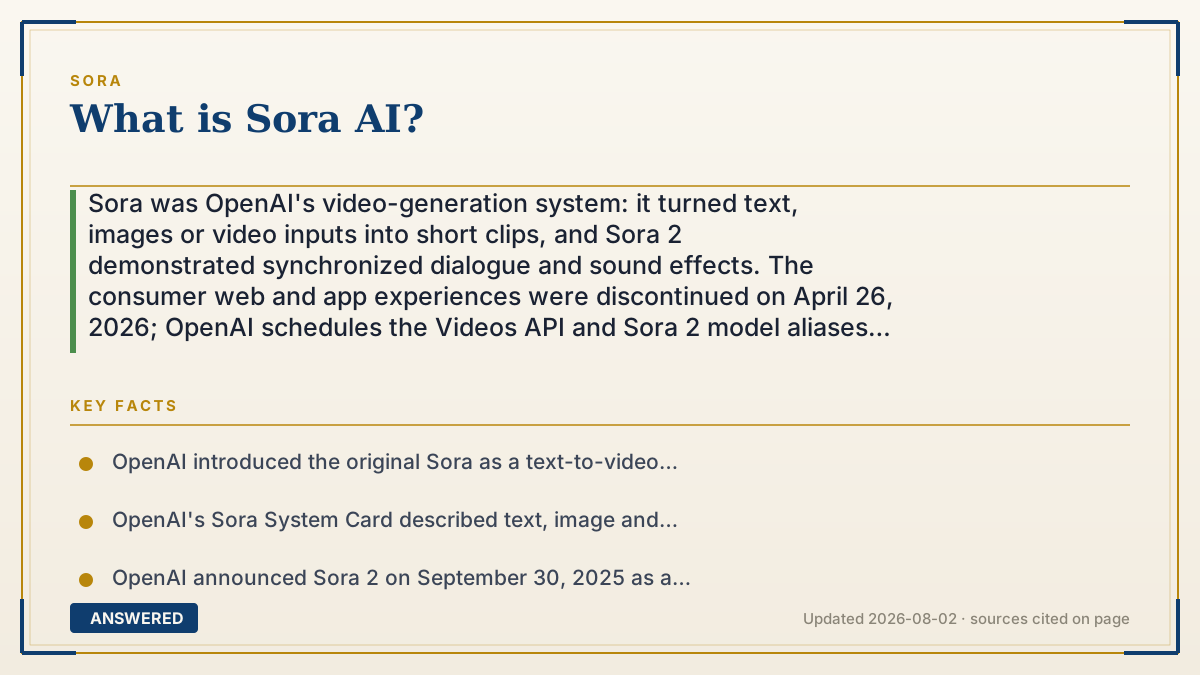
Sora was OpenAI's video-generation system: it turned text, images or video inputs into short clips, and Sora 2 demonstrated synchronized dialogue and sound effects. The consumer web and app experiences were discontinued on April 26, 2026; OpenAI schedules the Videos API and Sora 2 model aliases for removal on September 24, 2026. Treat current 'Sora access' sellers as a different product unless an official OpenAI page confirms them.
Why — the first-principles explanation
Sora is easiest to understand as two layers that should not be confused. The first layer is the model: OpenAI described Sora as a diffusion model with a transformer architecture. It learns visual and temporal patterns, starts from a noisy representation, and iteratively denoises it while conditioning on a prompt or another visual input. Because it processes space and time together, it can try to keep an object or scene consistent across frames. The model can produce a convincing clip, but it can still invent details, break continuity or violate real-world physics. A generated video is not evidence that an event happened.
The second layer is the product service: an app, web interface, account system, feed, safety filters, provenance signals, storage and (for developers) an API. Sora 2 was announced as a video-and-audio model with a social Sora app and consent-based characters, but OpenAI now marks the Sora product as no longer available. This distinction explains why old tutorials can be technically accurate yet operationally useless: they describe a model or interface that has already been retired.
For a practical decision, ask three separate questions. What can the model do in a dated demonstration? Is the official surface still available to your account and region? And do you have the rights, consent, review process and budget to publish the result? A fluent or photorealistic clip answers none of those questions by itself.
An example that makes it click
Suppose you find an old Sora demo showing a three-shot product scene: a camera moves toward a bottle, a hand picks it up, and the bottle remains readable in the final frame. The useful lesson is that Sora was designed for text-conditioned video and temporal consistency—not that you can still generate that shot in Sora today. If you already created the clip, export it through OpenAI's official sunset flow, keep the original file and provenance metadata, confirm that every person and asset was used with permission, and label it as generated before publishing. For a new clip, choose a currently operating video tool and test the same storyboard there.
How to do it
- Check the date and source: OpenAI says the Sora web and app experiences ended on April 26, 2026, so a current-access tutorial may be historical.
- Do not pay a reseller for a Sora invite, subscription or API key. Verify the destination on an official OpenAI domain before entering credentials or payment details.
- If you used Sora previously, export your own creations from the official sunset page and keep local originals before any final export window closes.
- Separate model capability from service availability: text-to-video, image-to-video, synchronized audio and characters describe historical capabilities, not a promise of current access.
- For archived clips, retain provenance metadata, inspect for visible or invisible AI signals, and do not present generated footage as documentary evidence.
- For a new project, define the shot list, aspect ratio, motion, audio, rights and review criteria before comparing a live tool such as Veo, Runway, Kling or Pika.
- Use only images, voices, characters and music for which you have the required permission; consent and platform terms matter more than a good-looking prompt.
- Run a short test, check text, faces, hands, continuity, physics and audio, then have a human approve the final export before an ad, client delivery or public claim.
Key facts
- OpenAI introduced the original Sora as a text-to-video model on February 15, 2024; its launch page said it could generate videos up to a minute long.
- OpenAI's Sora System Card described text, image and video inputs, outputs up to 1080p and clips up to 20 seconds for that documented system; specifications varied by product surface and date.
- OpenAI announced Sora 2 on September 30, 2025 as a video-and-audio generation model with synchronized dialogue and sound effects.
- OpenAI's current Sora pages state that the Sora web and app experiences were discontinued on April 26, 2026.
- OpenAI's API deprecations page schedules removal of the Videos API and Sora 2 model aliases on September 24, 2026.
- OpenAI documented visible and invisible provenance signals, including C2PA metadata, and consent controls for likenesses in its Sora safety materials.
- The official discontinuation notice says users can export Sora content through the sunset flow and that remaining Sora data will be permanently deleted after the applicable export period.
- Historical Sora demonstrations show what a model could generate under particular settings; they do not establish that the footage is real or that the service is still sold.
Choose a live video workflow, not a dead Sora checkout
Use Sora for historical context or content export; for new work, compare active tools by shot control, audio, consent, provenance, privacy, plan and review cost.
▶ The 60-second explainer (script)
What is Sora AI? It was OpenAI's video-generation system. You could give it text, images or video, and it generated a new clip; Sora 2 also demonstrated synchronized dialogue and sound. Under the hood, OpenAI described a diffusion model with a transformer that denoises a noisy representation while following the prompt across time. But here is the part many old explainers miss: a model is not the same thing as a live product. OpenAI says the Sora web and app experiences ended on April 26, 2026, and the Videos API and Sora 2 model aliases are scheduled for removal on September 24, 2026. If you have old creations, use the official export flow and preserve provenance. If you need a new AI video today, compare a live tool by shot control, audio, rights, privacy and cost—and review the final footage like an editor, not like evidence.
What authoritative sources say
People also ask
What is Sora AI?
Sora was OpenAI's text-to-video system. It accepted text and, depending on the documented product surface, image or video inputs to generate a new video; Sora 2 also generated synchronized dialogue and sound effects.
Can I use Sora right now?
Not through the consumer app or website. OpenAI says those Sora experiences were discontinued on April 26, 2026. Be cautious with any current seller claiming to provide the original Sora.
Is the Sora API still available?
OpenAI's API deprecations page schedules the Videos API and Sora 2 model aliases for removal on September 24, 2026. Check that official page for the latest status rather than building a new integration around a sunset model.
How did Sora generate video?
OpenAI described a diffusion model with a transformer architecture. It starts from a noisy representation and progressively denoises it while conditioning on the prompt and visual context, attempting to maintain consistency across frames.
Could Sora turn an image into a video?
Historically, OpenAI documented image-to-video and video-input capabilities, but the exact inputs and limits depended on the product version. Those historical capabilities do not imply that the consumer service is currently available.
Did Sora make sound?
Sora 2 was announced as a video-and-audio model with synchronized dialogue and sound effects. Treat that as a historical product description because the consumer Sora service has been discontinued.
How long or how high-resolution were Sora videos?
OpenAI's historical pages documented different limits: the original launch page described up to one minute, while the Sora System Card documented up to 1080p and 20 seconds for that system. Do not use either figure as a current plan or API promise.
Can I use Sora videos commercially?
That depends on the applicable OpenAI terms, your inputs, third-party rights and the way the output is used. You need rights to uploaded media and likenesses, should preserve the relevant records, and should obtain legal review for branded, public-figure or high-stakes uses.
What happened to videos I made in Sora?
OpenAI says users can export content through its official sunset flow and that remaining Sora data will be permanently deleted after the applicable export period. Export promptly if you still need a copy.
What should I use instead of Sora?
Choose a currently operating video tool by job: compare generation quality, shot control, audio, editing, rights, privacy, regional access and total cost. Veo, Runway, Kling and Pika are examples to evaluate, but verify each vendor's current plan and availability directly.
The same question, asked other ways
- What is the Sora function in ChatGPT?