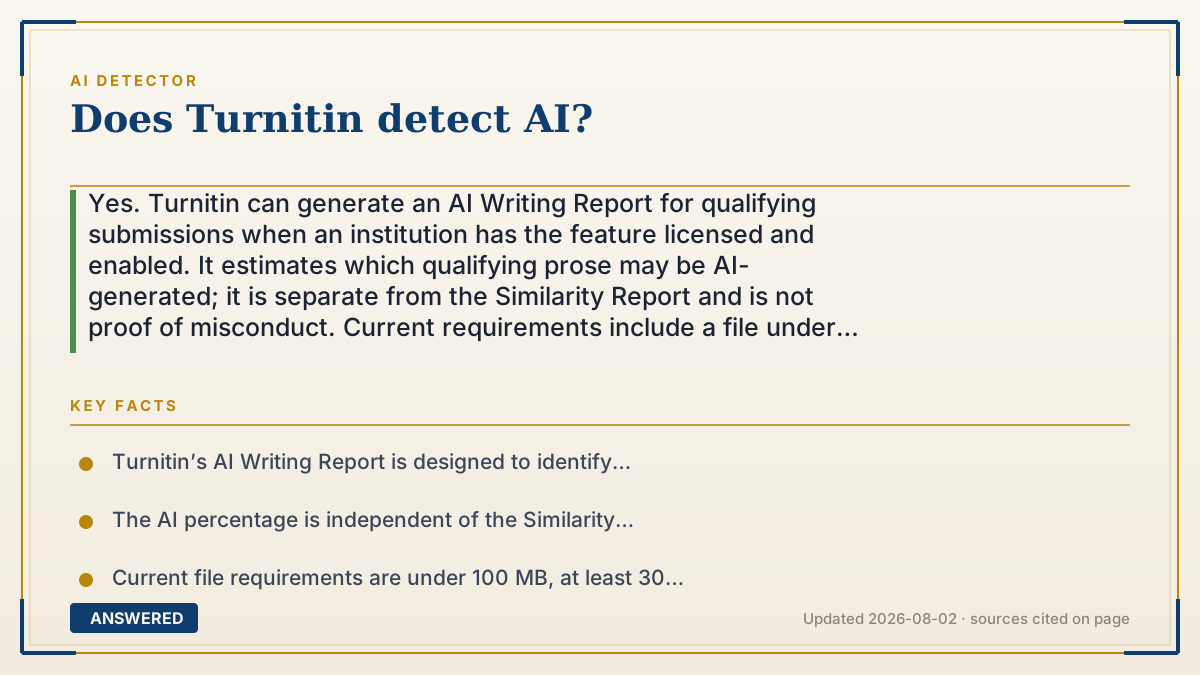
Does Turnitin detect AI?
Yes. Turnitin can generate an AI Writing Report for qualifying submissions when an institution has the feature licensed and enabled. It estimates which qualifying prose may be AI-generated; it is separate from the Similarity Report and is not proof of misconduct. Current requirements include a file under 100 MB, 300–30,000 words of prose, a supported language, and an accepted file type. Human review and the institution’s policy decide what happens next.
Why — the first-principles explanation
Turnitin has two different signals that people often collapse into one. The Similarity Report compares submitted text with indexed sources and surfaces matches. The AI Writing Report is a model-based estimate of qualifying prose that may have been generated or altered by an AI writing tool. A similarity percentage is not an AI percentage, and an AI percentage is not a plagiarism finding.
The AI report does not score every character in every file. Turnitin’s current guide defines qualifying text as prose sentences in a longer-form writing format, such as an essay, dissertation or article. It says the model does not reliably detect poetry, scripts, code, bullet points, tables or annotated bibliographies. A document can therefore contain text that is invisible to the AI indicator while still being visible in the normal submission or Similarity Report.
A report also has input gates. The current requirements are a file smaller than 100 MB, at least 300 words of prose, no more than 30,000 words, English, Spanish or Japanese, and one of DOCX, PDF, TXT or RTF. Institutions should confirm their product and LMS configuration; a failed report can mean the file did not qualify, detection was disabled at submission time, processing failed, or a newer report requires resubmission.
The number is an estimate about qualifying text, not a probability that a student cheated. Turnitin says its model may misidentify human-written, AI-generated and AI-paraphrased text, and explicitly says the report should not be the sole basis for adverse action. New reports do not surface a numerical score or highlights for detected proportions below 20%; an asterisk signals that the result is less reliable. That threshold reduces misinterpretation; it does not turn a higher score into proof.
Language and model version matter. The current guide says English includes AI-paraphrase and bypasser detection capabilities, while the Spanish and Japanese detectors do not include those categories. Turnitin’s release notes show continuing model updates, including 2026 changes for Spanish and general detection. Updates are not necessarily applied retroactively: a previously generated report may need the submission resubmitted before a newer model is used.
The interface is also changing. Turnitin’s July 2026 product update says some licensed products moved from separate blue/purple categories to one unified blue highlight for likely AI-generated content, including text that may have been paraphrased or bypassed. Do not use a screenshot from an old guide as a permanent UI specification. Check the current report, product license and release notes for the institution using it.
Access is a governance choice, not a universal student feature. AI Writing Report availability depends on the institution’s license and whether detection is enabled. In many workflows instructors or administrators review the report; a student’s access to an abridged or full report can depend on assignment settings and product. If a school does not provide the feature, a student cannot infer their official Turnitin result by uploading work to an unrelated public detector.
For a fair review, combine the score with the assignment policy, the student’s drafts and version history, citations, research notes, oral explanation and the actual highlighted passages. Ask what the student intended and how the work was produced. A school may decide to permit, disclose, cite, restrict or prohibit particular AI uses; the detector does not write that policy or decide the violation.
Privacy is part of the decision. A submitted essay can contain personal data, unpublished research or sensitive educational records. Students and instructors should use the institution’s approved Turnitin route, understand retention and access rules, and avoid sending the same paper to multiple public detector sites. A tool that produces a percentage is not automatically a safe place to upload confidential work.
The honest answer is therefore “yes, with boundaries.” Turnitin can flag text that its model considers likely AI-generated in qualifying submissions, but it cannot certify authorship, recover a hidden source or guarantee that human writing will never be flagged. Treat the report as one review input, preserve process evidence, and follow the local academic-integrity policy.
An example that makes it click
A 1,200-word English essay uploaded as a DOCX may qualify for an AI Writing Report. If Turnitin returns an asterisked low result, that is not a clean bill of authorship; the current guidance says low proportions are less reliable. If it returns a higher percentage, the instructor should inspect the qualifying passages, compare the work with drafts and the rubric, and talk with the student before applying policy. A 200-word reflection, a Python script, a table-heavy lab report or an unsupported language may not produce a comparable report at all.
How to do it
- Identify the question you need answered: similarity to existing sources, possible AI-generated prose, or compliance with an assignment’s AI-use rule. These are separate checks.
- Read the institution’s syllabus and academic-integrity policy before submitting or reviewing work. Record which AI uses require disclosure, citation, permission or prohibition.
- Check the current Turnitin product license and assignment settings. Confirm that AI Writing detection is enabled and who is allowed to view the report.
- Prepare a qualifying file: under 100 MB, 300–30,000 words of long-form prose, a supported language, and DOCX, PDF, TXT or RTF format.
- Submit through the approved LMS or Turnitin workflow. Do not treat a public AI detector as an official substitute, and do not upload sensitive work to an unapproved service.
- Wait for processing and record the report date, product, language and model/release context. Resubmit when the institution requires a newer detector version.
- Interpret the AI indicator as an estimate of qualifying prose. Remember that a low asterisked result is less reliable, and that Similarity and AI percentages answer different questions.
- Review the highlighted passages with drafts, version history, sources, notes, assignment instructions and a conversation with the student. Never make a disciplinary decision from the number alone.
- Document the evidence and the policy reasoning, including uncertainty and any accessibility or language considerations. Give the student a fair opportunity to explain the work.
- If you are choosing a tool or workflow, compare reporting scope, privacy, student visibility, institutional controls, model updates and total cost rather than buying an accuracy promise.
Key facts
- Turnitin’s AI Writing Report is designed to identify text that might be prepared by generative AI, AI paraphrasers or bypasser tools; it does not determine academic misconduct.
- The AI percentage is independent of the Similarity Score. The AI report estimates the share of qualifying prose that may be AI-generated or altered, while Similarity surfaces matches to indexed sources.
- Current file requirements are under 100 MB, at least 300 words of prose in long-form writing, at most 30,000 words, English/Spanish/Japanese, and DOCX/PDF/TXT/RTF.
- Turnitin says qualifying text excludes or may not reliably detect non-prose such as poetry, scripts, code, bullet points, tables and annotated bibliographies.
- For new reports, detected proportions above 0% and below 20% are not surfaced as a numerical score or highlights; an asterisk indicates a less reliable low result.
- The current guide says English includes AI-paraphrase and bypasser detection categories, while Spanish and Japanese AI detectors do not include those categories.
- Turnitin’s 2026 release notes show ongoing model updates and say previously generated reports may need resubmission before a new model is applied.
- A July 2026 product update describes a unified blue highlight in some licensed products, replacing an earlier two-color distinction; report appearance depends on product and version.
- AI Writing Report availability, viewer roles and student visibility depend on an institution’s license, account settings, LMS and assignment configuration.
- Turnitin’s own guidance says the report may be inaccurate and should not be the sole basis for adverse action; human judgment and the institution’s policy remain necessary.
Make an AI-detection decision fairly
Start with the institution’s policy and data controls, then compare reporting scope, student visibility, evidence quality and total cost before adopting or relying on a detector.
▶ The 60-second explainer (script)
Does Turnitin detect AI? Yes, when the institution has AI Writing detection enabled and the submission qualifies. But the report is not a plagiarism match and it is not a verdict. Similarity compares text with indexed sources. The AI Writing Report estimates whether qualifying prose may have been generated or altered by an AI tool. The current requirements are strict: a file under 100 megabytes, 300 to 30,000 words of long-form prose, English, Spanish or Japanese, and DOCX, PDF, TXT or RTF. Code, poetry, tables and short reflections may not produce a comparable report. New low results below 20 percent are not shown as a normal number and may carry an asterisk. Turnitin says the model can misidentify human and AI writing and should never be the sole basis for adverse action. Review the assignment policy, highlighted passages, drafts, version history, sources and the student’s explanation. Check the current product release and access settings, because models, highlights and student visibility change by license and version.
What authoritative sources say
People also ask
Does Turnitin detect AI writing?
Yes, when the institution licenses and enables the AI Writing Report and the submission meets its requirements. It estimates qualifying prose that may be AI-generated or altered; it does not prove authorship or misconduct.
Is the Turnitin AI score the same as plagiarism?
No. Similarity compares a submission with indexed sources and shows matches. The AI Writing Report is a model-based estimate, independent of the Similarity Score, and normally has no source document to click.
What files can Turnitin’s AI detector process?
The current guide lists files under 100 MB, 300–30,000 words of long-form prose, English/Spanish/Japanese, and DOCX, PDF, TXT or RTF. Code, poetry, tables, bullet points and short pieces may not qualify.
What does a Turnitin AI percentage mean?
It is the share of qualifying prose that the model identifies as likely AI-generated or AI-altered. It is not the chance that a student cheated, not the percentage of the entire file, and not a disciplinary finding.
Does Turnitin show scores below 20 percent?
For new reports, Turnitin says detected proportions above 0% and below 20% are not surfaced as a normal numerical score or highlights; an asterisk indicates a less reliable low result. Older reports may follow older display rules.
Can Turnitin detect AI in Spanish or Japanese?
Turnitin’s current documentation lists English, Spanish and Japanese AI detection. The guide says English includes AI-paraphrase and bypasser categories, while Spanish and Japanese do not include those categories. Check the current language release notes.
Can a high Turnitin AI score prove cheating?
No. Turnitin explicitly says the model can be wrong and should not be the sole basis for adverse action. Review the policy, highlighted passages, drafts, sources, version history and the student’s explanation.
Can students see their Turnitin AI score?
It depends on the institution, license, LMS and assignment settings. Instructor and administrator access is common; some products or assignments can expose an abridged report to students. Ask the instructor or institution rather than assuming.
Why did Turnitin’s result change after resubmitting?
Turnitin updates its detection models. Its release notes say older reports are not retroactively updated; a resubmission may be evaluated with a newer model and can produce a different result.
What should I do if my human-written work is flagged?
Keep drafts, notes, version history, source records and edit timestamps. Ask which passages were highlighted, review the assignment policy, and request a fair conversation. Do not rely on another public detector as definitive proof.