Are AI detectors accurate?
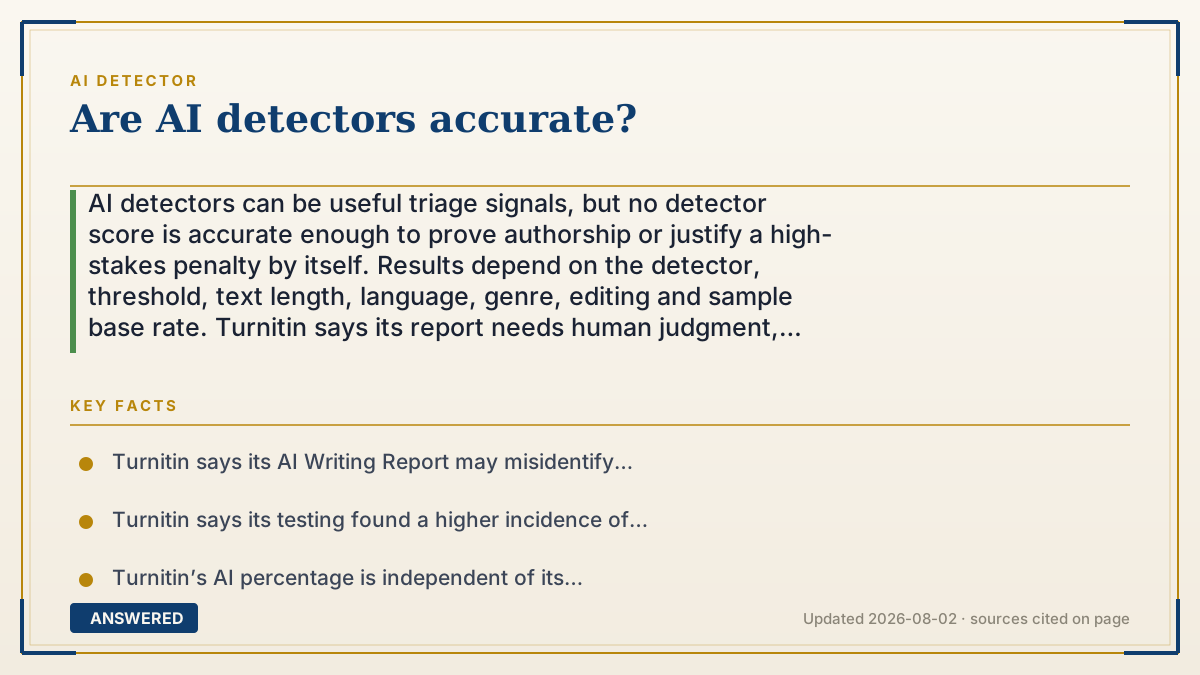
AI detectors can be useful triage signals, but no detector score is accurate enough to prove authorship or justify a high-stakes penalty by itself. Results depend on the detector, threshold, text length, language, genre, editing and sample base rate. Turnitin says its report needs human judgment, OpenAI retired its own classifier for low accuracy, and Stanford research found strong bias against non-native English writing.
Why — the first-principles explanation
“Accuracy” is not one property of an AI detector. A result comes from a particular model, threshold, language, document type, sample and definition of error. A vendor benchmark on clean, unedited AI text and clean human text does not tell you how the same tool behaves on a short, translated, formulaic, edited or mixed-authorship document.
Base rates change the meaning of a positive result. In an illustration—not a claim about any specific detector—suppose 5% of a class used AI, sensitivity were 98% and the false-positive rate were 2%. The tool would flag about 49 genuine cases and about 19 human papers, so only about 72% of positive results would be genuine under those assumptions. Change the prevalence, threshold or sample and the result changes. A score can be useful for deciding what to review while still being poor evidence for an accusation.
Errors are not evenly distributed or independent. The Stanford/Patterns study found seven detectors repeatedly misclassified essays by non-native English writers, and simple rewriting could evade the tested systems. Short text, code, predictable lists, poetry, scripts, non-supported languages, formulaic writing and heavy editing can all move a result outside the test conditions. Running several similar detectors does not automatically create independent corroboration.
Product scope matters too. Turnitin says its AI Writing Report estimates qualifying prose that may have been generated or AI-paraphrased; it is separate from the Similarity Report, may misidentify human and AI text, and should not be the sole basis for adverse action. It also says its testing found a higher incidence of false positives between 0% and 19%, which is why current reports use an asterisk instead of a precise percentage below 20%.
OpenAI’s own historical classifier illustrates why a famous percentage is not a guarantee: OpenAI reported 26% true positives and 9% false positives on an English challenge set, warned that short text and non-English text were unreliable, and made the classifier unavailable on July 20, 2023 because of low accuracy. That does not prove every current detector fails; it proves that tool, date, test set and operating conditions must stay attached to any number.
For a school, hiring, publishing or reputation decision, the stronger evidence is provenance and process: drafts, version history, notes, source files, citations, permissions and a conversation in which the author explains the work. Content Credentials can provide tamper-evident provenance for supported assets, but they do not by themselves prove identity, intent or a complete ingredient chain. A detector should trigger a documented human review, not replace one.
An example that makes it click
Suppose an instructor sees a high detector score on a short essay by a multilingual student. The responsible response is not to average three scores and issue a penalty. Preserve the original file, check the assignment policy, review drafts and sources, ask the student to explain the argument and record the tool, language, length, version and date. If the evidence remains ambiguous, the score is not enough to establish misconduct.
How to do it
- Name the decision and its stakes. Treat detection as higher risk for grades, discipline, employment, publication, benefits or reputation than for a low-stakes editorial queue.
- Identify the detector, model version, threshold, language, text length, genre, editing history and date. Do not compare headline percentages from different test sets.
- Ask what the score actually estimates: likely AI-generated prose, similarity to a reference corpus, AI paraphrasing or something else. Do not confuse an AI percentage with a similarity or plagiarism score.
- Use the score only as triage. Preserve the submitted file and do not upload protected student, client or employee work to an unapproved service.
- Gather process evidence: drafts, version history, notes, source files, citations, permissions and an explanation of the author’s choices.
- Check subgroup, language and genre limits. Look for known false-positive warnings, qualifying-text gates and whether the detector can be bypassed or has not been validated on the actual population.
- Follow the written policy, give the person notice and a chance to respond, and document who made the decision. Multiple correlated scores are not independent proof.
- If a result remains uncertain, do not convert a probability into a finding. Use a safer assessment or request new process evidence, and review the policy and vendor contract before repeating the test.
Key facts
- Turnitin says its AI Writing Report may misidentify human-written, AI-generated and AI-paraphrased text and should not be the sole basis for adverse action.
- Turnitin says its testing found a higher incidence of false positives between 0% and 19%; current reports use an asterisk and no precise percentage below 20%.
- Turnitin’s AI percentage is independent of its Similarity score and applies to qualifying prose, not every character, code block, table, script or bullet list.
- OpenAI reported that its historical classifier identified 26% of AI-written text as likely AI-written and incorrectly labeled human text 9% of the time on an English challenge set; it was unavailable from July 20, 2023 because of low accuracy.
- Stanford reported that seven detectors flagged 61.22% of 91 TOEFL essays by non-native English writers, with 97% flagged by at least one and 19% by all seven; this is a study result, not a universal current rate.
- The peer-reviewed study found that simple prompting and rewriting could bypass the tested detectors, so multiple scores do not establish independent proof.
- UT Austin classifies AI detection software as high-risk and requires an approved institutional contract before submitting student work, citing privacy, security, accessibility and intellectual-property concerns.
- C2PA Content Credentials can record cryptographically signed, tamper-evident provenance for supported assets, but the core specification does not itself establish individual or organizational attribution.
- A detector score is a model-dependent estimate, not a probability that a named person used AI, and it cannot establish intent or misconduct alone.
Use detection as triage, not a verdict
Choose a documented, human-led review workflow; compare privacy, evidence and support before uploading sensitive work or buying a detector.
▶ The 60-second explainer (script)
Are AI detectors accurate? They can be useful for triage, but no detector score proves authorship or justifies a high-stakes penalty alone. Accuracy depends on the model, threshold, language, genre, length, editing and base rate. Turnitin says its report may misidentify human and AI text and should not be the sole basis for adverse action. OpenAI’s historical classifier found 26% true positives and 9% false positives on an English challenge set, then was retired for low accuracy. Stanford research found strong bias against non-native English writing. Use a score to decide what to review, then check drafts, sources, version history and the written policy.
What authoritative sources say
People also ask
Are AI detectors accurate enough to prove cheating?
No. They can provide a review signal under particular test conditions, but Turnitin says its report should not be the sole basis for adverse action. Authorship and intent require process evidence and a human-led policy review.
What is the most accurate AI detector?
There is no independent, current ranking that makes a detector reliable for authorship or misconduct decisions. Compare the test set, language, genre, editing, threshold, false-positive rate and intended use instead of trusting a single leaderboard.
Does a high AI score prove a person used AI?
No. A score is a model-dependent estimate with false positives, base-rate effects and correlated errors. It does not identify the author, prove intent or establish misconduct.
Does running several detectors make a result reliable?
Not necessarily. Similar tools can share training data, signals and subgroup bias. Agreement can be correlated error, not independent corroboration.
Why do AI detectors flag non-native English writing?
The Stanford/Patterns study found substantial false-flagging of TOEFL essays by non-native English writers and linked the problem to language-pattern measures. Treat language background as a risk factor, not as evidence of AI use.
Is Turnitin’s AI score the same as its plagiarism score?
No. Turnitin says the AI Writing Report and Similarity score are independent. The AI report covers qualifying prose and may not evaluate code, tables, scripts, poetry, bullets or every part of a file.
Is it safe to upload someone else’s work to a detector?
Only when the institution or employer has approved the service and its data terms. Student, client and employee work can carry privacy, copyright and confidentiality obligations; UT Austin treats these tools as high risk.
What should teachers or employers do instead?
Use drafts, version history, sources, notes, permissions and a conversation about the work; follow the written policy, notify the person and allow a response. If uncertainty remains, do not treat the detector score as a verdict.
The same question, asked other ways
- How accurate are AI detectors?
- Are AI checkers accurate?
- Do AI detectors work?
- Are AI detectors reliable?
- Do AI detectors actually work?
- How reliable are AI detectors?
- Should I rely on AI detectors to verify content authenticity?