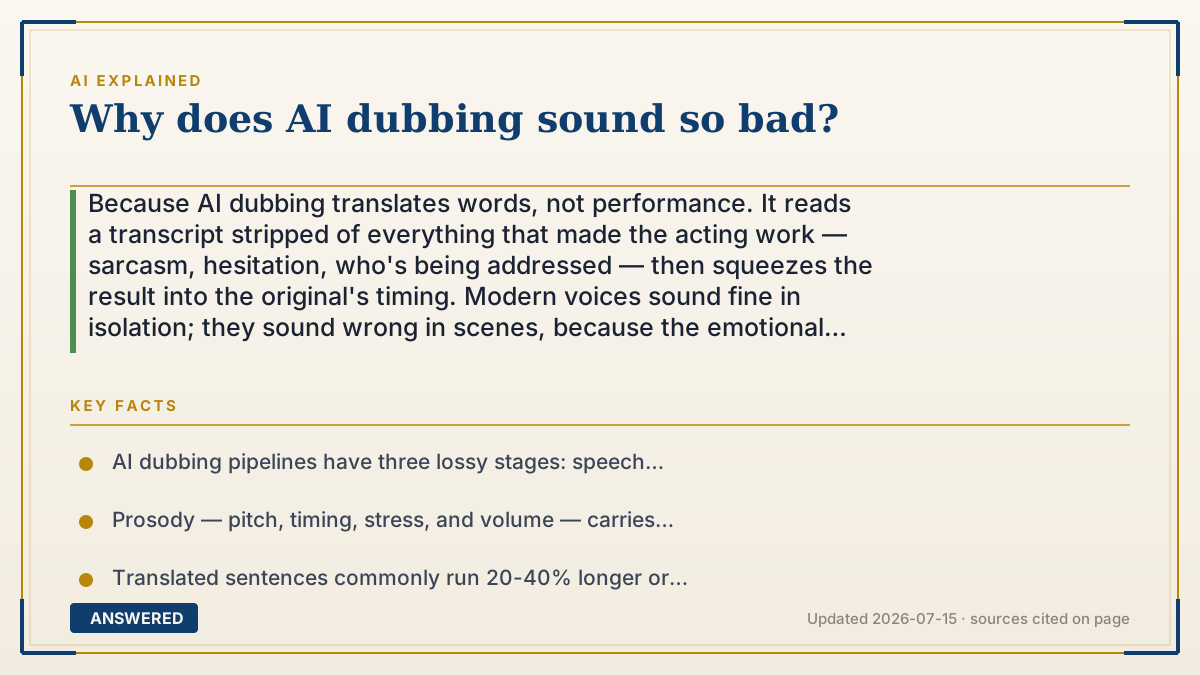
Why does AI dubbing sound so bad?
Because AI dubbing translates words, not performance. It reads a transcript stripped of everything that made the acting work — sarcasm, hesitation, who's being addressed — then squeezes the result into the original's timing. Modern voices sound fine in isolation; they sound wrong in scenes, because the emotional information was thrown away two steps upstream.
Why — the first-principles explanation
The voice usually isn't the problem, which is why "the TTS is bad" is the wrong diagnosis. Modern speech synthesis, judged on a single line, is often indistinguishable from a person. The failure happens before the voice ever speaks, in a pipeline where each stage discards something it can't pass along.
Stage one: speech recognition turns audio into text. The instant that happens, the performance is gone. "Oh, great" dripping with sarcasm and "oh, great" said with genuine delight become the identical five characters. All the meaning lived in the pitch contour, and the transcript doesn't have a column for it. Stage two: translation works on that flattened text, so it can't restore what stage one deleted — and it adds its own losses, because languages carry social information in wildly different places. Japanese encodes politeness and relationship in verb endings; English uses tone of voice. Translate one to the other and the information has nowhere to land. Stage three: synthesis now has to guess emotion from words alone, and the safest guess — the statistically average reading — is exactly what "flat" means.
Then comes the constraint that breaks it even when everything above went well: timing. The dub must fit the original's mouth movements. But translations don't preserve length — the same sentence can run 20–40% longer or shorter across languages. So the system either rushes, stretches, or truncates. Human dub writers solve this by rewriting the line entirely to hit the timing while keeping the meaning; it's a craft with a name (adaptation) and it takes real skill. AI dubbing typically translates first and squeezes second, which is why the pacing feels subtly wrong even when the words are right.
And the deepest issue: there's no director. A human voice actor knows the character is lying, that she's about to leave him, that this callback pays off a joke from twenty minutes ago. The AI is reading one line with maybe a few lines of context, having never seen the film. It cannot deliver a performance because it doesn't know what's happening. That's why the uncanny feeling is strongest in emotional scenes and nearly absent in documentaries and corporate video — narration has no subtext to lose, which is why AI dubbing genuinely works there.
An example that makes it click
Imagine hiring someone to redo the paint on a portrait — but instead of showing them the painting, you hand them a list.
"Blue. Red. Dark brown. Skin tone." They're a superb painter. The colors they mix are perfect. But nobody told them the blue was the shadow under her eye, that the red was a blush and not a scarf, or that the whole picture is about the fact she's just been crying. So they paint every color beautifully, in the wrong places, with the wrong weight — and the result is technically flawless and emotionally dead.
That's AI dubbing. The transcript is the color list. Everything that made it a portrait — what's foreground, what's a hint, what's the point — got deleted the moment someone wrote it down.
How to do it
- Match tool to content. AI dubbing works genuinely well for narration, documentaries, tutorials, and corporate video — content with no subtext to lose. It struggles most on drama and comedy.
- Fix the transcript before translating. Correct recognition errors and add speaker labels; every error upstream compounds through three stages.
- Give the system emotional context if it accepts it. Some tools take per-line direction ('sarcastic', 'whispered') — this replaces information that speech recognition deleted.
- Adapt for length, don't just translate. Rewrite lines to fit the original timing rather than letting the system stretch or rush audio. This is what human dub writers do and it's the single biggest quality lever.
- Use voice cloning for consistency across a project so the same character keeps one voice, and check pronunciation of names and jargon — these are common, fixable failures.
- Have a native speaker review emotional scenes. AI can't hear that a line landed wrong, and this is exactly where the uncanny effect concentrates.
Key facts
- AI dubbing pipelines have three lossy stages: speech recognition (discards prosody), machine translation (works on flattened text), and speech synthesis (must re-infer emotion from words alone).
- Prosody — pitch, timing, stress, and volume — carries meaning that plain transcripts cannot represent; sarcasm and sincerity produce identical text.
- Translated sentences commonly run 20-40% longer or shorter than the source, forcing AI systems to rush, stretch, or truncate audio to fit original mouth timing.
- Human dubbing uses 'adaptation' — rewriting lines to match timing and lip movement while preserving meaning — a step most automated pipelines skip by translating first and fitting second.
- Languages encode social information differently: Japanese marks politeness and relationship in verb morphology, while English carries it in tone of voice, so the information has no destination in translation.
- AI dubbing performs markedly better on narration, documentary, and instructional content, where there is little subtext or performance to lose.
- Text-to-speech and speech recognition are inference tasks — the models apply frozen weights to new input and do not learn a film's context from watching it.
▶ The 60-second explainer (script)
Why does AI dubbing sound so bad? Here's the surprise: the voice usually isn't the problem. Modern speech synthesis, on a single line, is often indistinguishable from a person. The failure happens before the voice ever speaks. Follow the pipeline. Stage one, speech recognition turns audio into text. The moment that happens, the performance is gone. Sarcastic oh, great and delighted oh, great become the exact same five characters. All the meaning was in the pitch — and a transcript has no column for pitch. Stage two, translation works on that flattened text. It can't restore what stage one deleted, and it adds its own losses — Japanese puts politeness in verb endings, English puts it in tone of voice, and translating one to the other leaves that information nowhere to land. Stage three, synthesis has to guess emotion from words alone. And the safest guess is the average reading. That's what flat means. Then there's timing. The dub has to fit the original's mouth. But translations don't preserve length — the same sentence runs twenty to forty percent longer or shorter across languages. So the system rushes, stretches, or cuts. Human dub writers solve this by rewriting the line completely to hit the timing. It's a craft. It's called adaptation. AI translates first and squeezes second, which is why the pacing feels off even when the words are right. And the deepest issue — there's no director. A voice actor knows the character is lying. Knows she's about to leave him. The AI has seen one line and never watched the film. It can't perform, because it doesn't know what's happening. Which is exactly why AI dubbing works fine for documentaries. No subtext to lose.
What authoritative sources say
People also ask
Isn't the problem just that AI voices sound robotic?
Usually not. Judged on one isolated line, modern synthesis is often indistinguishable from a person. The wrongness appears in scenes because the emotional information was destroyed at the transcript stage, long before the voice spoke.
Why does the timing feel off even when the words are correct?
Translated lines run roughly 20-40% longer or shorter than the original, but the dub must fit the same mouth movements. AI pipelines translate first then squeeze; human dub writers rewrite the line to fit, which is a genuine craft called adaptation.
Will AI dubbing get good?
For narration it already is. For drama, the fix isn't better voices — it's pipelines that carry prosody and context through instead of collapsing to text. End-to-end speech-to-speech models that skip the transcript are the promising direction.
When does AI dubbing actually work well?
Documentaries, tutorials, corporate video, and narration — content where there's no subtext, no performance, and no lip-sync pressure. The less a scene depends on how something is said, the less the pipeline loses.
Why can't the AI just detect the emotion in the original audio?
Some systems try, and it helps. But standard pipelines convert audio to text first, and once that happens the pitch contour is gone — you can't recover from a transcript what the transcript never recorded.