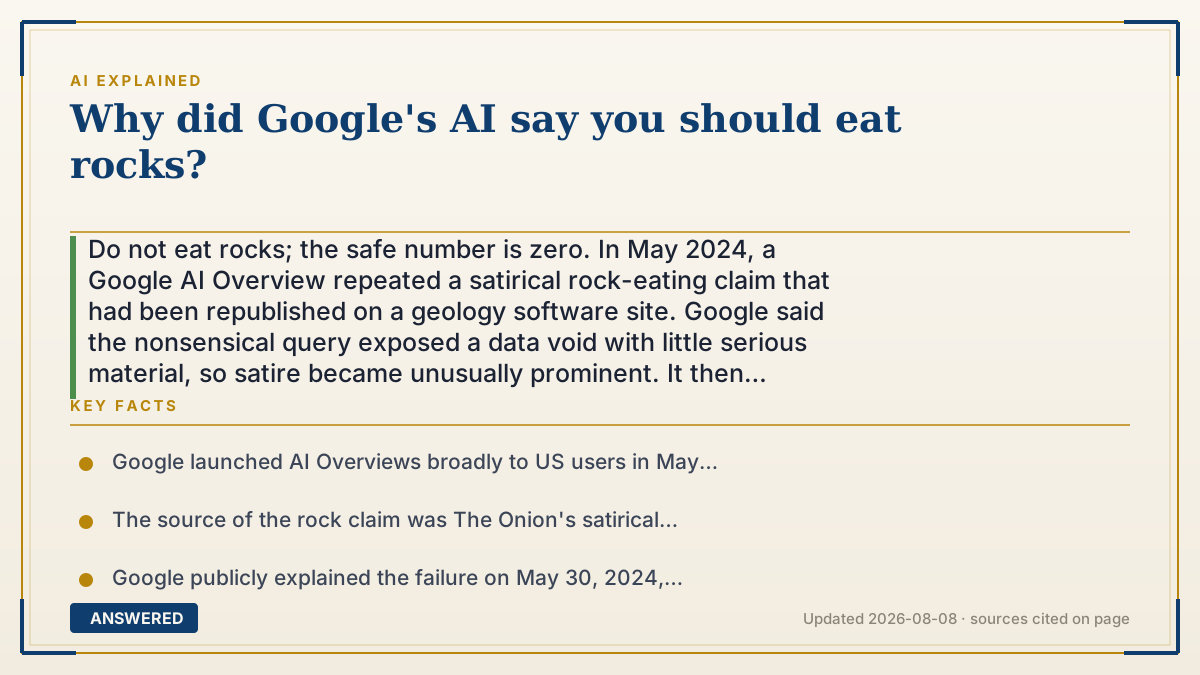
Why did Google's AI say you should eat rocks?
Do not eat rocks; the safe number is zero. In May 2024, a Google AI Overview repeated a satirical rock-eating claim that had been republished on a geology software site. Google said the nonsensical query exposed a data void with little serious material, so satire became unusually prominent. It then improved nonsensical-query detection and limited satire and humor inclusion. Verified 2026-08-08.
Rock-eating answer: safety and cause
| Question | Direct answer | Evidence |
|---|---|---|
| Should I eat rocks? | No — zero rocks per day | Non-food ingestion can cause choking, dental injury, blockage, infection or poisoning |
| Why did Google show it? | A satirical source surfaced in a data void | Google's May 30, 2024 incident explanation |
| Did Google change the system? | Yes, for this failure class | Better nonsensical-query detection and limits on satire/humor inclusion |
| Already swallowed one? | Choking or breathing trouble: call emergency services now | Otherwise get case-specific poison or medical advice; in the US call 1-800-222-1222 or use webPOISONCONTROL |
Why — the first-principles explanation
This was not a sound health answer, and it was not purely an unsupported sentence invented from nowhere. It was a retrieval-and-judgment failure: the system found a real satirical claim, then presented it in an answer format that made it look factual.
Google's own post describes the mechanism as a data void. Almost no serious publisher answers a nonsensical question about a daily rock allowance. A satirical Onion article did, and a geological software provider had republished it. With little high-quality material for that exact query, the joke had disproportionate influence. Grounding a generated answer in web pages reduces some fabrication, but it cannot help when the selected evidence is inappropriate.
The republication mattered because context is part of credibility. Readers recognize The Onion as satire on its own site. A copied passage on a geology-related domain can preserve topical relevance while losing the strongest comedy signal. Search systems therefore need more than keyword relevance: they must also classify source purpose, query plausibility and safety risk.
Google said it responded by improving detection of nonsensical queries that should not receive an AI Overview and limiting the inclusion of satire and humor. That is a targeted safeguard, not proof that every generated search answer is now correct. For health or safety questions, verify the answer against a medical or public-health source before acting.
An example that makes it click
Imagine a research assistant searching a nearly empty shelf for "How many rocks should I eat per day?" Serious medical books do not frame advice that way, but a humor column does. Someone has copied that joke into a geology company's binder without the original comedy cover. The assistant treats topical relevance as factual suitability and returns the joke as an answer.
The assistant found evidence, but it was the wrong kind of evidence. That is the useful distinction: citations do not make an answer safe unless the source's purpose, context and authority also fit the claim.
Key facts
- Google launched AI Overviews broadly to US users in May 2024, moving it from an opt-in experiment into general production.
- The source of the rock claim was The Onion's satirical article "Geologists Recommend Eating At Least One Small Rock Per Day," republished on a geological software provider's website.
- Google publicly explained the failure on May 30, 2024, attributing it to a data void — little serious web content for a nonsensical query — plus satire republished without its original context.
- Google said it built better detection for nonsensical queries that should not show an AI Overview and limited the inclusion of satire and humor content.
- Rocks and dirt are not food. Repeated ingestion can cause constipation, infection or heavy-metal poisoning, and hard non-food objects can also create choking, dental and gastrointestinal risks.
- If the person is choking or having trouble breathing, call emergency services immediately. Otherwise get case-specific poison or medical advice; US Poison Control is available at 1-800-222-1222 and online.
Check AI-generated claims before acting
Use these related guides to understand AI Overview errors and verify high-stakes answers against primary sources.
▶ The 60-second explainer (script)
First: do not eat rocks. The safe daily amount is zero. In May 2024, Google's AI Overview repeated a satirical claim about eating a small rock each day. Google later explained that the query created a data void: almost no serious page answers a nonsensical rock-diet question, while an Onion satire piece had been republished on a geology software site. The system found relevant words but failed to preserve the source's purpose. Google said it improved detection for nonsensical queries and limited satire and humor in AI Overviews. The practical lesson is broader: a cited AI answer can still be wrong when the cited source is inappropriate. Check health and safety claims against medical sources. If someone who swallowed a rock is choking or having trouble breathing, call emergency services immediately; otherwise get case-specific poison or medical advice.
What authoritative sources say
People also ask
Did Google's AI invent the rock advice?
It did not invent the core claim from nothing: Google said a satirical Onion article had been republished on a geology software site. The failure was treating that inappropriate evidence as a factual health answer.
What is a "data void"?
A query where almost no serious content exists on the web. Whatever content does exist — even a joke — then dominates the AI's summary because there is nothing to outweigh it.
Has Google fixed this?
Google said it improved detection for nonsensical queries and limited satire and humor in AI Overviews. That addresses this failure class, but it is not a guarantee that every generated answer is correct.
Should you actually eat rocks?
No. Zero rocks per day. If the person is choking or having trouble breathing, call emergency services now. Otherwise get case-specific poison or medical advice; in the US call 1-800-222-1222 or use webPOISONCONTROL.
What was the glue-on-pizza answer?
The same May 2024 wave. AI Overviews suggested adding non-toxic glue to help cheese stick to pizza, tracing back to a joking Reddit comment that the system read as genuine advice.