Why does AI love em dashes?
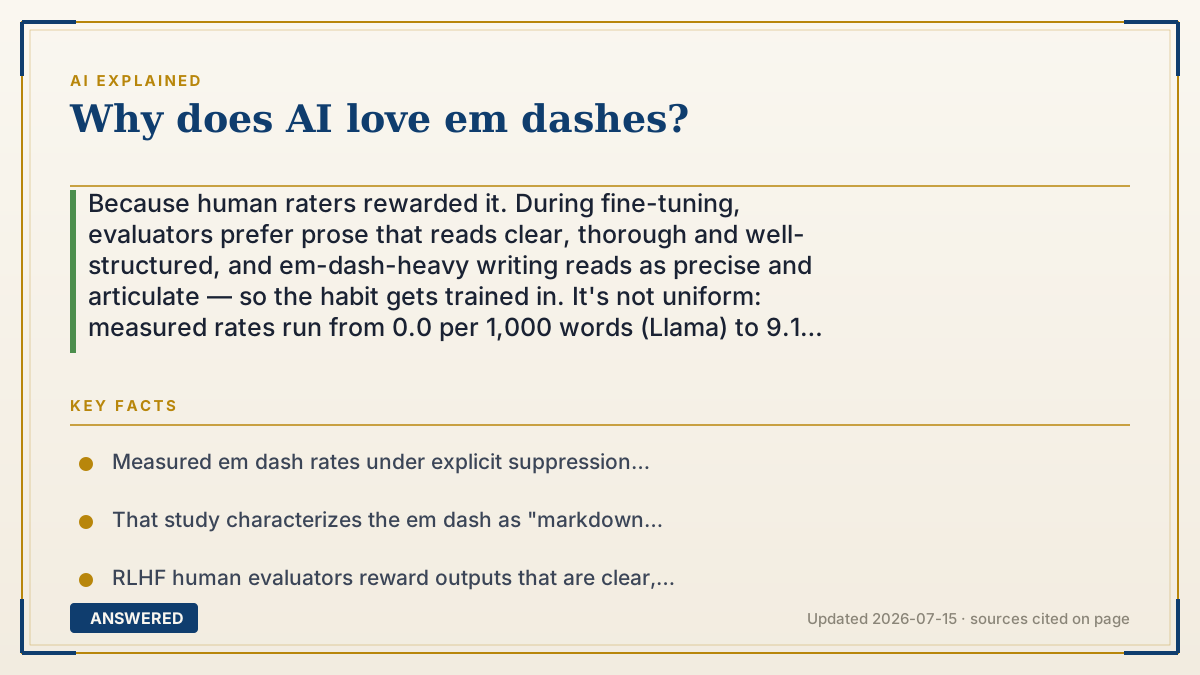
Because human raters rewarded it. During fine-tuning, evaluators prefer prose that reads clear, thorough and well-structured, and em-dash-heavy writing reads as precise and articulate — so the habit gets trained in. It's not uniform: measured rates run from 0.0 per 1,000 words (Llama) to 9.1 (GPT-4.1) even when explicitly told to stop.
Why — the first-principles explanation
Two mechanisms stack, and neither is what people assume. The popular theory — "AI copies em-dash-heavy writers from the internet" — is too weak to explain the size of the effect. Human writing on the web is not this dash-happy.
The first real cause is what the training text looks like. Models are trained on corpora saturated with markdown and structured documents — headers, bullets, bold, code blocks. That teaches a whole register: signposted, hierarchical, visibly organized. One research paper describes the em dash as markdown leaking into prose — the smallest surviving piece of that structural habit. When you strip the headers and bullets out of a model's output and force it into flowing paragraphs, the structuring impulse doesn't vanish. It squeezes into punctuation. The dash becomes a header you can't see.
The second cause is RLHF, and this is the strong one. After reading, models are tuned on human comparisons: raters see two answers and pick the better one. Raters consistently reward writing that seems clear, thorough and well-organized. And em-dash prose reads as precise, articulate, structurally aware. So the training loop doesn't reward the dash directly — it rewards the feeling the dash produces, and the dash comes along for free. Nobody ever wrote a rule saying "use more em dashes." It fell out of optimizing for a preference. This is a general lesson about these systems: you get what you measure, including things you never intended to measure.
The evidence that this is fine-tuning and not "the internet" is the variation between models. Measured under explicit instructions to suppress em dashes, one study found rates from 0.0 per 1,000 words in Llama up to 9.1 in GPT-4.1. Same internet, wildly different dash rates. The paper reframes em dash frequency as a diagnostic of the fine-tuning procedure — a fingerprint of the lab, not of the training data. Sam Altman publicly acknowledged that ChatGPT's em dash frequency was adjusted in response to user preference, confirming labs do tune punctuation directly.
One fairness note, since this became a witch hunt: the em dash is a legitimate, centuries-old punctuation mark, and plenty of good human writers lean on it. Using dash count to accuse someone of AI writing is a bad test.
An example that makes it click
Imagine training a dog by giving it a treat every time you feel happy. You never meant to reward tail-wagging — but you happen to smile when it wags, so the wagging gets reinforced. Six months later you have a dog that wags constantly and you can't explain why.
Raters smiled at prose that felt crisp and organized. The em dash makes prose feel crisp and organized. Nobody ever handed out a treat for the dash itself. The dog just noticed what made you smile.
Key facts
- Measured em dash rates under explicit suppression instructions range from 0.0 per 1,000 words (Llama) to 9.1 (GPT-4.1), per a 2026 arXiv study — same training internet, different fine-tuning.
- That study characterizes the em dash as "markdown leaking into prose — the smallest surviving unit of the structural orientation that LLMs acquire from markdown-saturated training corpora."
- RLHF human evaluators reward outputs that are clear, well-structured and thorough, which systematically rewards the markdown register that produces em dashes.
- The study reframes em dash frequency as "a diagnostic of fine-tuning methodology rather than a stylistic defect" — a fingerprint of the lab, not the corpus.
- Sam Altman publicly acknowledged that em dash frequency in ChatGPT output was adjusted in response to user preference, confirming punctuation-level features are directly targeted in fine-tuning.
- In a post-editing study, human participants removed only 23% of the 254 em dashes present in LLM-generated drafts.
▶ The 60-second explainer (script)
AI loves em dashes because human raters rewarded it — by accident. The popular theory is that AI just copied dash-happy writers off the internet. That's too weak. Human writing on the web isn't nearly this dash-heavy. Two real mechanisms are stacked here. First: what the training text looks like. These models are trained on piles of markdown — headers, bullets, bold, code blocks. That teaches a whole register: signposted, hierarchical, visibly organized. One paper calls the em dash markdown leaking into prose. Strip out the headers and force flowing paragraphs, and the structuring impulse doesn't disappear. It squeezes into punctuation. The dash is a header you can't see. Second, the strong one: RLHF. After training, models get tuned on human comparisons — raters see two answers, pick the better one. Raters reward writing that feels clear, thorough, organized. And dash-heavy prose reads as precise and articulate. So the loop never rewarded the dash. It rewarded the feeling the dash creates, and the dash rode along. Nobody wrote a rule. It fell out of optimizing for a preference. That's the whole lesson about these systems: you get what you measure, including what you didn't mean to measure. Proof it's fine-tuning and not the internet? The variation. Told explicitly to stop using em dashes, Llama drops to zero. GPT-4.1 keeps producing 9.1 per thousand words. Same internet. Different lab. The researchers call it a fingerprint of the fine-tuning. And a fairness note: the em dash is a legitimate mark that good writers have used for centuries. Counting dashes is a terrible way to accuse someone of using AI.
What authoritative sources say
People also ask
Does using em dashes mean my writing looks AI-generated?
Only to people running a bad test. The em dash is a legitimate mark that human writers have used for centuries, and dash rates vary hugely across AI models anyway — one measured at 0.0 per 1,000 words. Dash count is not evidence.
Can I just tell the AI to stop using em dashes?
It depends on the model, and researchers measured exactly this. Some comply completely. GPT-4.1 still produced 9.1 em dashes per 1,000 words while explicitly instructed to suppress them. The habit sits deeper than the prompt.
Did AI companies do this on purpose?
Not originally — it emerged from rewarding prose that felt clear and organized. But labs do tune punctuation deliberately once they notice: Sam Altman acknowledged adjusting ChatGPT's em dash frequency after user complaints.
What are the other AI writing tells?
The register they come from is the same: signposting words like 'moreover' and 'furthermore', tidy three-sentence paragraphs, symmetrical structure, intros that restate the question, conclusions that summarize, and hedging instead of specifics. The dash is just the most visible member of that family.
Why does an em dash make writing feel smarter?
It adds a clarification without starting a new sentence or creating a run-on — so it reads as precise and structurally aware. That's exactly the impression human raters reward, which is how the habit got trained in.