Will AI replace accountants?
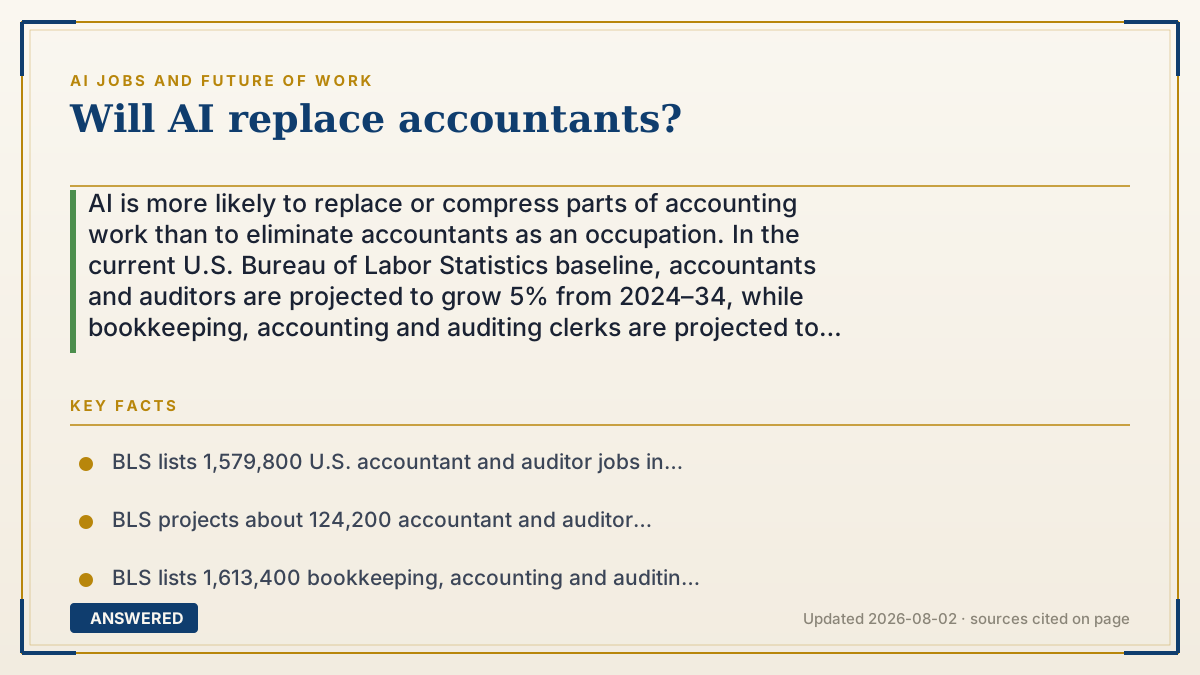
AI is more likely to replace or compress parts of accounting work than to eliminate accountants as an occupation. In the current U.S. Bureau of Labor Statistics baseline, accountants and auditors are projected to grow 5% from 2024–34, while bookkeeping, accounting and auditing clerks are projected to decline 6%. Those forecasts are not an AI causal estimate. The practical risk is a changing task mix, a thinner entry-level apprenticeship and a higher premium on judgment, controls, communication and review.
Why — the first-principles explanation
“Accountant” is an occupation containing many different tasks, not one automatable unit. BLS describes accountants and auditors as examining statements, preparing taxes, evaluating risks, recommending improvements and explaining findings to managers and clients. It also says they may use AI and robotic process automation to increase productivity, allowing more focus on analysis and higher-level responsibilities. By contrast, BLS describes bookkeeping, accounting and auditing clerks as recording transactions, checking postings, reconciling differences and producing routine reports—work closer to structured data processing.
That split gives a better answer than “AI can do math.” A system may draft a reconciliation, classify a transaction or compare a ledger quickly, yet still need a person to check source documents, resolve an ambiguous rule, investigate fraud, communicate a risk and accept responsibility for a regulated report. PCAOB auditing standards require an auditor to reduce audit risk through due professional care and sufficient appropriate audit evidence. A model can support that process; the standard does not turn a generated answer into evidence by itself.
The labor evidence needs similar discipline. BLS projections are occupation-level baselines, not a forecast that AI caused a particular change. Stanford's early-career study finds a broad pattern in AI-exposed occupations, but it is not an accountant-specific estimate. Yale's latest macro review finds no clear economy-wide employment effect so far. The ILO's global task analysis says most jobs are more likely to be transformed than made redundant. So the honest forecast is conditional: routine entry tasks face pressure first; accounting work that combines domain judgment, controls, client context and accountable review is more resilient, but not immune to productivity and staffing changes.
An example that makes it click
Consider a month-end close. An AI tool can import invoices, suggest account codes, flag an unusual variance, draft a reconciliation and summarize open items. A senior accountant still has to verify the source data, decide whether an unusual contract changes the accounting treatment, document the control, ask the business owner for context and approve the final report. A firm that automates only the first pass may serve more clients; a firm that removes review and evidence controls merely moves errors faster. For a junior employee, the career move is to learn the automated workflow while deliberately practicing controls, analysis, communication and judgment—not to compete with software at data entry.
How to do it
- Separate the occupation into tasks: transaction entry, reconciliations, reporting, tax preparation, audit evidence, controls, analysis, advice, client communication and sign-off.
- Measure a task's exposure with evidence: how standardized the inputs are, how often exceptions occur, how costly an error is and whether a responsible human must explain or approve the result.
- Pilot one bounded workflow with historical samples. Record time saved, exception rate, correction rate, missing evidence and reviewer minutes—not just the number of generated drafts.
- Keep source documents, formulas, assumptions, prompts, model versions and reviewer decisions so an output can be reconstructed and challenged.
- Do not put confidential financial, tax or personal data into an unapproved tool. Confirm the vendor's retention, training, access, regional processing and deletion terms.
- Set a human approval gate for tax positions, external reporting, audit evidence, fraud alerts, material estimates, payments and any decision with legal or client consequences.
- Redesign junior development rather than deleting it: rotate people through controls, variance analysis, source research, client explanation and supervised exception handling.
- Build skills around accounting judgment and AI-enabled operations: data quality, spreadsheet/ERP fluency, internal controls, audit evidence, privacy, prompt evaluation and clear communication.
- For a firm, compare cost per accepted close or reviewed workpaper, including model usage, integration, security, training and rework—not cost per generated token.
- Review the workforce plan every quarter against local BLS/O*NET data, client demand, error rates and regulatory changes. No 2030 headline can replace a task-level measurement.
Key facts
- BLS lists 1,579,800 U.S. accountant and auditor jobs in 2024, a 2024 median wage of $81,680 and a 5% projected employment increase from 2024 to 2034.
- BLS projects about 124,200 accountant and auditor openings per year on average from 2024 to 2034, including replacement needs.
- BLS lists 1,613,400 bookkeeping, accounting and auditing clerk jobs in 2024 and projects a 6% decline from 2024 to 2034, with about 170,000 annual openings mainly from replacement needs.
- BLS says accountants and auditors may use AI and robotic process automation to increase productivity and focus on analysis and higher-level responsibilities.
- BLS describes clerk work as posting transactions, checking figures, reconciling differences and producing reports, which is a different task mix from professional accounting judgment and advice.
- O*NET lists accountant tasks including audit findings, control deficiencies, fraud or non-compliance analysis and recommendations to management; O*NET lists routine recording and verification tasks for accounting clerks.
- PCAOB auditing standards require auditors to reduce audit risk through due professional care and sufficient appropriate audit evidence; a generated draft is not automatically evidence or an audit opinion.
- Stanford's 16% relative early-career employment decline concerns AI-exposed occupations broadly and should not be treated as an accountant-specific causal estimate.
- Yale's latest review reports no clear economy-wide relationship between current AI exposure measures and employment or unemployment changes, while noting that better data is needed.
- The ILO's 2025 update estimates that one in four workers are in occupations with some GenAI exposure but says continued human input means most jobs are more likely to be transformed than made redundant.
Plan for task change, not a headline about job extinction
Map exposure, evidence and accountability to your role, then choose tools and training that increase accepted work without removing review controls.
▶ The 60-second explainer (script)
Will AI replace accountants? The honest answer is that it will replace or compress some accounting tasks faster than it replaces the occupation. The U.S. Bureau of Labor Statistics projects accountants and auditors to grow five percent from 2024 to 2034, while bookkeeping and accounting clerks are projected to decline six percent. Those are occupation forecasts, not proof that AI caused either number. The task split matters. Software can post transactions, draft reconciliations and flag variances. Accountants still have to inspect evidence, resolve ambiguous rules, investigate risk, explain findings and approve work under professional standards. The career risk is real at the entry level if routine work disappears before people learn judgment. The best response is not to compete with automation at data entry. Learn the tools, controls, data quality, exception handling, analysis and client communication—and measure how much accepted, reviewed work you can produce safely.
What authoritative sources say
People also ask
Will AI replace accountants?
Current evidence supports task automation and job redesign more strongly than a uniform disappearance of accountants. BLS projects U.S. accountant and auditor employment to grow 5% from 2024 to 2034, while routine clerk work is projected to decline 6%.
Will AI replace bookkeepers first?
Routine bookkeeping, posting, checking and reconciliation tasks are more exposed because they are structured and repeatable. BLS projects a 6% decline for bookkeeping, accounting and auditing clerks, but that is a baseline projection—not a claim that AI alone causes every change.
Can AI perform an audit?
AI can assist with sampling, anomaly detection, documentation and analysis. An audit still requires the responsible firm and auditor to apply professional standards, obtain evidence and exercise judgment; a generated answer is not automatically audit evidence or an opinion.
Should I still study accounting?
Yes, but build beyond routine entry work. Combine accounting fundamentals with controls, data quality, audit evidence, systems, AI evaluation, analysis and client communication so you can supervise and explain automated work.
Which accounting tasks are most exposed to AI?
Transaction posting, invoice coding, standard reconciliations, first-draft reports and other repeatable checks are more exposed. Exceptions, ambiguous contracts, risk interpretation, fraud investigation, stakeholder communication and accountable review require more context and judgment.
Will AI create more accounting jobs?
It may increase demand for some analysis, controls, implementation and review work while reducing or changing other tasks, but the net effect is uncertain by market and employer. Measure actual workflow demand instead of assuming a universal gain or loss.
Will AI replace accountants by 2030?
No credible source can give a universal 2030 answer. Use a task-level scenario: identify which work is automatable, what evidence and approval remain required, how clients buy the service and whether your local labor market is growing or shrinking.
Can I trust AI for tax advice?
Use it for a documented first pass, research checklist or draft—not as an unchecked tax position. Verify the applicable authority, facts, calculations and filing requirements with a qualified professional when stakes are material.
What skills will accountants need as AI improves?
Accounting judgment, internal controls, data and systems literacy, exception handling, audit evidence, privacy/security, clear explanation and the ability to evaluate a model's output will matter more than competing with software on routine keystrokes.
How should an accounting firm adopt AI?
Start with a bounded workflow, approved data, a labeled test set, reviewer gates, evidence retention and a rollback path. Track accepted work, error/rework, exceptions, review time and client risk before expanding access.
Does AI make an accounting degree worthless?
No. It changes which parts of the degree pay off. A credential plus strong judgment, controls, communication and AI-enabled systems skills can remain valuable; a plan that assumes routine work will stay unchanged is the fragile part.
The same question, asked other ways
- Will accounting be replaced by AI?
- Will AI take over accounting?
- Will accountants be replaced by AI?
- Will accounting jobs be replaced by AI?
- Will AI replace accountants by 2030?
- Will AI replace bookkeepers and accountants?