Will AI replace artists?
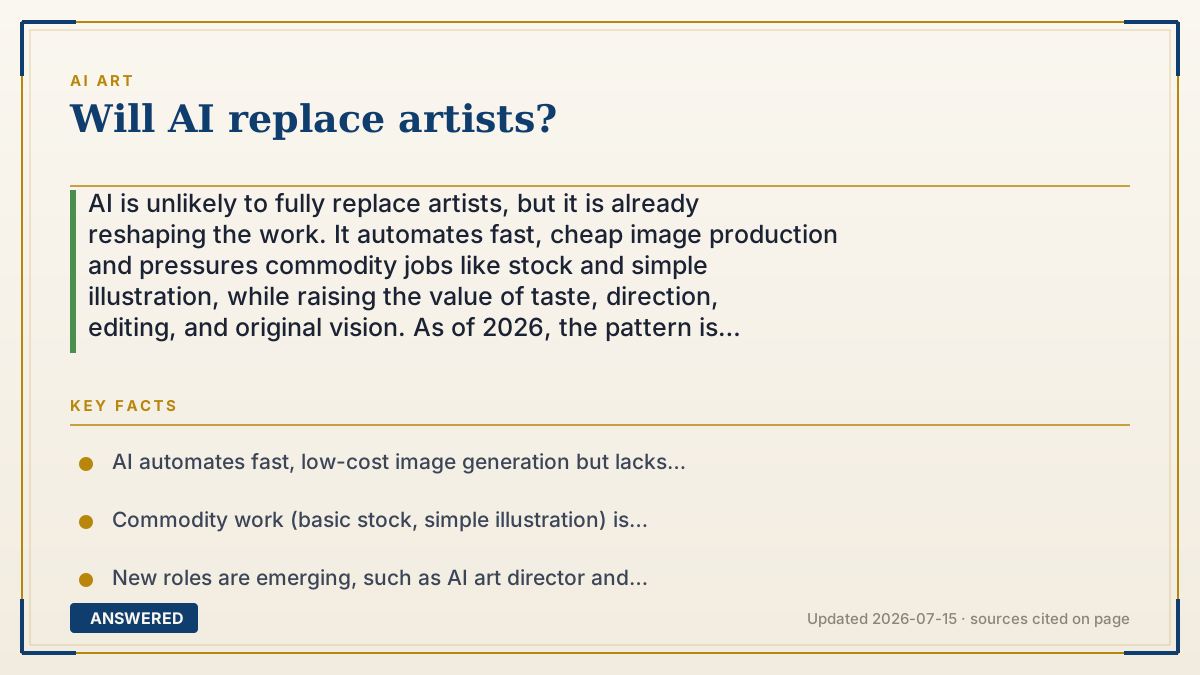
AI is unlikely to fully replace artists, but it is already reshaping the work. It automates fast, cheap image production and pressures commodity jobs like stock and simple illustration, while raising the value of taste, direction, editing, and original vision. As of 2026, the pattern is augmentation and disruption, not wholesale replacement.
Why — the first-principles explanation
The key is to separate an artist's job into tasks, not treat it as one lump. AI is very good at some tasks (generating lots of options fast, mimicking styles, filling in backgrounds) and weak at others (a distinct personal vision, understanding a client's real intent, emotional resonance, and taking responsibility for choices). Automation hits the tasks it's good at, not the whole role.
This is why the impact is uneven. Commodity work, where the buyer just needs 'a decent image, cheap and fast,' is most exposed: basic stock, simple spot illustration, quick concept sketches. High-context work, where a human relationship, brand judgment, or unique voice matters, is far more durable.
History rhymes here. Photography didn't end painting; it pushed painting toward things cameras couldn't do and created whole new careers. Digital tools didn't end illustration; they changed it. Powerful new tools usually shift and expand creative work more than they erase it, though the transition is painful for those doing the automated tasks.
The likely 2026-forward outcome: fewer people paid purely to render images, more value on the humans who direct, curate, edit, and bring original ideas, plus new roles that didn't exist before, like AI art director and prompt-driven designer.
An example that makes it click
Think of what calculators did to math. They instantly replaced the task of long division by hand, so nobody gets paid to be a human calculator anymore. But they didn't replace mathematicians, engineers, or accountants, they freed those people to do higher-level thinking and actually created more jobs that use math.
AI art is the calculator moment for images. The task of 'render a picture fast' gets automated, but the human who decides what's worth making, and whether it's any good, becomes more important, not less.
Key facts
- AI automates fast, low-cost image generation but lacks independent vision and client understanding.
- Commodity work (basic stock, simple illustration) is most exposed; high-context work is more durable.
- New roles are emerging, such as AI art director and prompt-based designer.
- Historical parallels: photography and digital tools disrupted but did not eliminate art careers.
- As of 2026, the trend is augmentation plus disruption of specific tasks, not full replacement.
▶ The 60-second explainer (script)
Will AI replace artists? Probably not entirely, but it's already changing the job in a big way. Here's the useful way to think about it: an artist's work is really a bundle of tasks. AI is great at some of them, generating lots of options fast, mimicking styles, filling backgrounds, and weak at others, like having a genuine personal vision, understanding what a client actually needs, and taking responsibility for the final choices. So AI hits the tasks it's good at. That means commodity work, cheap fast stock images and simple illustration, is most at risk. But work that depends on a unique voice or a real client relationship is far safer. Remember, photography didn't kill painting, it pushed it somewhere new and created fresh careers. The likely outcome: fewer people paid just to render, more value on the humans who direct, curate, and imagine, plus brand-new roles like AI art director.
What authoritative sources say
People also ask
Which artists are most at risk?
Those doing commodity, low-context work like basic stock images and simple spot illustration face the most pressure.
Can AI have its own vision?
Not really. It generates from patterns and needs a human to decide what's worth making and whether it's good.
Are there new jobs because of AI art?
Yes, roles like AI art director, prompt designer, and AI-assisted editor are emerging.
Should artists learn AI tools?
Learning to direct and edit AI can make an artist more competitive, much like learning digital tools once did.