Will AI replace jobs?
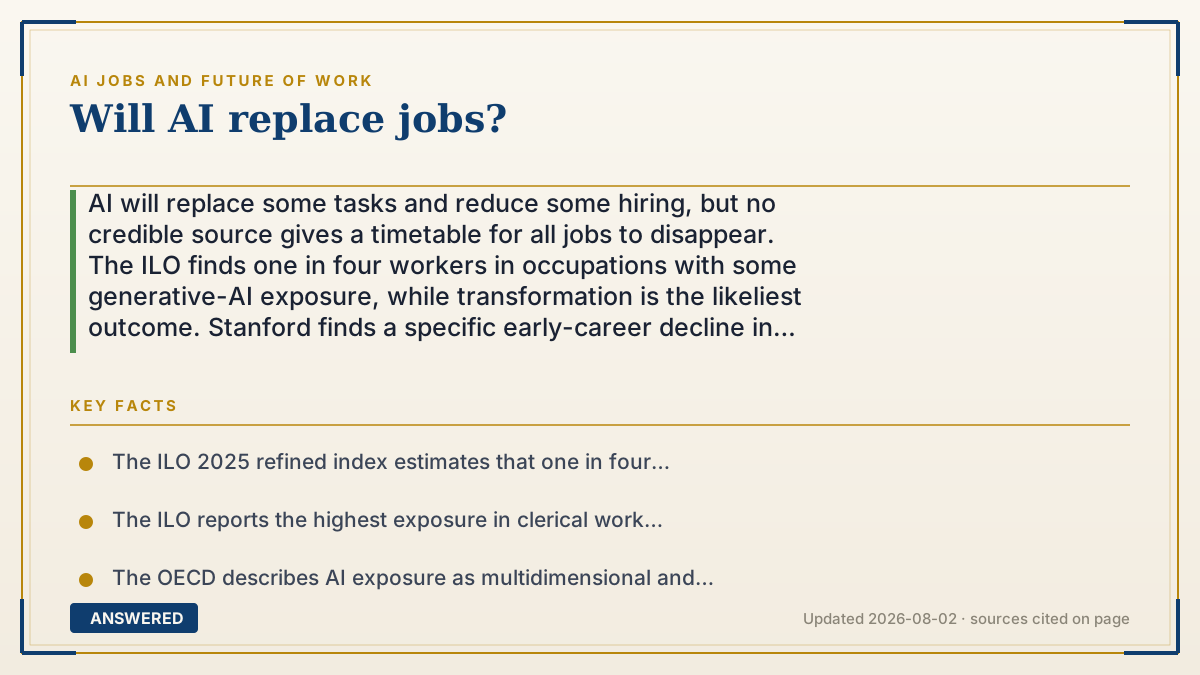
AI will replace some tasks and reduce some hiring, but no credible source gives a timetable for all jobs to disappear. The ILO finds one in four workers in occupations with some generative-AI exposure, while transformation is the likeliest outcome. Stanford finds a specific early-career decline in highly exposed U.S. occupations; Yale finds no broad U.S. disruption yet. Use a task audit, not a headline, to plan.
Why — the first-principles explanation
A job is a bundle of tasks, relationships, decisions and accountability—not a single switch marked replaceable. A customer-support specialist may draft a reply, retrieve a policy, decide whether an exception is allowed, protect account data, calm a customer and own the outcome. AI may automate the draft while leaving the judgment and responsibility with a person. That is why 'AI can do part of this job' is a much lower bar than 'the occupation disappears.'
A useful forecast has four gates. Exposure: can a system perform or accelerate the task at the required quality? Adoption: will a particular employer buy, integrate and govern it? Economics: will lower unit cost create more demand, or will a fixed market need fewer workers? Accountability: who checks errors, handles exceptions, protects data and answers to a customer, regulator or patient? A task can pass the first gate and fail the other three.
The evidence also operates at different levels. The ILO measures occupational exposure globally; the Stanford ADP study examines a narrow early-career U.S. population; Yale looks for economy-wide U.S. changes since ChatGPT; BLS projects employment for all occupations without treating it as an AI forecast. These findings are not contradictory: they answer different questions. A cautious answer can be true at the same time as a real worker faces fewer entry-level openings.
The practical question is not 'Will AI replace my title?' but 'Which tasks are changing, what proof of competence will replace the old entry ladder, and what human or system responsibility remains?' Track your tasks, tool adoption, error rates, hiring signals and skills demand. Revisit the plan when the employer, technology or local labor market changes.
An example that makes it click
Imagine a 40-person customer-support team at a retailer. An AI assistant can draft answers and retrieve the return policy, so the team may handle more tickets with the same headcount. If demand is fixed, the company might hire fewer entry-level agents; if faster answers attract more customers, it might keep the team and expand service. A human still needs to approve exceptions, protect account data, handle an angry customer and own the outcome. Before calling the role replaced, measure adoption, resolution quality, escalations, staffing and training over several months.
How to do it
- State the question precisely: your occupation, country, employer or industry, and the time horizon. A 2026 entry-level hiring question is not the same as a global 2030 scenario.
- Break the job into recurring tasks, then label each as drafting, retrieval, calculation, physical work, relationship work, judgment, coordination or accountability.
- For every task, ask whether AI can perform it with the required accuracy, latency, privacy and audit trail—not merely produce a plausible demo.
- Check adoption evidence from your employer and industry: approved tools, workflow integrations, job postings, staffing changes, training and observed output—not vendor promises alone.
- Separate automation from augmentation. Record whether the tool removes a task, speeds it up, changes who reviews it or creates new exception and governance work.
- Protect the entry-level ladder. Identify which beginner tasks teach the domain, then find another way to practice them under supervision instead of skipping foundational judgment.
- Build a small portfolio of reviewed outcomes: before/after time, error corrections, sources, permissions and the human decision that remained yours.
- Use local evidence before making an irreversible career decision: BLS or the relevant national labor data, occupation profiles, current job postings, professional bodies and conversations with practitioners.
- Choose one adjacent skill that compounds with domain knowledge—verification, data handling, workflow design, communication, customer judgment or safe tool use—and test it in a real project.
- Revisit the plan quarterly or after a major tool, employer or regulation change. Forecasts are scenarios; your measured task results are the more useful signal for your next move.
Key facts
- The ILO 2025 refined index estimates that one in four workers globally are in occupations with some generative-AI exposure; 3.3% of global employment is in its highest exposure category, and transformation is the likeliest impact.
- The ILO reports the highest exposure in clerical work and says most occupations still contain tasks requiring human input; exposure is not a count of jobs that will disappear.
- The OECD describes AI exposure as multidimensional and says effects depend on adoption, regulation and organizational change as well as technical capability.
- A Stanford Digital Economy Lab study using ADP payroll data through September 2025 found a 16% relative employment decline for workers aged 22–25 in the most AI-exposed occupations; the decline was concentrated where AI automated rather than augmented work, and the authors caution that other factors may contribute.
- The Budget Lab at Yale reports no discernible economy-wide U.S. labor-market disruption in the 33 months after ChatGPT release, while explicitly warning that this snapshot does not predict the future.
- The World Economic Forum projects 170 million jobs created and 92 million displaced by structural change through 2030 from expectations of more than 1,000 employers; it is a survey-based scenario, not a layoff count or AI-only forecast.
- The U.S. Bureau of Labor Statistics projects total employment across all occupations to grow 3.1% from 169.96 million in 2024 to 175.17 million in 2034, with about 18.86 million annual openings; this is a general projection, not an AI-specific prediction.
- The BLS Occupational Outlook Handbook provides occupation-level work, education, pay and outlook profiles that can be combined with local employer evidence.
- A lower number of entry-level openings can coexist with stable experienced employment: the pathway into a profession may change before the occupation itself disappears.
- A forecast should be treated as conditional evidence. It cannot tell an individual whether to quit, retrain or borrow money without checking local demand, constraints and alternatives.
Turn job anxiety into a task-and-skill plan
Separate exposure from replacement, measure your real workflow and compare tools, training and total cost before making a career decision.
▶ The 60-second explainer (script)
Will AI replace jobs? Some tasks, yes; every job, no credible source can put a reliable date on that. A job is a bundle of tasks, judgment, relationships and accountability. The ILO estimates one in four workers are in occupations with some generative-AI exposure, but says transformation is more likely than full automation. Stanford finds a specific early-career decline in highly exposed U.S. occupations, while Yale finds no broad U.S. disruption yet. Those studies answer different questions. Audit your own tasks, check whether your employer is actually adopting a tool, protect the entry-level learning ladder, and build reviewed evidence of the skills that remain valuable. Use labor data and local job postings before making a major career decision.
What authoritative sources say
People also ask
Will AI replace all jobs?
There is no credible timetable or evidence that every job will disappear. AI can automate parts of many jobs, but adoption, economics, accountability and human relationships determine whether an occupation changes, shrinks or grows.
Which jobs are most at risk from AI?
Tasks are more informative than titles. Routine digital writing, extraction, classification, predictable support and some coding are often more exposed. Exposure means a system may help or automate part of the work; it does not prove the occupation will vanish.
Why do Stanford and Yale seem to disagree?
They study different populations and outcomes. Stanford examines a narrow early-career U.S. payroll group in highly exposed occupations; Yale looks for economy-wide U.S. disruption. A focused effect can coexist with no detectable aggregate effect.
Will AI replace entry-level jobs first?
Entry-level work can be vulnerable when it consists of routine digital tasks, and Stanford reports a specific decline for 22–25-year-olds in highly exposed occupations. That is evidence of risk, not a universal forecast. Employers may also redesign training and create new review work.
Will AI create new jobs?
It may, but the size and timing are uncertain. The WEF figures are employer-survey scenarios about structural change, not a guaranteed list of AI jobs or a count of realized hiring. Check local demand and the skills actually requested.
How can I assess my own AI risk?
List your recurring tasks, identify which are digital and predictable, check your employer’s real adoption, and measure quality, time, exceptions and responsibility. Then build a reviewed portfolio around domain judgment, verification and workflow skills.
Should I change careers because of AI?
Not from a headline alone. Compare your local labor data, current job postings, training cost, transferable skills, personal constraints and multiple time horizons. A smaller entry ladder may call for a skill shift rather than abandoning the field.
Can human judgment protect a job from AI?
It can reduce direct substitutability when the work requires context, relationships, physical presence, regulated decisions or accountability, but it is not a guarantee. Organizations may still redesign roles and change how much judgment each person handles.
What skills should I build?
Start with skills that make an outcome reliable: domain knowledge, source checking, data and privacy handling, clear communication, exception management, workflow design and the ability to evaluate an AI result. Test them on real work rather than collecting vague tool badges.
The same question, asked other ways
- Is AI taking over jobs?
- Will AI take my job?
- Will AI take over jobs?
- Will agentic AI replace your job?
- Will AI make human workers obsolete?
- Is AI going to replace jobs?
- Does AI replace every field of jobs?
- Will artificial intelligence replace human workers entirely?
- Is AI replacing the role of humans?