How does AI write like a human?
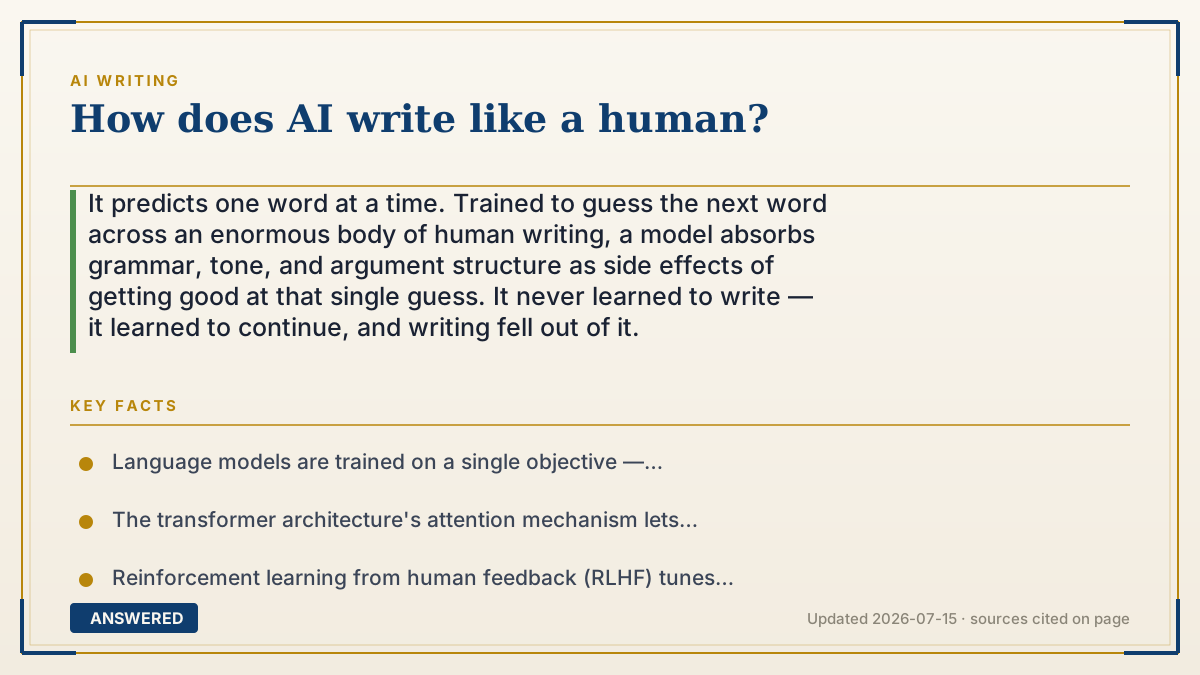
It predicts one word at a time. Trained to guess the next word across an enormous body of human writing, a model absorbs grammar, tone, and argument structure as side effects of getting good at that single guess. It never learned to write — it learned to continue, and writing fell out of it.
Why — the first-principles explanation
The whole thing rests on one unreasonably productive trick: guess the next word. Show the model "The capital of France is" and it produces a probability across every possible next word — "Paris" high, "purple" low. Do this over a staggering amount of human text, adjusting billions of internal numbers each time the guess is off, and something strange happens on the way.
To predict well, the model is forced to learn structure it was never explicitly taught. Predicting a verb ending requires grammar. Predicting the next sentence in an argument requires knowing where arguments go. Predicting how an angry email ends requires tone. None of these were goals — they're what you must internalize to win at next-word guessing. Human-sounding text is a byproduct of compression: the cheapest way to store how humans write is to learn the rules they write by.
A second piece makes it coherent over distance. The transformer lets each word look back at every other word and weigh which ones matter — that's "attention." It's why a pronoun in paragraph four still points at the right noun in paragraph one. Earlier systems forgot; this architecture keeps the whole context live at once.
Then a final stage explains the personality. Raw next-word prediction just imitates the internet, cheerfully including the worst of it. So labs apply reinforcement learning from human feedback: people rate outputs, and the model is tuned toward what raters preferred — helpful, balanced, hard to object to. This is where the familiar assistant voice comes from, and it's also the source of the flatness: rewarded for being agreeable and inoffensive, the model drifts to the middle of the distribution. Which yields the honest summary. It writes like a human because it models the statistical shape of human writing, not because it understands your situation. It's an extraordinary map of how sentences go. It has never been anywhere on the map.
An example that makes it click
Think of someone who has watched ten thousand hours of chess without ever being taught the rules. They can't recite a single rule. But they've seen bishops move diagonally so many times that a bishop moving straight would look wrong to them — and they'd flinch. They absorbed the rules by watching, as the price of predicting what comes next.
The model did that with sentences. It never got a grammar lesson. It saw enough English that "the cat sat on the" makes "mat" feel inevitable and "Wednesday" feel wrong. Grammar, tone, structure — all of it soaked in as a side effect of guessing. Which also explains the limit: our chess watcher can predict a plausible next move beautifully and still has no idea why you want to win this particular game.
Key facts
- Language models are trained on a single objective — predict the next token given the preceding ones — and grammar, tone, and argument structure emerge as byproducts of optimizing that objective, not as separately taught skills.
- The transformer architecture's attention mechanism lets every token weigh every other token in context, which is what sustains coherent reference across long passages.
- Reinforcement learning from human feedback (RLHF) tunes raw predictors toward outputs human raters preferred — helpful, balanced, inoffensive — producing both the assistant voice and its characteristic flatness.
- Because each token is selected for high probability, model output has low perplexity by construction; this is the measurable statistical fingerprint that AI detectors attempt to read.
- Model text also has low burstiness — less sentence-length variation than human prose — which is the second signal detectors score.
- That fingerprint is not a reliable authorship marker: seven detectors flagged 61.22% of TOEFL essays by non-native English writers as AI, because plain human writing shares the same low-perplexity profile (Liang et al., Patterns, 2023).
▶ The 60-second explainer (script)
How does AI write like a human? It predicts one word at a time. That's it — that's the trick. Show the model 'the capital of France is' and it spits out a probability for every possible next word. Paris, high. Purple, very low. Now do that across an enormous amount of human writing, nudging billions of internal numbers every time the guess is wrong. And something strange happens along the way. To get good at guessing, the model is forced to learn things nobody taught it. Predicting a verb ending requires grammar. Predicting the next sentence in an argument requires knowing how arguments work. Predicting how an angry email ends requires tone. None of that was the goal. It's just what you have to absorb to win at next-word guessing. Human-sounding text is a byproduct. There's a second piece: the transformer. It lets every word look back at every other word and decide which ones matter. That's why a pronoun in paragraph four still points to the right noun in paragraph one. And a third piece explains the personality. Raw prediction just imitates the internet — all of it. So labs add reinforcement learning from human feedback: people rate answers, and the model gets tuned toward what they liked. Helpful. Balanced. Hard to argue with. That's where the assistant voice comes from — and where the flatness comes from too. So: it writes like a human because it models the statistical shape of human writing. It's a beautiful map of how sentences go. It has never been anywhere on that map.
What authoritative sources say
People also ask
Does the model understand what it writes?
It models relationships between words well enough to produce coherent, often correct text. Whether that constitutes understanding is genuinely disputed — but it has no access to your situation beyond what's in the prompt.
Is it copying sentences from its training data?
Usually not. It learned statistical patterns rather than storing text verbatim, so output is typically novel — though memorized passages can surface, especially for text repeated many times in training.
Why does AI writing feel flat if it's trained on great writing?
Because it's trained to pick likely words and then tuned toward what raters found agreeable. Both pressures push toward the middle. Great writing lives at the edges.
How does it stay on topic for pages?
Attention. Every word in the context can be weighed against every other word, so earlier material stays available instead of fading like it did in older architectures.
If it's just predicting words, how does it answer questions?
Answering is a special case of continuing. The most likely continuation of a question, in text written by helpful humans, is an answer — and RLHF sharpens that tendency.