How to humanize AI content?
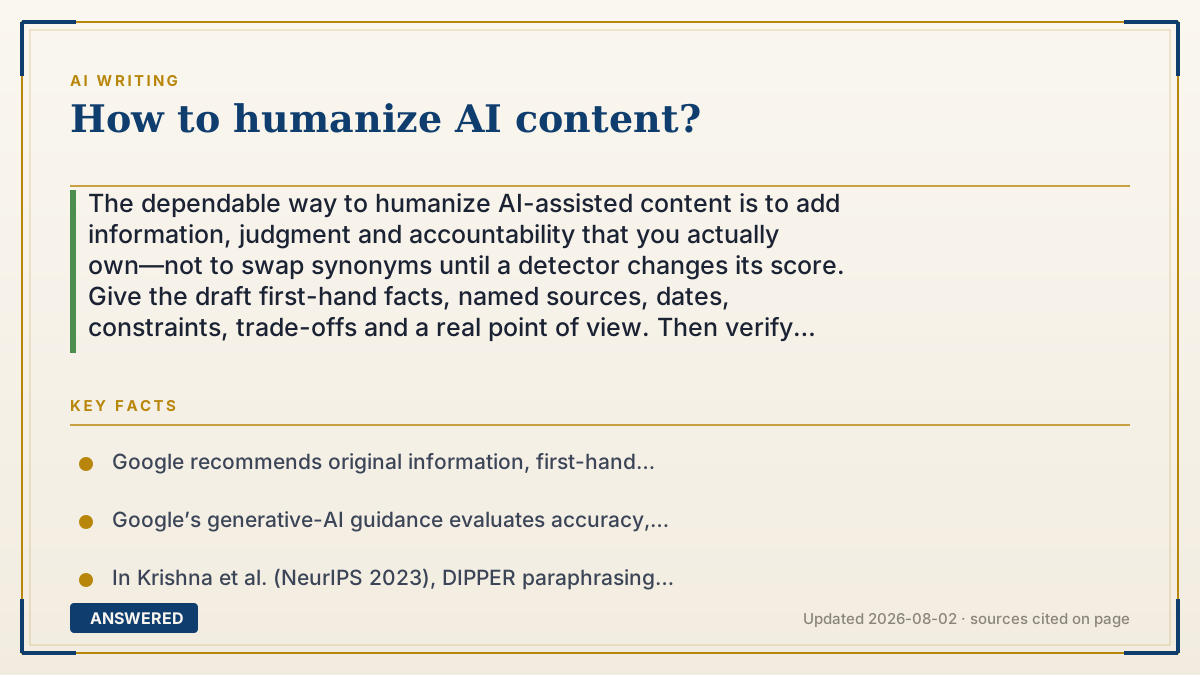
The dependable way to humanize AI-assisted content is to add information, judgment and accountability that you actually own—not to swap synonyms until a detector changes its score. Give the draft first-hand facts, named sources, dates, constraints, trade-offs and a real point of view. Then verify every claim, respect privacy and copyright, and disclose AI assistance when readers would reasonably want to know how the piece was made. A detector score is not proof of authorship or quality.
Why — the first-principles explanation
A language model is good at producing a fluent continuation from the context it receives. It is not a witness to your customer call, experiment, failed launch or editorial decision. When the prompt contains only a broad topic, the output tends toward familiar abstractions: useful-sounding claims with few details that distinguish your situation from anyone else’s. That is why the durable fix happens at the information level.\n\nThere are three different goals people call “humanizing.” Reader quality means the piece is specific, useful and memorable. Search quality means it adds original value instead of mass-producing a rewrite of other pages. Authorship and provenance mean you can show what a person contributed, which sources were used, and what the system did. They overlap, but none is the same as making a detector produce a preferred score.\n\nSurface paraphrasing can change statistical signals without adding truth or experience. Krishna et al. showed that a paraphrase model could reduce one detector’s accuracy from 70.3% to 4.6% at a fixed 1% false-positive rate, while a retrieval-based defense could still identify many paraphrased generations. Stanford’s detector study likewise found large false-positive rates for non-native English writers. Those results are reasons not to use a detector as an authorship verdict—not a recipe for disguising generic or dishonest work.\n\nGoogle’s guidance points to the same quality test: original information, first-hand expertise, substantial additional value, clear authorship and a people-first reason for publishing. The U.S. Copyright Office says prompts alone generally do not provide sufficient control for copyright; human-authored expression, creative selection or arrangement, and creative modifications are assessed case by case. So “humanize” should mean supplying and checking the human contribution, not laundering an unverified output.
An example that makes it click
Suppose an AI draft says that a SaaS onboarding flow should be simple and transparent. That sentence could describe every competitor. A useful human revision supplies the evidence: your team tested 14 new-user sessions, removed an optional integration from step 3, cut median setup from 11 days to 6, and still saw two permission errors that required a review step. The model can help organize those facts and make the prose readable; you decide whether the numbers are correct, explain the trade-off and own the conclusion. That is humanizing because the information and judgment came from a real process, not because the adjectives sound less formal.
How to do it
- Define the reader’s decision and the evidence they need; do not start with a request to sound human.
- Collect first-party material: measurements, dates, prices, constraints, customer language, screenshots, experiments and what failed. Mark anything you cannot verify.
- Give the model a source packet and ask for an outline, missing-claim list or counterargument before asking for prose. Instruct it not to invent examples, citations or personal experience.
- Keep a claim ledger with the claim, source, date, confidence and the person responsible for checking it. Replace or qualify stale, anonymous or unsupported claims.
- Add the human decisions: why you chose one option, what you rejected, what trade-off remains and who is accountable for the result.
- Delete generic sentences that would remain true if a competitor’s name replaced yours. Replace abstract nouns with concrete actions, objects and numbers.
- Use a natural editorial pass: vary rhythm where it serves meaning, prefer precise verbs, keep a real voice, and read the piece aloud. Do not force quirks or slang that are not yours.
- Run separate accuracy, privacy, copyright and permissions checks. Never publish invented testimonials, private customer details, confidential prompts or unlicensed extracts.
- For school, client or regulated work, follow the applicable policy, retain drafts and source notes, and disclose AI assistance when required or reasonably expected. Do not use a humanizer to evade review.
- Publish for people first: a descriptive title, answer-first structure, useful headings, accessible links and relevant internal routes. Measure helpful outcomes and revise from real feedback rather than chasing a detector score.
Key facts
- Google recommends original information, first-hand expertise and substantial additional value; simply rewriting other sources is not the people-first standard.
- Google’s generative-AI guidance evaluates accuracy, quality and relevance, and warns that scaled content made primarily to manipulate rankings can violate spam policies. The tool used to draft a page is not a quality exemption.
- In Krishna et al. (NeurIPS 2023), DIPPER paraphrasing reduced DetectGPT accuracy from 70.3% to 4.6% at a 1% false-positive rate; that demonstrates detector fragility, not improved authorship or reader value.
- Stanford HAI reported that detectors classified 61.22% of TOEFL essays by non-native English writers as AI-generated, so a score can encode writing-style bias and should not be treated as proof.
- A detector measures a model-specific signal under a test setup. It does not establish who wrote a passage, whether the facts are true, or whether the work is useful.
- The U.S. Copyright Office says prompts alone generally do not provide sufficient control for copyright; human expression, creative selection or arrangement, and creative modifications are evaluated case by case.
- A first-person anecdote is useful only when it is true and attributable. Asking a model to invent lived experience creates a trust and disclosure problem, even if the prose sounds natural.
- Humanizing is not the same as plagiarism checking, fact checking or provenance tracking. Keep citations, source versions, drafts and approvals as separate controls.
- SEO gains come from satisfying the searcher with original evidence and a clear answer, not from a target word count, keyword stuffing or a particular perplexity/burstiness score.
- If the draft contains personal, customer, health, financial or confidential data, use an approved workflow and confirm retention, training, access and deletion terms before uploading it.
Choose a transparent writing workflow
Add evidence and review controls first; use tools only after the task, privacy and acceptance criteria are clear.
▶ The 60-second explainer (script)
How do you humanize AI content? Start with information, not synonyms. A model can make a fluent paragraph, but it was not in your customer call, experiment or failed launch. If the prompt contains only a topic, the draft will often contain familiar abstractions that could describe any competitor. Give it the facts only you can verify: dates, measurements, constraints, source quotes, what broke and what you changed. Ask it to organize those facts, then keep a claim ledger and check every line. Read the draft aloud, cut sentences that would survive a competitor-name swap, and add the trade-offs you actually decided. A detector score is not the goal. Research shows paraphrasing can defeat detectors without improving the writing, and Stanford found serious false positives for non-native English writers. Google wants original, useful, people-first value; the Copyright Office says prompts alone do not make you the author. Humanize the work by making your contribution visible, verifiable and worth reading.
What authoritative sources say
People also ask
What does it mean to humanize AI content?
Add verifiable human information, judgment, voice and accountability so the piece is useful and attributable. It does not mean adding random slang or forcing a detector to change its score.
Do AI humanizer tools actually work?
They can change surface signals and sometimes evade a detector, but that does not add facts, originality or permission. Use an editor and a source-checking workflow for quality.
Will humanizing AI text help SEO?
Only if the result gives searchers original, accurate and satisfying value. Google does not publish a preferred humanizer score or word count; generic scaled rewrites remain a quality risk.
Is it the em dashes or words like ‘delve’ that reveal AI?
No single word is reliable evidence. Remove clichés when they are not your voice, but prioritize specific claims, first-hand evidence and a clear editorial point.
Can I ask AI to write in my personal voice?
You can provide representative writing and explicit style constraints, but review every factual and personal claim. The system should not invent experiences, opinions or credentials you do not hold.
How much do I have to rewrite for it to count as mine?
There is no universal percentage. Keep a record of your sources and contributions, and make substantive human choices about the facts, structure, selection, arrangement and modifications. Copyright questions are case-specific.
Can AI invent a customer story to make a page feel human?
No. Use a real, permissioned case or label a fictional example clearly. Invented testimonials and implied first-hand experience can mislead readers.
Should I use an AI humanizer to avoid an academic detector?
Do not use it to evade academic review. Follow your institution’s policy, keep drafts and citations, disclose assistance when required and ask an instructor how the assignment treats AI.
What if I have no first-hand experience with the topic?
Say so, then use primary documents, interviews with permission, expert review and clearly attributed examples. Do not simulate experience you do not have.
Can I publish AI-assisted content commercially?
Check the tool’s current terms, licenses, privacy settings and any client or platform rules. Keep your own expressive contribution and the provenance of sources visible; legal treatment varies by jurisdiction and facts.
What is the final quality check?
Run four passes: claim-and-source accuracy, reader usefulness, privacy/permissions and voice/editing. Then inspect title, headings, internal links and disclosure; a detector score is optional context, not the release gate.
The same question, asked other ways
- How to humanize AI text?
- How to make AI sound more human?
- How can I humanize AI content?
- How to humanize AI text manually?