How will AI change the world?
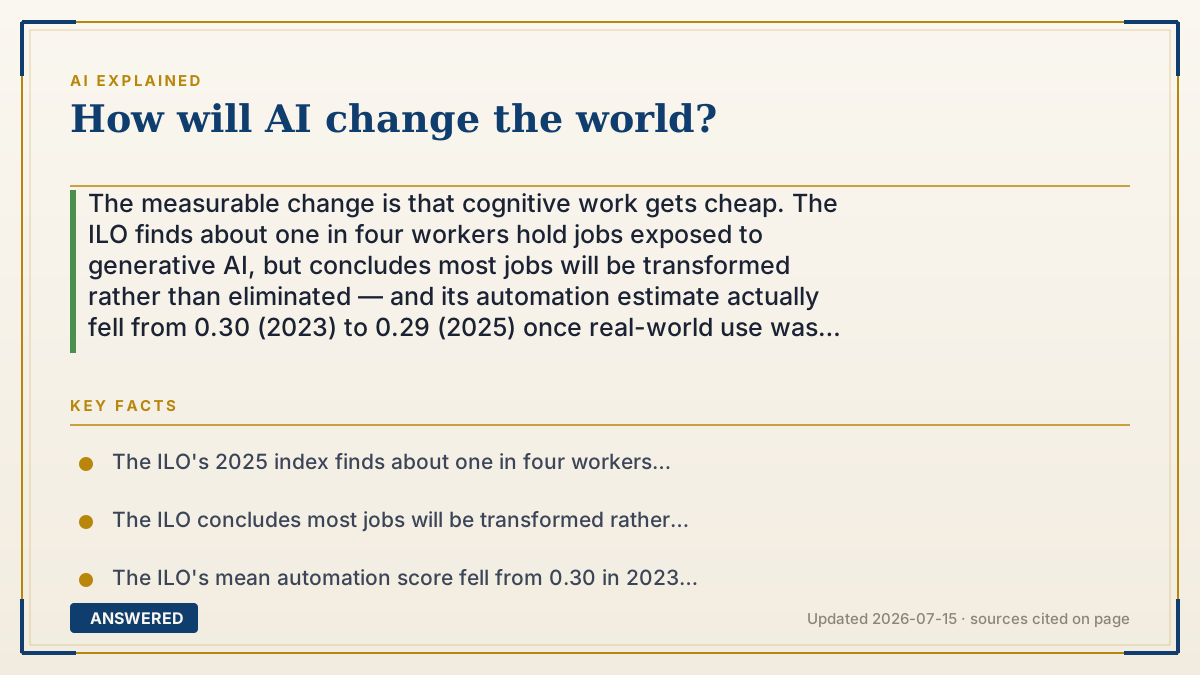
The measurable change is that cognitive work gets cheap. The ILO finds about one in four workers hold jobs exposed to generative AI, but concludes most jobs will be transformed rather than eliminated — and its automation estimate actually fell from 0.30 (2023) to 0.29 (2025) once real-world use was measured. Expect tasks to shift faster than jobs disappear.
Why — the first-principles explanation
Every general-purpose technology does one thing: it makes something previously expensive nearly free, and then everything reorganizes around the new price. Steam made physical power cheap. Semiconductors made calculation cheap. The internet made distribution cheap. AI makes a specific kind of cognitive work cheap — drafting, summarizing, translating, classifying, generating a first version of almost anything. That's the whole engine. Everything downstream follows from it.
When something becomes nearly free, three things happen with near-certainty. First, we use vastly more of it than we did when it was expensive — the same way cheap photography meant people take 500 pictures of a birthday instead of 12. Second, its price collapses, so nobody makes a living selling the thing itself. Third — and this is the part people miss — value migrates to whatever is now the bottleneck. When drafting is free, the scarce goods become judgment (which draft is right), verification (is it true), distribution (who sees it), and trust (who believes you). Those aren't things AI supplies.
That's why the labor prediction is subtler than the headlines. The ILO's 2025 index, built from nearly 30,000 task-level assessments, found roughly one in four workers are in occupations with some generative-AI exposure — but exposure means tasks inside the job change, not that the job vanishes. Their conclusion is explicit: most jobs will be transformed rather than made redundant, because human involvement is still required. The strongest evidence here is the direction of the revision. Between 2023 and 2025 the ILO's mean automation score went down, from 0.30 to 0.29, after they folded in how the tools actually performed for real users. Theoretical capability outran practical deployment. That's the opposite of what almost every 2023 forecast assumed, and it should make you distrust any confident number in either direction.
What's genuinely uncertain, and where honest people disagree: whether this is a normal general-purpose technology (electricity — huge, slow, absorbed over decades) or a discontinuity (something that automates the process of invention itself). Nobody knows. What's not uncertain is the near-term shape: harms and gains arriving through ordinary channels. Fraud scaling because generation is cheap — the FTC's Operation AI Comply documented schemes with at least $25 million in alleged consumer losses. Bias arriving statistically, not deliberately — seven AI detectors flagged non-native English essays 61.3% of the time while native-speaker essays passed nearly perfectly. The world doesn't change because a machine wakes up. It changes because a cost fell, and everything downstream reorganized around the new price.
An example that makes it click
Think about what happened when cameras got free. In 1990 film cost money, so you took twelve photos at a birthday and each one mattered. Today you take five hundred. Photography didn't disappear — it exploded. But the job of photography changed completely. Nobody pays for a picture of a birthday anymore, because everyone has five hundred. They pay for the wedding photographer's eye: knowing which moment matters, and which four hundred and ninety-six shots to throw away.
The camera never took the judgment. It took the scarcity.
AI is doing this to writing, coding, analysis, and design at once. Expect the same shape: an explosion of output, a collapse in the price of output, and a scramble to figure out who can tell the good ones from the bad ones. That last skill just became the whole job.
Key facts
- The ILO's 2025 index finds about one in four workers worldwide are in occupations with some degree of generative-AI exposure.
- The ILO concludes most jobs will be transformed rather than made redundant, because continued human involvement is required.
- The ILO's mean automation score fell from 0.30 in 2023 to 0.29 in 2025 — the estimated risk went down after refining with real-user data.
- The 2025 ILO index draws on human and AI assessment across nearly 30,000 tasks at detailed occupational levels.
- The FTC's Operation AI Comply (September 25, 2024) documented AI-branded fraud at scale, including alleged consumer losses of at least $25 million in the Ascend Ecom case.
- Bias arrives statistically rather than deliberately: seven AI detectors misclassified non-native English essays as AI-generated 61.3% of the time versus near-perfect accuracy on native-speaker essays (Patterns, 2023).
▶ The 60-second explainer (script)
How will AI change the world? Skip the robot predictions. Here's the actual mechanism. Every general-purpose technology makes one expensive thing nearly free, and then everything reorganizes around the new price. Steam made power cheap. Chips made calculation cheap. The internet made distribution cheap. AI makes cognitive work cheap — drafting, summarizing, translating, generating a first version of almost anything. That's the whole engine. And when something becomes free, three things always follow. We use way more of it. Its price collapses, so nobody sells it. And value moves to whatever's now the bottleneck — judgment about which output is right, verification that it's true, distribution, and trust. AI doesn't supply any of those. Now the jobs question, honestly. The International Labour Organization's 2025 index, built from nearly thirty thousand task assessments, found about one in four workers are in occupations exposed to generative AI. But exposed means tasks change — not that the job vanishes. Their conclusion: most jobs get transformed, not made redundant. And here's the detail nobody quotes. Between 2023 and 2025, their automation estimate went down. Zero-point-three-zero to zero-point-two-nine. After they measured how the tools actually performed for real people. Theoretical capability outran real deployment. That should make you skeptical of confident numbers in either direction. Think of cameras. Film was expensive, so you took twelve photos. Now you take five hundred. Photography exploded — but nobody pays for a picture anymore. They pay for the eye that knows which one matters. AI is doing that to writing, coding, and analysis at the same time.
What authoritative sources say
People also ask
Will AI take most jobs?
The best institutional estimate says no. The ILO finds about one in four workers are in exposed occupations but concludes jobs will mostly be transformed rather than eliminated. Notably, their automation estimate fell slightly from 2023 to 2025 once real-world performance was measured.
What's the single biggest change AI makes?
Cognitive work becomes cheap to produce. Everything else — the flood of content, the collapse in what output is worth, the premium on judgment and verification — follows from that one price change.
Which jobs are most exposed?
Clerical work ranks highest for automation potential — data entry, payroll, typing. The 2025 ILO update also raised exposure for media and web occupations because of advances in voice, image, and video generation.
Is AI an existential risk?
Genuinely contested, and nobody has evidence that settles it. What's documented right now is mundane by comparison: fraud scaling because generation is cheap, and bias arriving as a statistical residue of training data. Those are measurable today; the long-run question isn't.
Why do AI predictions disagree so much?
Because they measure different things. Task exposure isn't job loss, theoretical capability isn't deployment, and per-task studies don't aggregate to an economy. The ILO's own downward revision — after adding real-user data — shows how much the boundary you pick drives the number you get.
The same question, asked other ways
- How AI will change the world?