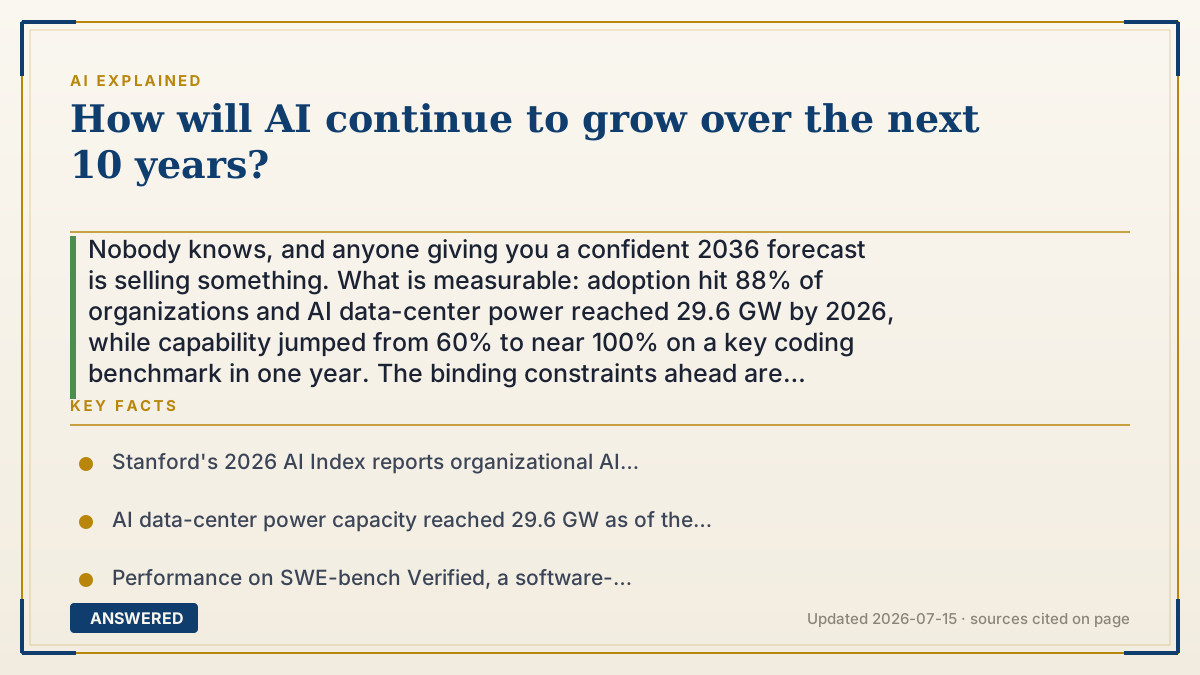
How will AI continue to grow over the next 10 years?
Nobody knows, and anyone giving you a confident 2036 forecast is selling something. What is measurable: adoption hit 88% of organizations and AI data-center power reached 29.6 GW by 2026, while capability jumped from 60% to near 100% on a key coding benchmark in one year. The binding constraints ahead are electricity, capital, and data — not ideas.
Why — the first-principles explanation
Ten-year technology forecasts have a terrible track record, so the honest approach is to reason about constraints rather than predictions. What is running out is more knowable than what will be invented. Right now the field grows by scaling three inputs: compute, data, and capital. Each has a physical ceiling that is coming into view.
Electricity is the hard one. Stanford's 2026 AI Index puts AI data-center power capacity at 29.6 GW — roughly what it takes to power New York State at peak. Power plants and transmission lines take 5–10 years to build, while a data center takes about 18 months. That mismatch, not model architecture, is the realistic governor on the next decade. When people ask what limits AI, the answer is increasingly grid interconnection queues and turbine backlogs.
Capital is the second. Google alone reported over $150 billion in annual capex in 2025, and frontier labs are spending ahead of revenue. This is the part most likely to break, and it does not require AI to fail — it only requires returns to arrive slower than the spending schedule assumed. Historically, infrastructure booms overbuild, correct hard, and leave the infrastructure behind. Railways and fiber both did exactly this. A capital correction would be violent for investors and barely noticeable in the underlying capability trend.
Data is the third. High-quality human text is finite and largely consumed. The field's response — synthetic data, reinforcement learning on verifiable tasks, longer reasoning at inference time — is why gains have shifted toward domains with checkable answers. That is precisely why SWE-bench Verified went from 60% to near 100% in a single year: code can be automatically graded. Expect the pattern to continue — fast progress where correctness is machine-checkable, slow progress where it is a matter of judgment.
So the defensible shape of the next decade: capability keeps improving but unevenly, tilted toward verifiable domains; deployment lags capability by years because organizations change slowly; energy and capital become the actual battleground; and measurement gets harder — the AI Index itself notes capabilities are advancing faster than our ability to measure and manage them. Anyone naming a year for AGI is expressing a belief, not a finding.
An example that makes it click
Think about electricity in 1900. Someone asking "how will electricity grow in ten years?" would have gotten wild answers, and the honest reply would have been: the physics is settled, the bottleneck is copper wire and generating stations, and it'll show up unevenly — factories first, farms decades later.
That's roughly where AI is. The interesting question isn't whether the technology works. It's how fast you can pour concrete, string transmission lines, and get a turbine delivered. In 1910, the limit on electric light wasn't a better bulb. It was whether a line reached your street. Today the limit on AI isn't a cleverer model. It's whether a substation reached the data center.
Key facts
- Stanford's 2026 AI Index reports organizational AI adoption reached 88%, with generative AI used in at least one business function at 70% of organizations.
- AI data-center power capacity reached 29.6 GW as of the 2026 AI Index — approximately the peak power demand of New York State.
- Performance on SWE-bench Verified, a software-engineering benchmark, rose from roughly 60% to near 100% within a single year.
- Google reported more than $150 billion in annual capital expenditure in 2025 as major cloud providers accelerated AI infrastructure spending.
- Four in five university students now use generative AI, per the 2026 AI Index.
- The 2026 AI Index states explicitly that AI capabilities are advancing more quickly than our ability to measure and manage them.
▶ The 60-second explainer (script)
How will AI grow over the next ten years? Honest answer: nobody knows, and anyone handing you a confident 2036 forecast is selling something. Ten-year tech predictions have a miserable track record. So let's do the useful thing instead — reason about constraints. What's running out is more knowable than what gets invented. AI grows by scaling three things: compute, data, and capital. All three are hitting physical ceilings. Electricity is the hard one. Stanford's AI Index puts AI data-center power at twenty-nine point six gigawatts — roughly what it takes to run New York State at peak. Here's the problem: a data center takes eighteen months to build. A power plant and transmission lines take five to ten years. That mismatch is the real governor on this decade. Not model architecture. Turbine backlogs and interconnection queues. Capital's next. Google alone reported over a hundred and fifty billion in capex in 2025. That's the part most likely to break — and it doesn't require AI to fail. It just requires returns to show up slower than the spending assumed. Railways did this. Fiber did this. You overbuild, you correct hard, and the infrastructure stays. Then data. High-quality human text is largely used up. Which is why progress has tilted toward things you can automatically grade — that's why a coding benchmark went from sixty percent to nearly a hundred in one year. Code can be checked by a machine. Taste can't. So expect that split to widen. Fast where correctness is checkable. Slow where it's judgment.
What authoritative sources say
People also ask
Will AI reach human-level intelligence in 10 years?
No one knows. Expert surveys produce wildly scattered dates, the term itself lacks an agreed definition, and there is no measurement we could use to settle it. Treat specific years as opinions.
Is the AI boom a bubble?
Investment is running ahead of revenue at frontier labs, which is the classic setup for a correction. But infrastructure booms that correct — railways, fiber — still left the infrastructure behind. A financial bust and a technology failure are different things.
What's the biggest bottleneck?
Electricity. AI data centers reached 29.6 GW of capacity, and grid buildout takes 5–10 years against roughly 18 months for a data center. Power, not algorithms, is the near-term governor.
Where will AI improve fastest?
Domains where answers can be automatically verified — code, math, formal reasoning — because models can be trained against a grader. Progress is slower where quality is a matter of judgment.
Will AI take jobs?
The evidence so far shows task-level change rather than wholesale job elimination, and credible economists disagree sharply about the scale. Anyone quoting one precise number is ignoring the spread between the estimates.