Is AI a bubble?
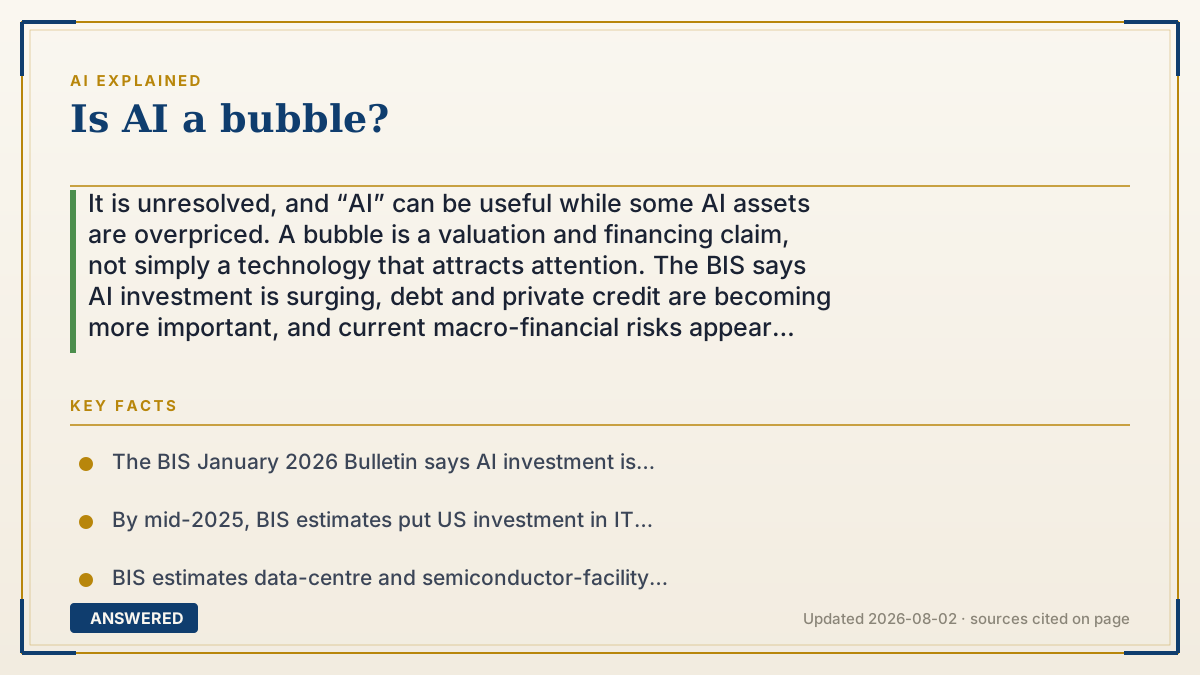
It is unresolved, and “AI” can be useful while some AI assets are overpriced. A bubble is a valuation and financing claim, not simply a technology that attracts attention. The BIS says AI investment is surging, debt and private credit are becoming more important, and current macro-financial risks appear moderate—but the boom’s sustainability depends on AI firms meeting high earnings expectations. Test the thesis with cash flows, leverage, adoption and downside scenarios, not a headline or a ticker.
Why — the first-principles explanation
Separate four questions that are often collapsed into “the AI bubble.” First, is the technology useful? A useful technology can still be sold at an irrational price. Second, are public and private valuations consistent with plausible future cash flows? That is an estimate, not a present fact. Third, how is the infrastructure financed? Cash, equity and debt create different failure paths if returns disappoint. Fourth, how much of the current macro economy depends on continued investment?
The BIS Bulletin “Financing the AI boom: from cash flows to debt” provides measurable evidence for the financing and macro questions. By mid-2025, US expenditures on IT manufacturing facilities and data centres were equivalent to about 1% of GDP, while total IT-related investment including other equipment and software reached about 5% of GDP. Data-centre and semiconductor-facility investment contributed an average 0.4 percentage points to US GDP growth over the subsequent three years; total IT investment accounted for almost half of GDP growth in recent quarters. Those are investment and contribution measures, not proof of future profits.
The financing signal is more cautionary. The BIS reports that outstanding private-credit loans to AI-related sectors grew from near zero to over $200 billion, rising from less than 1% to almost 8% of outstanding private-credit loan volumes; it estimates around $300–600 billion by 2030 under projected investment growth. The BIS says macroeconomic and financial stability risks appear moderate, but warns that the boom’s sustainability hinges on high earnings expectations and notes a disconnect between debt pricing and equity valuations. Debt does not prove a bubble; it increases the cost of being wrong.
A useful conclusion can therefore be conditional: real infrastructure, genuine scientific progress, excessive valuations and future distress can coexist. The 1990s telecom buildout left useful fibre after many investors lost money. Do not ask for a yes/no prophecy. Ask what revenue, margins, utilization, cash flow and refinancing assumptions must be true—and what happens if each one misses.
An example that makes it click
Imagine a company building a data centre. The building, chips, power connection and customers are real. If the centre earns enough to cover operating costs, depreciation and financing, the investment may be productive. If utilization or pricing disappoints, an all-cash owner may take a lower return while a heavily indebted owner still owes lenders. The same infrastructure can be useful to customers and a poor investment at its purchase price. That is why “AI works” and “AI is a bubble” are not opposites.
How to do it
- Define the claim: are you asking about model capability, a company’s valuation, private-market funding, infrastructure spending or the wider economy?
- Separate observed facts from forecasts. Record the date, source, geography and definition for every number before comparing it with a price or valuation.
- Read the business evidence: recurring revenue, customer retention, gross margin, cash flow, capital expenditure, depreciation, backlog and concentration.
- Map the infrastructure economics: data-centre utilization, power and cooling costs, chip replacement, network constraints, lease terms and who bears stranded-asset risk.
- Trace financing: operating cash flow, equity issuance, corporate bonds, leases, private credit, guarantees and off-balance-sheet structures.
- Stress-test the thesis with slower adoption, lower prices, model substitution, higher energy costs, delayed construction, regulation and a refinancing shock.
- Compare equity and debt signals. Different risk pricing can reveal disagreement, but it is evidence to investigate—not proof that one market is correct.
- Check the adoption denominator. “Users,” pilots, revenue, production deployments and accepted outcomes measure different things and should not be added together.
- Set a valuation and concentration rule before buying or committing capital. A good technology thesis does not remove portfolio, liquidity or tax risk.
- Revisit the evidence as earnings and filings arrive. If the required assumptions stop holding, reduce exposure or change the thesis; do not average down solely because the technology is important.
Key facts
- The BIS January 2026 Bulletin says AI investment is surging and accounts for a substantial share of economic growth, while the boom’s sustainability depends on high earnings expectations.
- By mid-2025, BIS estimates put US investment in IT manufacturing facilities and data centres at about 1% of GDP and total IT-related investment at about 5% of GDP.
- BIS estimates data-centre and semiconductor-facility investment contributed an average 0.4 percentage points to US GDP growth over the three years after 2022; total IT investment accounted for almost half of GDP growth in recent quarters.
- Outstanding private-credit loans to AI-related sectors grew from near zero to over $200 billion, and their share rose from less than 1% to almost 8% of outstanding private-credit loan volumes.
- The BIS estimates private credit to AI-related firms could reach around $300–600 billion by 2030 under projected AI-investment growth; this is a scenario estimate, not a guarantee.
- The BIS says current macroeconomic and financial-stability risks from the AI boom appear moderate, while warning that a failure to meet expected returns could produce sharp corrections.
- The BIS identifies a disconnect between debt pricing and equity valuations: loan spreads on AI-related private-credit loans are close to other loans while equity valuations imply outsized future returns.
- Stanford’s 2026 AI Index says technical capabilities, investment and adoption are rising while data transparency and governance preparedness lag, making independent measurement more important.
- A useful technology and a bad investment can coexist. Cash flows, valuation, leverage, utilization and refinancing—not the word “AI”—determine the investment outcome.
- A thematic forecast is not personal financial advice. Country, account, tax, liquidity and suitability rules differ; use current filings and qualified local advice for an actual decision.
Test the AI thesis before taking concentration risk
Separate technology utility, valuation, financing and macro exposure before acting on a bubble headline.
▶ The 60-second explainer (script)
Is AI a bubble? The honest answer is unresolved. Separate four questions: Is the technology useful? Are valuations supported by plausible future cash flows? How is infrastructure financed? How much of the economy depends on continued spending? The BIS says AI investment is surging, private credit to AI-related sectors has risen from near zero to over two hundred billion dollars, and current stability risks appear moderate. But it also says sustainability depends on high earnings expectations and highlights a disconnect between debt pricing and equity valuations. That is caution, not a verdict. Real infrastructure, useful models, excessive prices and investor losses can coexist. Test revenue, margins, utilization, leverage and refinancing assumptions. A technology thesis is not an investment thesis, and a useful data centre can still be a bad purchase at the wrong price.
What authoritative sources say
People also ask
Is AI definitely a bubble?
No reliable source can prove that ex ante. The technology can be useful while some assets are overpriced. Check whether earnings, cash flows, utilization and financing assumptions support the valuation.
What would prove the AI boom is not a bubble?
Sustained revenue, margins, cash flow and productive utilization that meet or exceed the expectations embedded in prices. Adoption headlines alone are not enough.
Why does debt financing matter?
Debt must be repaid even when returns disappoint. Leverage can turn a lower-than-expected return into distress, especially for long-lived data-centre assets and opaque private-credit structures.
Can AI be a bubble and still change the world?
Yes. A buildout can leave useful infrastructure after investors lose money, as the telecom example illustrates. Social value and the price paid for exposure are different questions.
What does equity pricing running ahead of debt pricing mean?
The two markets are assigning different risk assumptions to related companies. The BIS treats that gap as a tension worth investigating, not as proof that stocks or bonds are correct.
Is current AI investment large enough to affect the economy?
BIS estimates US data-centre and IT-manufacturing investment at about 1% of GDP by mid-2025 and says total IT investment contributed materially to recent growth. That measures economic exposure, not future profitability.
What is private credit’s role in AI?
BIS reports rapidly growing private-credit lending to AI-related sectors. It can finance asset-heavy projects, but private credit is less transparent than public markets and can amplify losses if underwriting or assumptions fail.
Does Stanford’s AI Index say there is a bubble?
No. It documents capability, investment, adoption and governance trends. Use it to understand the ecosystem, not as a buy or sell signal.
Should I sell all my AI investments?
That depends on your portfolio, taxes, time horizon, liquidity and risk tolerance. A general page cannot set a personal allocation; review concentration and downside with a qualified local professional.
What is the simplest bubble test for a company?
Write down what revenue, margin, cash flow, capital spending, utilization and refinancing assumptions must be true. Then compare each assumption with filings and independent evidence.
Is this investment advice?
No. It is a dated research framework using BIS, Stanford and IEA sources. It does not recommend a security, fund, allocation or trade.
The same question, asked other ways
- Is there an AI bubble?