What are the pros and cons of AI in education?
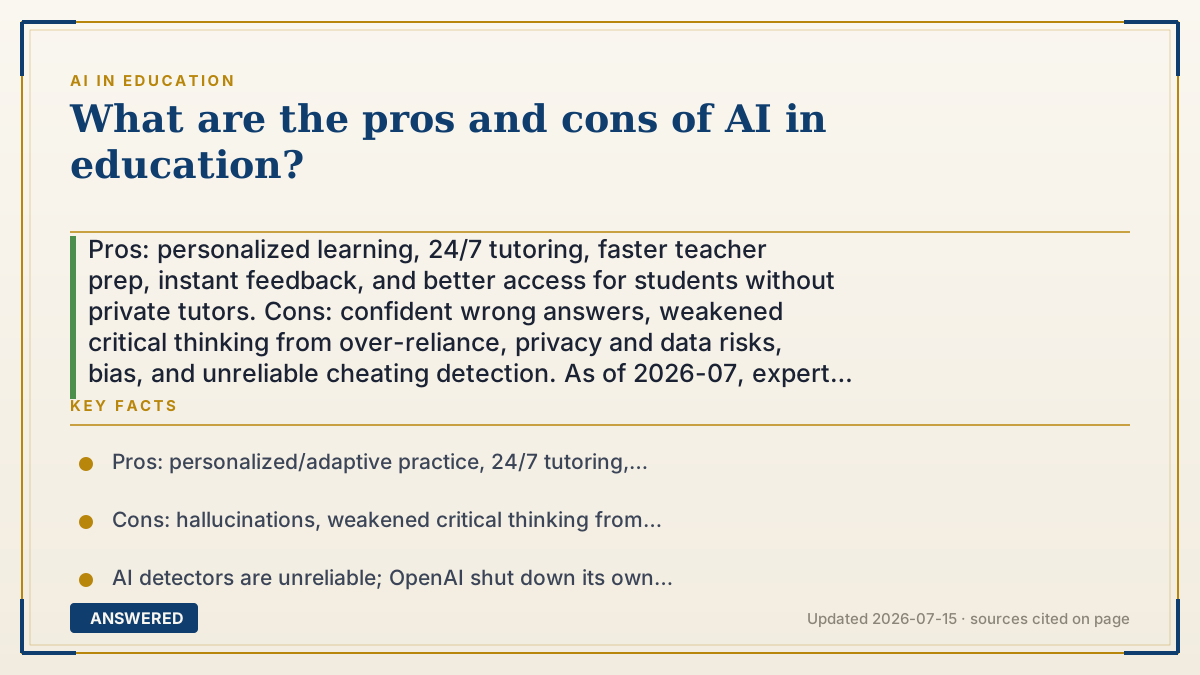
Pros: personalized learning, 24/7 tutoring, faster teacher prep, instant feedback, and better access for students without private tutors. Cons: confident wrong answers, weakened critical thinking from over-reliance, privacy and data risks, bias, and unreliable cheating detection. As of 2026-07, experts say the pros win only when a human stays in the loop.
Why — the first-principles explanation
Every pro and con traces back to how the technology works. AI language models generate fluent text by predicting likely words from massive datasets. That makes them fast, tireless, and endlessly patient, which is where the pros come from, and it also makes them prone to plausible-sounding errors and to echoing the biases in their training data, which is where the cons come from. You can't get one side without the other; they're two faces of the same mechanism.
The pros are about scale, speed, and access. A single model can give every student personalized practice, explain a topic five different ways at midnight, cut a teacher's prep time, and deliver instant feedback so students revise before grading. Historically, that kind of one-on-one attention cost money; AI can spread it more widely.
The cons are about trust, effort, and data. Because it can be confidently wrong, learners may absorb errors. Because it can do the work for you, over-reliance can short-circuit the effortful thinking that builds real skill. Student data flowing to outside companies raises privacy concerns, and cheating detectors are unreliable enough to falsely accuse honest students. The consistent expert conclusion, echoed by the Department of Education, is that these tools are a net positive only when a human stays in the loop to check accuracy, protect data, and keep students thinking.
An example that makes it click
Think of AI in education like fast food for the brain. It's quick, cheap, always open, and it fills you up, which is genuinely useful when you're short on time. That's the pro. But if it becomes your only diet, you miss the slow, effortful nutrition that actually makes you strong. That's the con.
A student who uses AI to get unstuck and then does the work is eating well. A student who lets AI do every assignment is living on drive-thru. Same convenient window; very different outcomes for the body, or here, the mind.
Key facts
- Pros: personalized/adaptive practice, 24/7 tutoring, faster prep, instant feedback, wider access to tutoring-style help.
- Cons: hallucinations, weakened critical thinking from over-reliance, privacy/data risks, and bias.
- AI detectors are unreliable; OpenAI shut down its own classifier in 2023 for low accuracy (26% true positives).
- The U.S. Department of Education's 2023 report says AI should augment teachers with humans in the loop.
- Benefits depend on human oversight; unchecked use amplifies the harms.
▶ The 60-second explainer (script)
What are the pros and cons of AI in education? Both come from the same source: AI generates fluent text by predicting likely words, which makes it fast and patient, and also prone to confident mistakes. Start with the pros. It personalizes practice for each student, tutors any time of day, cuts teacher prep, and gives instant feedback so kids can revise before a grade. It spreads one-on-one help that used to cost money. Now the cons. It can be confidently wrong, so students may absorb errors. It can do the work for you, and over-reliance skips the effort that builds real thinking. Student data raises privacy concerns, there's bias baked into training data, and cheating detectors are so unreliable that OpenAI shut down its own in 2023. Notice the pattern: the pros show up with human oversight, and the cons grow without it. That's why the U.S. Department of Education says AI should support teachers, with a human always in the loop. Fast food for the brain: great in a pinch, dangerous as your whole diet.
What authoritative sources say
People also ask
What is the biggest pro of AI in education?
Personalized learning at scale: matching practice and feedback to each student, which one teacher can't do for a whole class alone.
What is the biggest con?
Over-reliance that weakens critical thinking, plus confident wrong answers that students may believe without checking.
Do the pros outweigh the cons?
Experts say yes, but only when a human stays in the loop to verify accuracy, protect data, and keep students doing the thinking.
Is AI bias a real problem in education?
Yes. Models can reflect biases in their training data, so outputs need review, especially in grading and examples.