Which local AI model is best for homework help?
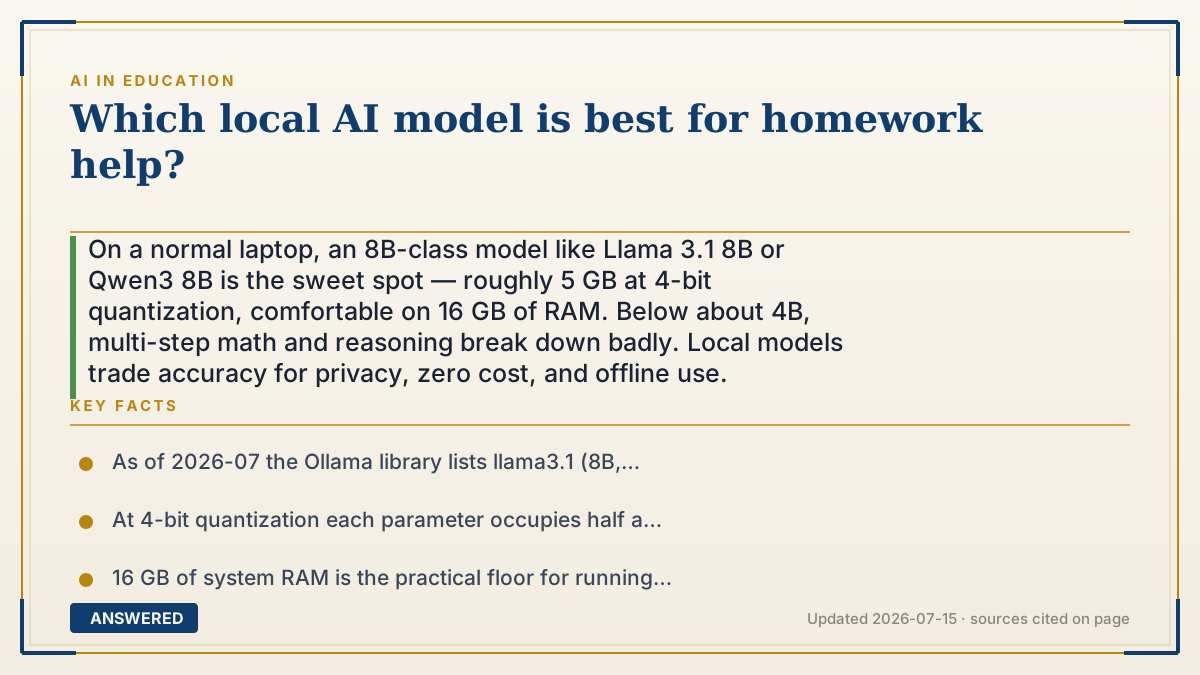
On a normal laptop, an 8B-class model like Llama 3.1 8B or Qwen3 8B is the sweet spot — roughly 5 GB at 4-bit quantization, comfortable on 16 GB of RAM. Below about 4B, multi-step math and reasoning break down badly. Local models trade accuracy for privacy, zero cost, and offline use.
Why — the first-principles explanation
The answer is decided by one hard physical constraint: the model's weights must fit in your memory. At 4-bit quantization each parameter takes half a byte, so the arithmetic is simple — roughly 0.5 GB per billion parameters, call it 0.6 GB with overhead. An 8B model is about 4.5-5 GB. A 70B model is about 40 GB and is simply not happening on a normal laptop. Your RAM is a wall, not a preference, and it determines what "best" can even mean for you. The best local model is the largest one that fits with room left over for your operating system and the conversation itself.
Why does size matter so much for homework specifically? Small models are perfectly fine at reshaping text — summarizing a chapter, rephrasing a paragraph, defining a term. They fall apart on multi-step reasoning, because errors compound. Every step in a derivation is another chance to go wrong, and a wrong step doesn't announce itself; the model keeps going confidently. A 1B model will hand you a wrong derivative in beautifully formatted LaTeX. That's the worst possible failure mode for homework: fluent and wrong is harder to catch than obviously broken. This is why the jump from 3B to 8B matters more than the jump from 8B to 14B for most schoolwork.
What local actually buys you is worth being clear about, because it's not quality. It's that nothing leaves the machine — genuinely relevant for a kid's schoolwork and for any school worried about student data — plus no subscription and no internet needed. What it costs you is real too: an 8B model running on your laptop is meaningfully behind current frontier models at exactly the hard things — competition math, long proofs, tricky physics. Anyone who tells you a local 8B matches a frontier model on hard reasoning is selling something. Local wins when the binding constraint is privacy, cost, or connectivity. It loses when the constraint is being right about hard problems.
As of 2026-07, the practical shortlist on Ollama: llama3.1 (8B), qwen3 (8B or 14B), gemma3 (4B or 12B), phi4 (14B), and deepseek-r1 distills. The reasoning-tuned variants — deepseek-r1, qwen3's thinking mode — do noticeably better on math because they generate an explicit chain of steps before answering, but that costs time and tokens. Match to hardware: 8 GB RAM → a 3-4B model, and check its math; 16 GB → 8B, the sweet spot; 32 GB or more → 14B and up.
An example that makes it click
A local model is a thick paperback encyclopedia in your backpack. A frontier model is calling a professor. The paperback is always with you, costs nothing after you buy it, works in a basement with no signal, and nobody ever finds out what you looked up. It is also, unavoidably, thinner.
For "what is photosynthesis," the paperback and the professor give you the same answer, and the paperback gives it faster. For "is my proof valid," you want the professor. The mistake is assuming that because the paperback nailed photosynthesis, it can check your proof — it will answer either way, and it will sound equally confident both times.
How to do it
- Check your RAM first — it decides everything. 8 GB means a 3-4B model; 16 GB means 8B; 32 GB or more opens up 14B and larger.
- Install a local runner. Ollama is the most common and handles downloading and quantization for you.
- Pull an 8B-class general model to start: llama3.1:8b or qwen3:8b. This is the best default for mixed homework.
- For math and science, try a reasoning-tuned model (a deepseek-r1 distill, or qwen3 in thinking mode) and accept that answers take longer because it writes out its steps.
- Keep the context window modest — around 4k tokens on a 16 GB CPU-only machine — or long conversations will exhaust RAM and slow to a crawl.
- Verify every number. Ask it to show its steps, then check the steps yourself — which is the homework anyway, and the only use of it that isn't cheating.
Key facts
- As of 2026-07 the Ollama library lists llama3.1 (8B, 70B, 405B), llama3.2 (1B, 3B), qwen3 (0.6B through 235B), gemma3 (270M through 27B), phi4 (14B), mistral (7B) and deepseek-r1 (1.5B through 671B)
- At 4-bit quantization each parameter occupies half a byte, so weights need roughly 0.5-0.6 GB per billion parameters: an 8B model is about 4.5-5 GB on disk and in memory
- 16 GB of system RAM is the practical floor for running an 8B model comfortably alongside an operating system and a browser
- Local models run entirely offline — no schoolwork data is transmitted to any company's servers
- Reasoning-tuned models (deepseek-r1 distills, qwen3 thinking mode) improve multi-step math accuracy by generating explicit intermediate steps, at the cost of speed
- 54% of students reported using AI for schoolwork in winter 2025, but only 19% said a teacher had taught them how to use it (RAND, 2025)
Check local model availability
Model support and hardware fit vary; use the official library to verify what can run locally before installing.
▶ The 60-second explainer (script)
Which local AI model is best for homework? For most laptops: an 8B model — Llama 3.1 8B or Qwen3 8B. Here's why, and it's just physics. The model's weights have to fit in your memory. At 4-bit quantization, each parameter is half a byte, so you need roughly half a gig per billion parameters. An 8B model is about five gigabytes. A 70B model is forty — not happening on your laptop. Your RAM is a wall. So the best model is the biggest one that fits with room to spare. Why does size matter for homework specifically? Small models are fine at summarizing and rephrasing. They collapse on multi-step math, because every step is a chance to go wrong and the errors compound. A 1B model will give you a wrong derivative in perfect formatting. That's the worst case — fluent and wrong is harder to catch than obviously broken. Match it to your machine: 8 gigs, run a 3 to 4B; 16 gigs, run an 8B; 32 or more, go to 14B. For math, try a reasoning model like a deepseek-r1 distill — it writes out its steps, which is slower but much better. And be honest about the tradeoff. Local gets you privacy, zero cost, and offline. It does not get you frontier-level math. Check every number it gives you. That's the homework anyway.
What authoritative sources say
People also ask
Can a local model do my math homework?
It can attempt it, and an 8B model handles routine algebra reasonably. It will still make confident arithmetic and multi-step reasoning errors, so treat every numeric answer as a draft to check rather than a result to copy.
Is a local model as good as ChatGPT or Claude?
No, not on hard reasoning. An 8B model running on your laptop is meaningfully behind frontier models at competition math, long proofs, and tricky physics. It's competitive on summarizing, explaining basic concepts, and rephrasing.
Why run a model locally at all?
Three reasons: nothing you type leaves your machine, there's no subscription, and it works with no internet. For schoolwork privacy — especially for younger students — that first point is the main draw.
How much RAM do I really need?
16 GB is the practical floor for an 8B model with room for your OS. On 16 GB with CPU-only inference, keep the context window around 4k tokens; long chats grow memory use and can push you into swap.
Is using a local model to help with homework cheating?
That depends entirely on your school's policy, and only 34% of teachers report having one. Using it to explain a concept you're stuck on is generally fine; having it produce the work you submit is the thing rules target.