What is MagicSchool AI?
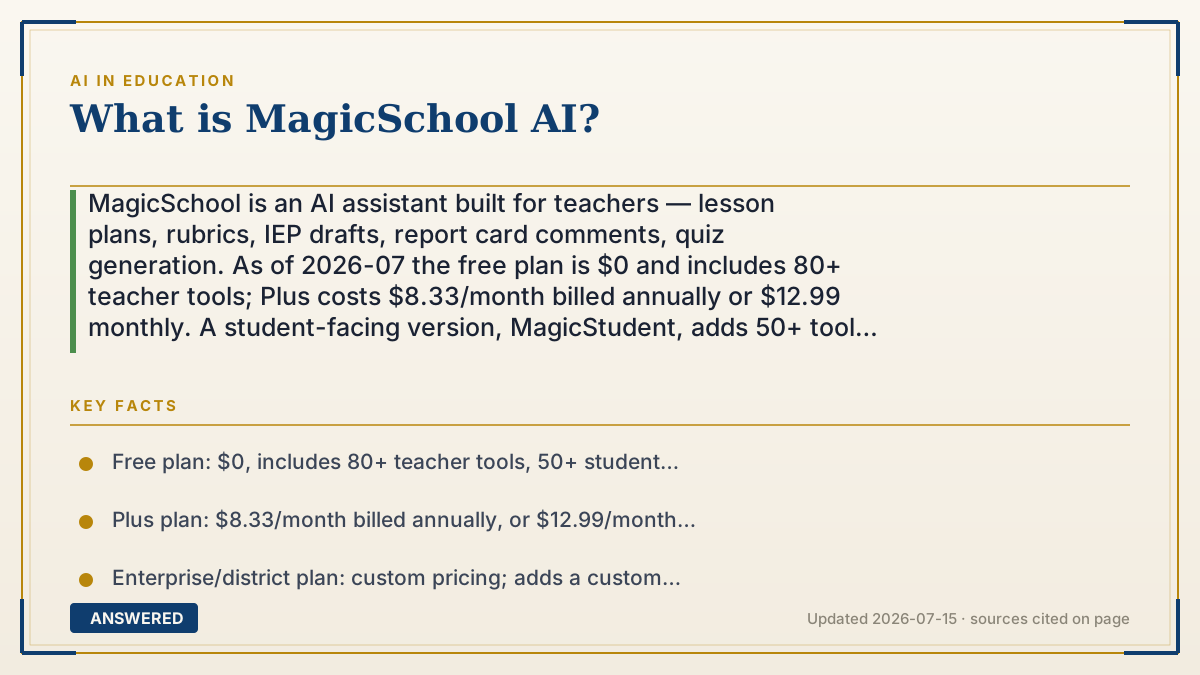
MagicSchool is an AI assistant built for teachers — lesson plans, rubrics, IEP drafts, report card comments, quiz generation. As of 2026-07 the free plan is $0 and includes 80+ teacher tools; Plus costs $8.33/month billed annually or $12.99 monthly. A student-facing version, MagicStudent, adds 50+ tools for teacher-led activities.
Why — the first-principles explanation
Under the hood, MagicSchool is a wrapper. It's a library of pre-written prompts running on top of general-purpose language models, wrapped in forms and organized by task. That sounds like a criticism; it isn't. It's the entire product. A teacher shouldn't have to become a prompt engineer to get a decent rubric, and MagicSchool's real value is that someone already wrote the prompt, tuned it for grade level and standards, and put a labeled box around it. Convenience is a legitimate thing to sell.
The obvious question is why this is a business at all when ChatGPT has a free tier. The answer is that the moat isn't the model — it's the institutional plumbing. A district cannot simply hand teachers a raw chatbot. It needs a custom data privacy agreement, single sign-on, rostering that syncs with Clever, ClassLink, Canvas or Schoology, admin controls over which tools students can touch, content safeguards, and a dashboard for whoever has to answer to the school board. That layer is what districts actually purchase. It's the same reason schools license plenty of software that is, technically, a thin shell over something cheaper.
How you should read its marketing claims matters. The site advertises "7-10 hours time saved per week," an "88%" figure for teachers saying it helps them reach every learner, and a "28% improvement in students meeting literacy grade-level expectations." These are vendor claims, not independent studies — published without methodology, sample size, or a control group. Treat them accordingly. The time-saving is plausible on its face, because the tasks it targets genuinely are repetitive and formulaic. The learning-outcome number is a different animal: a 28% improvement in literacy attainment is precisely the kind of claim that requires a controlled trial before anyone should repeat it, and one hasn't been published.
Finally, the constraints carry over. Because it runs on the same underlying models, it inherits the same failure mode: it can be confidently wrong. A generated rubric can misalign with a standard; a generated IEP draft can invent an accommodation that doesn't fit the student. That's the structural reason it's sold as teacher-facing, with a human reviewer in the loop — the teacher remains the accountable party, which is exactly how tools like this stay defensible in a school.
An example that makes it click
MagicSchool is to ChatGPT roughly what tax-prep software is to a blank spreadsheet. The arithmetic underneath is identical. You could do all of it yourself in the spreadsheet, for free, if you knew every form and never mistyped a line.
What you're paying for is that somebody already labeled the boxes, already knows which forms a teacher actually needs, and — the part districts care about most — won't let the intern see your neighbor's return. That last bit is the whole enterprise product.
Key facts
- Free plan: $0, includes 80+ teacher tools, 50+ student tools, the Raina chatbot, quizzes and class writing feedback, and basic support (as of 2026-07)
- Plus plan: $8.33/month billed annually, or $12.99/month billed monthly — adds unlimited generations, unlimited output history, unlimited AI-output editing, and MagicSchool Labs early access (as of 2026-07)
- Enterprise/district plan: custom pricing; adds a custom Data Privacy Agreement, SSO, integrations with Clever, ClassLink, Canvas and Schoology, tool management controls, and advanced dashboards
- Tools include a Lesson Plan Generator, Presentation Generator, Writing Feedback, Report Card Comments, Rubric Generator, IEP Generator, Multiple Choice Quiz Maker and an AI Tutor
- MagicStudent is the separate student-facing product, positioned for teacher-led AI learning activities
- Company marketing claims — "7-10 hours time saved per week," "88% of teachers say it helps them reach every learner," and a "28% improvement in students meeting literacy grade-level expectations" — are published without methodology, sample size or control group and have not been independently replicated
▶ The 60-second explainer (script)
What is MagicSchool AI? It's an AI assistant built specifically for teachers — lesson plans, rubrics, IEP drafts, report card comments, quiz generation. As of July 2026, the free plan is zero dollars and includes over eighty teacher tools. Plus is eight thirty-three a month billed annually, or twelve ninety-nine monthly. Districts get custom pricing. Under the hood, here's what it actually is: a wrapper. Pre-written prompts running on general-purpose language models, organized into labeled forms. That's not an insult — that's the product. A teacher shouldn't have to learn prompt engineering to get a usable rubric. So why is this a business when ChatGPT is free? The moat isn't the model. It's the plumbing. Districts need data privacy agreements, single sign-on, rostering that syncs with Clever and Canvas, admin controls over what students can touch. That's what schools are buying. Now, read the marketing carefully. The site claims seven to ten hours saved per week, and a twenty-eight percent improvement in students meeting literacy grade-level expectations. Those are vendor claims — no published methodology, no sample size, no control group. The time-saving is plausible; those tasks really are repetitive. The twenty-eight percent literacy number needs a controlled trial before anyone repeats it, and there isn't one. And because it runs on the same models, it inherits the same flaw: it can be confidently wrong. That's why the teacher stays in the loop.
What authoritative sources say
People also ask
Is MagicSchool free?
Yes, there's a genuine $0 tier that includes 80+ teacher tools and 50+ student tools as of 2026-07. The Plus plan ($8.33/month billed annually) mainly removes caps — unlimited generations, output history, and editing.
How is it different from just using ChatGPT?
It runs on general-purpose models, so the intelligence is similar. What you get is pre-written, education-tuned prompts in labeled forms, plus the district plumbing — data privacy agreements, SSO, rostering, and admin controls over student access.
Is the 28% literacy improvement claim reliable?
Treat it as marketing. It's a company-published figure with no methodology, sample size, or control group disclosed, and no independent replication. The time-savings claims are more plausible since the targeted tasks are genuinely repetitive.
Can students use it?
Yes, through MagicStudent, which the company positions for teacher-led activities with 50+ student tools. Districts on the Enterprise plan get controls over which tools students can access.
Can it make mistakes?
Yes. It inherits the errors of the models it runs on, so a generated rubric can misalign with a standard and an IEP draft can suggest an ill-fitting accommodation. It's designed teacher-facing precisely so a human reviews the output.