What is AI slop?
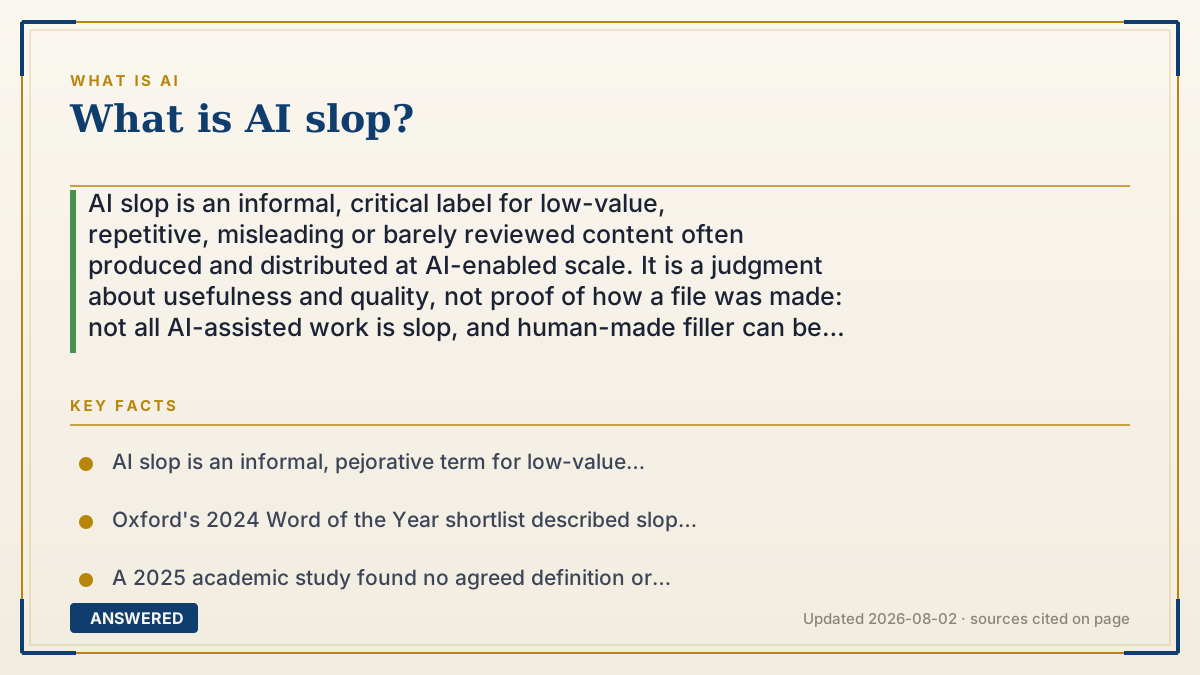
AI slop is an informal, critical label for low-value, repetitive, misleading or barely reviewed content often produced and distributed at AI-enabled scale. It is a judgment about usefulness and quality, not proof of how a file was made: not all AI-assisted work is slop, and human-made filler can be slop too.
Why — the first-principles explanation
Start with the category error. “AI slop” is not a reliable detector verdict and it is not a formal technical class. Oxford's definition describes content made with AI that is distributed indiscriminately or intrusively and viewed as low-quality, inauthentic or inaccurate. A 2025 research paper on measuring slop found no agreed definition or measurement method, and reported that judgments can be subjective. Use the term as a useful warning label, not as a scientific diagnosis.
The practical test is value. Ask whether the page is correct, relevant to a real audience, coherent, sufficiently specific, original enough to deserve its own URL, and reviewed by someone accountable for the result. Repetition, generic claims, invented citations, padded sections, mismatched examples and confident errors are common slop signals. None is conclusive by itself: a short templated weather update can be useful, while a long human-written article can be empty.
AI changes the economics by making plausible drafts cheap and fast. That can increase the temptation to publish every variation, but scale alone is not the verdict. One carefully edited AI-assisted page with original research can be valuable; one hundred pages stitched from the same generic outline may be useless even if a human clicked “publish.” The decision is whether each asset earns its existence for a reader.
For Google, this distinction is explicit. Google's guidance says generative AI is not automatically spam and can help with research or structure. Its scaled content abuse policy targets many pages produced primarily to manipulate rankings without adding value, regardless of whether the work came from AI, humans or both. The SEO risk is therefore a quality-and-purpose problem, not a hunt for an “AI writing percentage.”
Do not confuse three labels. AI-assisted content has a human goal, evidence and review. AI slop is content whose low value, inaccuracy, sameness or intrusive distribution outweighs its usefulness. Human slop is the same failure mode without AI in the production chain. The output—not the tool's brand—is what readers and search systems ultimately experience.
A lightweight editorial scorecard makes the idea operational: (1) every material claim has a source or is clearly framed as opinion, (2) the page adds firsthand evidence, original analysis or a useful synthesis, (3) the answer appears early and matches the query, (4) a reviewer checked facts and sensitive implications, (5) duplicate variants are consolidated, and (6) an owner and update date are recorded. A detector score can be one signal, but it cannot replace this review.
The best antidote is not to avoid AI. It is to reserve generation for leverage—outlines, clustering, transformations and first drafts—and spend the saved time on verification, judgment, original examples and editing. That is how AI becomes a production aid instead of a content factory.
An example that makes it click
Imagine a town where an automated press can print ten thousand pamphlets in a minute. A useful local guide still needs someone to attend the meeting, check the address and explain what residents should do. A pile of nearly identical pamphlets with exciting headlines does not become useful because the press is sophisticated. AI slop is that pile: the problem is low information value and indiscriminate distribution, not the existence of the press.
How to do it
- Define the reader and the job to be done. If you cannot say what decision, task or question the page serves, do not generate it yet.
- Collect primary sources, firsthand observations, product tests or internal data before asking AI for a draft. Give the model evidence to organize instead of asking it to invent authority.
- Extract every material claim from the draft and verify its date, number, quotation and link. Mark uncertainty explicitly and delete claims that cannot be supported.
- Add something only you can provide: an experiment, screenshot, comparison, process detail, original dataset, customer language or a defensible point of view.
- Edit for information density. Remove repeated introductions, generic advice, fake precision, filler headings and examples that do not match the reader's context.
- Have a human with relevant subject knowledge review accuracy, safety, tone and disclosure before publication. Do not use an AI-detector result as the sole approval gate.
- Consolidate near-duplicate pages and publish only when the page earns its own URL. For SEO, check that the purpose is serving users rather than manufacturing ranking variations.
- Record the source set, reviewer, owner and next review date. Measure helpful outcomes such as qualified conversions, task completion and corrections—not page count alone.
- For images, video and audio, apply the same test: accurate context, clear provenance where it matters, useful editing and no deceptive or intrusive distribution. Slop is not limited to text.
Key facts
- AI slop is an informal, pejorative term for low-value AI-associated content; it is not a settled scientific taxonomy.
- Oxford's 2024 Word of the Year shortlist described slop as AI-generated content distributed indiscriminately or intrusively and characterized as low-quality, inauthentic or inaccurate.
- A 2025 academic study found no agreed definition or measurement for text slop and reported that slop judgments can be subjective; it also found current LLMs unreliable as a sole slop judge in its evaluation.
- Not all AI-generated or AI-assisted content is slop. Human review, original evidence, accuracy, relevance and a real audience need can make AI-assisted work useful.
- Human-written content can be slop when it is generic, misleading, repetitive or distributed without regard for reader value.
- Common warning signs include unsupported claims, invented citations, repetitive structure, generic examples, low information density and a mismatch between headline and answer.
- Google says generative AI is not automatically spam; using it for research or structure can be appropriate when the resulting page is useful and reliable.
- Google's scaled content abuse policy covers many pages created primarily to manipulate rankings without adding value, whether produced by automation, humans or a combination.
- Google's AI-search guidance emphasizes foundational SEO, unique viewpoints and non-commodity helpful content; it does not offer an AI-content or GEO hack that substitutes for quality.
- A detector label or a few stylistic quirks cannot prove that a page is slop. Quality review should examine claims, evidence, usefulness, originality and distribution purpose.
Judge AI content by value, not by a detector label
Use AI to accelerate research and drafts, then verify claims, add original evidence and remove repetition before publishing. For search, the risk is low-value scale made to manipulate rankings—not the mere use of an AI tool.
▶ The 60-second explainer (script)
What is AI slop? It is an informal insult for low-value, repetitive, misleading or barely reviewed content that is often produced and pushed online at AI-enabled scale. It is not a detector verdict, and not every AI-assisted page is slop. A 2025 research study found no agreed definition or reliable measurement, so treat the term as a quality warning. Ask four questions: Is it accurate? Is it relevant to a real audience? Does it add original evidence or analysis? Did someone accountable review it? Google makes the SEO distinction clear: generative AI is not automatically spam. The risk is scaled content abuse—many pages made primarily to manipulate rankings without adding value—whether the author was AI, a human or both. Use AI for research, clustering, outlines and drafts. Spend the saved time on sources, firsthand examples, fact-checking, editing and consolidation. A detector score cannot replace that work.
What authoritative sources say
People also ask
What is AI slop in simple terms?
It is low-value, repetitive, misleading or barely reviewed content often made and distributed with AI at scale. The label describes the result and its distribution, not a proven authorship test.
Is all AI-generated content AI slop?
No. AI-assisted work can be useful when it answers a real need, uses verified evidence, adds original value and receives accountable human review.
How can I tell if something is AI slop?
Look for unsupported claims, invented citations, repeated sections, generic examples, low information density and a headline that promises more than the answer delivers. Check evidence and usefulness rather than relying on a detector score.
Is AI slop the same as spam?
They overlap but are not identical. Slop is an informal quality judgment across text, images, video and audio. Spam is a platform or policy category that also considers deceptive, intrusive or manipulative distribution.
Can human-written content be slop?
Yes. Generic, inaccurate or repetitive human writing can have the same low value. AI is often associated with slop because it makes high-volume production easier, not because the tool alone determines quality.
Does Google penalize AI content?
Google says AI use itself is not automatically spam. Its policy targets scaled content made primarily to manipulate rankings without adding value, whether produced by AI, humans or both.
Can AI detectors reliably identify AI slop?
No single detector can establish that a page is slop. The research literature reports disagreement about the definition and limits on automated judgments, so use source checks and human editorial review.
Is AI slop only written text?
No. The term is also used for low-value or deceptive AI-generated images, videos, audio, books and social posts. Apply the same tests: context, accuracy, originality, usefulness and responsible distribution.
How do I avoid creating AI slop for SEO?
Start with a real audience need, gather primary evidence, add original analysis, verify every claim, remove filler, consolidate duplicate pages and publish only when the page earns its own URL.
What is the fastest quality check before publishing AI-assisted content?
Read the answer as a skeptical user: underline every factual claim, open each important source, remove anything unsupported or generic, and ask a named reviewer whether the page is useful enough to recommend.