What jobs will AI replace?
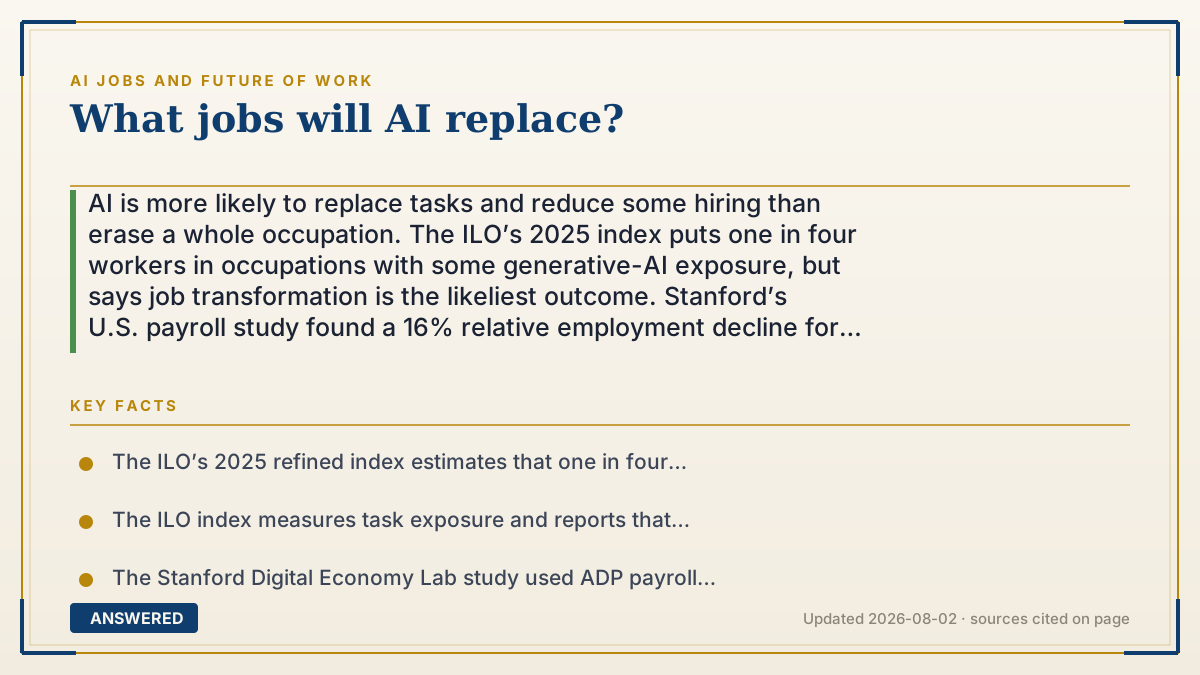
AI is more likely to replace tasks and reduce some hiring than erase a whole occupation. The ILO’s 2025 index puts one in four workers in occupations with some generative-AI exposure, but says job transformation is the likeliest outcome. Stanford’s U.S. payroll study found a 16% relative employment decline for 22–25-year-olds in the most exposed occupations; BLS projects overall U.S. employment to grow 3.1% from 2024 to 2034. Treat every forecast as conditional evidence, not a list of doomed jobs.
Why — the first-principles explanation
A job is a bundle of tasks, not a single switch marked replaceable. A customer-support specialist may draft a reply, search a policy, decide whether a refund is allowed, calm an upset customer, protect private data and take responsibility for the final decision. Generative AI may be good at the first two and unreliable or unauthorized for the rest. “AI can do part of this job” is therefore a much lower bar than “the occupation disappears.”
A useful risk model has four gates. First is exposure: can a system reduce the time or cost of a task while meeting the required quality? Second is adoption: will a specific employer buy, integrate and govern it? Third is economics: will lower unit cost create more demand, or will a fixed amount of work simply need fewer people? Fourth is accountability: who checks errors, handles exceptions, protects data and answers to a customer, regulator or patient? A task can pass the first gate and fail the other three.
The most directly exposed work tends to be digital, repetitive, language- or code-heavy, and easy to check: first drafts, routine classification, standard data extraction, basic summaries and predictable support. Work in physical or changing environments, care and interpersonal trust, negotiation, contextual judgment and consequential responsibility is usually harder to automate end to end. “Harder” does not mean safe: AI can still assist these roles, change their staffing mix or increase the amount of work expected from one person.
The current evidence has different apertures. The ILO’s 2025 global index finds one in four workers in occupations with some GenAI exposure, but only 3.3% of global employment in its highest exposure category and says transformation is more likely than full automation because most occupations still contain tasks requiring human input. The OECD similarly describes exposure as multidimensional and says actual effects depend on adoption, regulation, organizational change and social choices. These are exposure and policy measures, not probabilities that a named job will vanish.
Observed U.S. data can reveal a narrower shock. A Stanford Digital Economy Lab study using ADP payroll records through September 2025 found a 16% relative employment decline for workers aged 22–25 in the most AI-exposed occupations, with experienced workers more stable; the pattern was concentrated where AI use automated rather than augmented work. That is an important warning about entry-level hiring and the training ladder, but it is not a count of every job lost, a universal rate, or proof that AI alone caused every change. The Budget Lab at Yale’s current economy-wide snapshot found no discernible disruption in the 33 months after ChatGPT’s release and explicitly says the result is not a forecast. A concentrated entry-level effect and a stable national total can both be true.
Employer expectations are another category of evidence. The World Economic Forum’s 2025 Future of Jobs survey extrapolates 170 million jobs created and 92 million displaced by structural change by 2030, for a net gain of 78 million. Those numbers come from more than 1,000 employers’ expectations across 55 economies; they are not an observed list of layoffs, and the report combines AI with other forces such as demographics, the green transition, economic conditions and geoeconomic change.
For a personal decision, use official occupation data as a baseline rather than a viral ranking. The U.S. Bureau of Labor Statistics projects total employment to rise 3.1% from 2024 to 2034 and reports about 18.9 million annual openings across all occupations; that projection is not AI-specific, and openings include growth and replacement demand. Then inspect the target occupation’s actual tasks, adoption, quality bar, local demand and entry path. The actionable question is not “Will AI replace my job?” but “Which tasks are changing, what evidence would show a real staffing effect, and which skills let me supervise, verify or complement the system?”
The honest conclusion is conditional. Some tasks will disappear, some jobs will shrink, new work may appear and many roles will be redesigned. The people most exposed are often not the workers who can name a benchmark score; they are the workers whose first rung disappears before they have time to build experience. Plan around a task inventory, a human accountability boundary, measurable skills and a review date—not a promise that any occupation is permanently safe or doomed.
An example that makes it click
Imagine a 40-person customer-support team at a retailer. An AI assistant can draft answers and retrieve the return policy, so the team may handle more tickets with the same headcount. If demand is fixed, the company might hire fewer entry-level agents; if faster answers attract more customers, it might keep the team and expand service. A human still needs to approve exceptions, protect account data, handle an angry customer and own the outcome. Before calling the role “replaced,” measure adoption, resolution quality, escalations, staffing and training over several months. The change may be fewer first-draft tasks, a different junior role and more review work—not a vanished occupation.
How to do it
- Name the decision, geography and time horizon. A U.S. entry-level hiring question in 2026 is different from a global 2030 policy scenario.
- Write the occupation as a task inventory: inputs, judgment, communication, physical work, exceptions, approvals and accountability—not just the job title.
- Label each task as likely to be automated, augmented or unchanged, and record the quality, latency, privacy and safety requirements for each label.
- Check whether the employer or sector is actually adopting the tool. Exposure scores describe technical potential; they do not prove purchase, integration or worker use.
- Estimate the demand response. If output becomes cheaper, will customers buy more, or is the volume capped? This determines whether productivity becomes growth or fewer staff.
- Measure the entry-level pathway. Identify which tasks teach the next level of judgment and whether automation removes practice, mentoring or only low-value paperwork.
- Use BLS, ILO, OECD and credible local labor data for a baseline. Keep observed employment, employer surveys and theoretical exposure in separate columns.
- Build a small, permissioned pilot with a human owner, error sampling, escalation rules and a record of time, quality, rework and staffing—not just tool usage.
- Choose skills that remain valuable in the workflow: domain judgment, communication, verification, data handling, exception management and the ability to direct and audit AI.
- Set a review date and update the evidence. Do not make a high-stakes career, hiring or education decision from one forecast or one model’s exposure score.
Key facts
- The ILO’s 2025 refined index estimates that one in four workers globally are in occupations with some generative-AI exposure; 3.3% of global employment is in its highest exposure category, and transformation is the most likely outcome.
- The ILO index measures task exposure and reports that most occupations still contain tasks requiring human input; exposure is not a probability that a job will disappear.
- The Stanford Digital Economy Lab study used ADP payroll data through September 2025 and found a 16% relative employment decline for workers aged 22–25 in the most AI-exposed occupations, while experienced workers were more stable.
- Stanford’s pattern was concentrated where AI use automated rather than augmented work; the paper cautions that its findings may be influenced by factors other than generative AI and should be tracked over time.
- The Budget Lab at Yale found no discernible economy-wide labor-market disruption in its 33-month snapshot after ChatGPT’s release and says the result is not predictive of the future.
- The World Economic Forum’s 2025 employer survey extrapolates 170 million jobs created and 92 million displaced by structural change to 2030; the figures are expectations across more than 1,000 employers, not a count of AI layoffs.
- The OECD says AI exposure is multidimensional: current capabilities are closer to routine information processing and codifiable tasks than to contextual judgment, interpersonal understanding, complex decisions and responsibility, while actual impact depends on adoption and organizational change.
- BLS projects U.S. employment across all occupations to grow from 169.96 million in 2024 to 175.17 million in 2034, a 3.1% increase, with about 18.86 million annual openings; this baseline is not an AI forecast.
- BLS Occupational Outlook Handbook profiles can provide occupation-specific work activities, education, pay and outlook, but they should be combined with local employer evidence and current adoption data.
- A job’s exposure score, an employer’s intention to automate, a measured employment change and a worker’s chance of being displaced are different quantities; collapsing them into one percentage creates false certainty.
Turn job anxiety into a task-and-skill plan
Map the workflow first, then compare tools, privacy controls and training paths; no tool can promise a job is safe or doomed.
▶ The 60-second explainer (script)
What jobs will AI replace? The honest answer is: tasks first, whole occupations only when nearly every task can be automated, adopted and held accountable. The ILO’s 2025 index puts one in four workers in occupations with some generative-AI exposure, but says transformation is more likely than full automation. Stanford’s U.S. payroll study found a 16% relative employment decline for 22-to-25-year-olds in the most exposed occupations, especially where AI automated rather than augmented work. That is a warning about entry-level pathways, not a universal job-loss rate. The World Economic Forum’s 170-million-created and 92-million-displaced numbers are employer-survey extrapolations, not observed layoffs. Map your tasks, check real adoption, use BLS and local data, and build skills around judgment, verification, exceptions and accountability.
What authoritative sources say
People also ask
Which jobs are most exposed to AI?
Tasks are more informative than titles. Routine digital writing, coding, classification, extraction, summaries and predictable support are often more exposed. Exposure means a system may help or automate part of the work; it does not mean the occupation disappears.
Will AI replace jobs by 2030?
Some tasks and some hiring pipelines will change, but there is no reliable universal list of occupations that will vanish by 2030. The WEF numbers are employer-survey extrapolations, while the ILO says transformation is more likely than full automation.
Are entry-level jobs at greater risk?
There is a credible warning signal, not a universal rule. Stanford’s ADP study found a 16% relative employment decline for 22–25-year-olds in the most exposed U.S. occupations, especially where AI automated work. It measured employment differences, not a complete causal count of layoffs.
What jobs are safest from AI?
No occupation is permanently safe. Work requiring physical presence in changing environments, trust, care, negotiation, contextual judgment or consequential accountability is generally harder to automate end to end, but AI can still change or assist it.
Should I change careers because of AI?
Not from one headline or exposure score. Map your tasks, check local demand and adoption, review BLS or equivalent labor data, and build skills that let you verify, direct and improve AI-assisted work. Revisit the decision as evidence changes.
Do the WEF 170 million and 92 million figures mean 92 million people will lose jobs?
No. They are gross job-creation and displacement estimates extrapolated from employer expectations about structural change, including forces beyond AI. They do not identify named workers, timing, transitions or guaranteed net outcomes.
How can I estimate my job’s AI risk?
List the job’s tasks, quality checks, exceptions, data restrictions and accountability. Then compare technical exposure with real employer adoption, demand, staffing and training data. Keep exposure, usage, employment change and displacement probability as separate measures.
What skills should I build?
Start with domain judgment, communication, verification, data handling, exception management and the ability to direct and audit AI in your field. Add tool-specific skills only when they improve a real workflow and can be demonstrated with reviewed outcomes.
Will AI create as many jobs as it removes?
It may create new tasks and increase demand in some markets, but no source can guarantee a one-for-one transition for a person or region. Track gross creation, displacement, re-training capacity, wage changes and the time needed for workers to move.
The same question, asked other ways
- What jobs will be replaced by AI?
- What jobs will AI replace by 2030?
- Which jobs will AI agents replace first?
- What jobs is AI replacing?
- What jobs are AI taking over?