When did AI become popular?
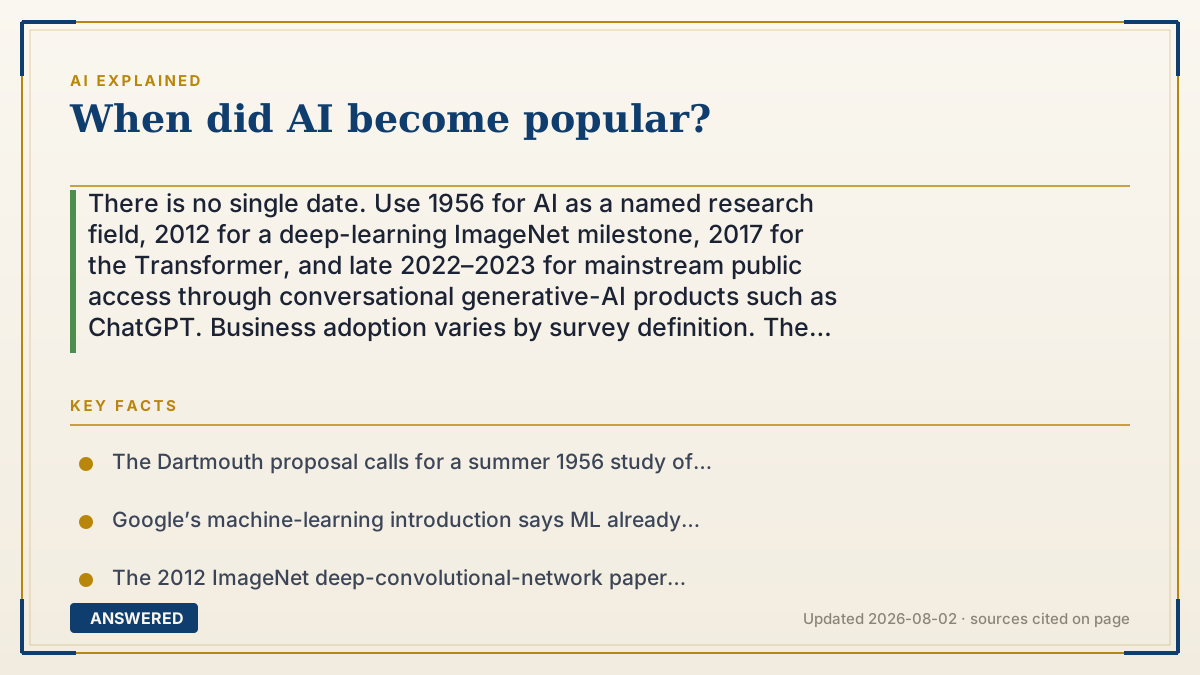
There is no single date. Use 1956 for AI as a named research field, 2012 for a deep-learning ImageNet milestone, 2017 for the Transformer, and late 2022–2023 for mainstream public access through conversational generative-AI products such as ChatGPT. Business adoption varies by survey definition. The short answer: AI became mainstream to the public around 2022–23, after decades of research and invisible product use.
Why — the first-principles explanation
The question hides three different meanings of “popular.” Research popularity asks when scientists formed a field. Technical popularity asks when a method changed what practitioners could build. Public popularity asks when a large number of people knowingly tried AI. Business popularity asks when organizations reported using it in work. Those clocks do not strike at the same time.
A defensible timeline is: 1956 for the field’s name and research agenda; the 1990s–2010s for AI becoming invisible infrastructure in search, recommendations, translation, spam detection and other products; 2012 for a deep-learning performance milestone on ImageNet; 2017 for the Transformer architecture that later underpinned many language models; and late 2022–2023 for the consumer interface inflection. OpenAI’s ChatGPT launch page describes a free research preview and a conversational dialogue format, which lowered the barrier from “use an API” to “type a question.”
Do not turn that timeline into a fake single-day origin story. Stanford’s 2025 AI Index reports that 78% of organizations said they used AI in 2024, while a U.S. Census measure found only about 3.8–3.9% of employer businesses used AI to produce goods or services in late 2023. The difference is not necessarily an error: the surveys use different populations, questions and definitions. The best short answer is therefore “mainstream with the public around 2022–23, built on decades of research and product use.”
An example that makes it click
Two people can answer this question correctly with different dates. A computer-science historian may say 1956 because Dartmouth gave the field its name and a research program. A machine-learning engineer may say 2012 because the ImageNet result made deep neural networks impossible to ignore, or 2017 because the Transformer changed the language-model path. A parent asking when they first used AI may say 2022–23 because a free chat interface made the technology visible. The disagreement disappears once “popular” is replaced by a measurable audience and behavior.
How to do it
- Define the audience and behavior: researchers naming a field, engineers adopting a method, consumers trying a product, or organizations using AI in production.
- Choose a dated primary source for the claim. A research proposal, benchmark paper, product launch and adoption survey answer different questions.
- Anchor the field’s origin separately from public awareness. The Dartmouth proposal is evidence about the research field, not proof that households used AI in 1956.
- Use 2012 and 2017 as technical milestones only when the question is about capability or architecture, not mass adoption.
- For the consumer inflection, check whether the product was accessible, conversational, affordable and easy to try; a model release alone does not equal popularity.
- When quoting adoption statistics, record the population, survey wording, field dates and whether “use” means experimentation, employee use or production output.
- Keep awareness, usage frequency, revenue, investment and social impact as separate measurements. A headline about one does not establish all five.
- Prefer a range with a reason—such as late 2022 to 2023 for mainstream generative-AI awareness—over an invented universal date.
- If the answer informs a current tool or business decision, move from history to a task test: capability, data boundary, cost, reliability, permissions and human review.
Key facts
- The Dartmouth proposal calls for a summer 1956 study of artificial intelligence and frames the field as a research problem about machine intelligence.
- Google’s machine-learning introduction says ML already powers translation, travel-time estimates, recommendations, autocomplete, summaries and generated content—examples of AI becoming useful before it was a consumer label.
- The 2012 ImageNet deep-convolutional-network paper reports substantially better top-1 and top-5 error rates than the previous state of the art, making it a practical deep-learning milestone.
- The 2017 Transformer paper proposes an attention-only architecture that was more parallelizable and faster to train than the recurrent or convolutional alternatives it compared with.
- OpenAI’s ChatGPT launch describes a free research preview and a conversational dialogue interface; this is evidence of an access and interface inflection, not the invention of AI.
- The Stanford 2025 AI Index reports that 78% of organizations said they used AI in 2024, up from 55% in 2023; this is a broad organization-level measure.
- The U.S. Census Bureau reported about 3.8–3.9% of employer businesses using AI to produce goods or services in late 2023; this narrower production-use measure cannot be compared directly with the Stanford survey.
- The most useful short answer is “AI became mainstream to the public around 2022–23,” while its research, technical and invisible-product histories began much earlier.
Put the AI timeline into a current decision
Start with the right definition, then compare today’s capabilities, cost, data boundaries and review needs.
▶ The 60-second explainer (script)
When did AI become popular? The honest answer is: it depends on what you mean by popular. If you mean a named research field, use 1956. The Dartmouth proposal organized a summer project on artificial intelligence and described machine intelligence as a research problem. That is the field’s origin story—not the moment households started using AI. If you mean technology that changed what engineers could build, two useful milestones are 2012 and 2017. The 2012 ImageNet paper reported a major deep-learning performance improvement. The 2017 Transformer paper introduced an attention-only architecture that was easier to parallelize and faster to train than the alternatives it compared with. Those are technical milestones, not adoption surveys. If you mean everyday public awareness, the strongest inflection was late 2022 into 2023. OpenAI’s ChatGPT launch described a free research preview and a conversational interface. That mattered because people could type a question without an API key, code or a machine-learning background. It made AI visible and directly usable. AI was already working behind the scenes. Google’s machine-learning documentation gives familiar examples: translation, recommendations, travel-time estimates, autocomplete and spam or image classification. The label became popular later than the technology. Business numbers need even more care. Stanford’s 2025 AI Index says 78% of organizations reported using AI in 2024. A U.S. Census measure found only about 3.8 to 3.9% of employer businesses used AI to produce goods or services in late 2023. Those figures are not automatically contradictory; they ask different questions and use different populations. So the short answer is: AI became mainstream with the public around 2022 to 2023, but it was a research field in 1956, a visible technical movement by the 2010s, and invisible infrastructure long before the chatbot boom. Always attach a date to a metric before calling AI popular.
What authoritative sources say
People also ask
When did AI become popular?
For mainstream public awareness and direct use, the best short answer is late 2022 to 2023, when conversational generative-AI products became easy to try. AI as a research field dates to 1956, and AI-powered product features were common before the chatbot boom.
Was AI popular before ChatGPT?
Yes, but often invisibly. Search ranking, recommendations, translation, spam filtering, autocomplete and image classification used machine-learning systems before most people thought of themselves as “using AI.”
Did ChatGPT invent AI?
No. ChatGPT was an accessible product built on decades of AI research and language-model work. Its importance was the interface and distribution: a conversational system that ordinary users could try directly.
Why do some answers say 1956?
The 1956 Dartmouth proposal is widely used as a field-origin marker because it organized a research project explicitly called artificial intelligence. It does not mean AI was already a mass consumer technology then.
Why does 2012 matter in AI history?
The ImageNet deep-convolutional-network result is a widely used technical milestone because it reported a large improvement over the previous state of the art. It describes capability progress, not household adoption.
Why does 2017 matter?
The Transformer paper introduced an attention-only architecture that was more parallelizable and faster to train in its reported comparisons. It later became an important foundation for many language-model systems.
When did businesses start adopting AI?
There is no single date. Stanford’s 2025 AI Index reports broad organization-level use in 2024, while a Census measure found about 3.8–3.9% of employer businesses used AI to produce goods or services in late 2023. The different definitions matter.
Is generative AI the same as AI?
Generative AI is a subset of AI that creates content such as text, images, audio, video or code. AI also includes systems that classify, rank, predict or recommend without generating a new artifact.
Is AI still becoming more popular?
Popularity is still changing, but measure it by a stated signal: awareness, active use, organizational deployment, production output, investment or policy attention. A single app’s user count cannot stand in for all of those.
What date should I use in an article or presentation?
Use the date that matches your claim: 1956 for the named research field, 2012 or 2017 for technical milestones, and late 2022–2023 for mainstream public generative-AI awareness. Cite the primary source and define the metric next to the date.
The same question, asked other ways
- When did AI become popular?