How many schools have AI policies?
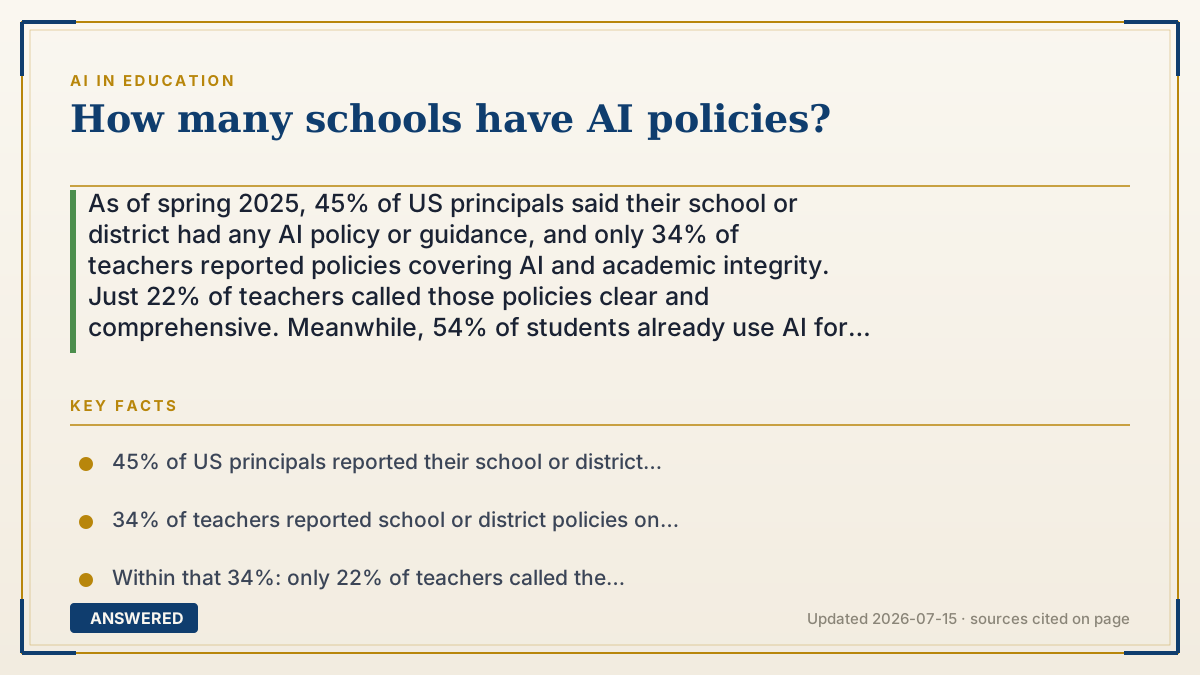
As of spring 2025, 45% of US principals said their school or district had any AI policy or guidance, and only 34% of teachers reported policies covering AI and academic integrity. Just 22% of teachers called those policies clear and comprehensive. Meanwhile, 54% of students already use AI for schoolwork.
Why — the first-principles explanation
There is no single official count, and the honest reason is that nobody is required to report one. US K-12 policy is made district by district, so "how many schools have AI policies" can only be answered by surveying people and asking them. The best current numbers come from RAND, which surveyed 3,668 principals in March-April 2025 and 8,601 teachers in April-June 2025.
Those surveys produce two different numbers, and the gap is instructive rather than contradictory. 45% of principals said their school or district had provided any policy or guidance on using AI. 34% of teachers said their school or district had put policies in place specifically about AI and academic integrity. Principals are answering about the existence of a document; teachers are answering about whether a usable rule reached the classroom. Broad guidance is more common than the specific rule everyone actually needs.
Even that 34% is generous. Broken apart, only 22% of teachers described the policies as clear and comprehensive — 6% called them limited and 6% called them unclear or confusing. So roughly one teacher in five is working with a rule they'd describe as actually usable.
The lag has a structural cause. School policy moves at the speed of board meetings, legal review, and school years. AI capability moves in months. Adoption doesn't wait for either: 54% of students reported using AI for schoolwork in winter 2025. The result is that the rules are thinnest exactly where the stakes are highest — coverage runs 49% in high schools versus 22% in elementary schools, and 51% of students now say they worry about being falsely accused of AI cheating.
An example that makes it click
Imagine a school installs a swimming pool over the summer. Kids are swimming in it the first week back. The handbook covering pool rules is scheduled for a board vote next spring.
In the meantime, every teacher on duty invents their own rules. One bans diving. One allows it. One hasn't thought about it and decides on the spot when something goes wrong. Nobody is being unreasonable — the pool simply arrived before the rulebook. That is roughly the state of AI policy in American schools right now: 45% have written something down, and about a fifth of teachers have a rule they'd call clear.
Key facts
- 45% of US principals reported their school or district had provided any policy or guidance on using AI (RAND, 3,668 principals surveyed March-April 2025)
- 34% of teachers reported school or district policies on AI related to academic integrity (RAND, 8,601 ELA/math/science teachers surveyed April-June 2025)
- Within that 34%: only 22% of teachers called the policies clear and comprehensive; 6% called them limited; 6% called them unclear or confusing
- Policy coverage by level: 49% of high school teachers vs 32% of middle school and 22% of elementary school teachers reported academic-integrity policies
- 54% of students reported using AI for schoolwork in winter 2025, including 61% of high schoolers — adoption is running ahead of policy
- 35% of district leaders reported providing students any training on AI; at the elementary level it was 3%
▶ The 60-second explainer (script)
How many schools have AI policies? As of 2025, fewer than half. RAND surveyed over three thousand principals in spring 2025: forty-five percent said their school or district had any policy or guidance on AI at all. Ask teachers a sharper question — is there a rule about AI and academic integrity? — and it drops to thirty-four percent. Push further: only twenty-two percent of teachers describe those policies as clear and comprehensive. So about one teacher in five has a rule they'd call usable. Here's why there's no official number. There's no federal AI mandate for K-12. Thirteen thousand districts each decide for themselves, so the only way to count is to ask people. And the coverage is thinnest where stakes are highest — forty-nine percent in high schools, twenty-two percent in elementary. Meanwhile fifty-four percent of students are already using AI for schoolwork. The pool opened before the rulebook was written. That gap has a cost: fifty-one percent of students now say they worry about being falsely accused of cheating with AI.
What authoritative sources say
People also ask
Is there a national AI policy for US schools?
No. There is no federal mandate covering AI use in K-12 classrooms, so roughly 13,000 districts each set their own rules. That is why no official national count exists — every figure you see comes from a survey estimate.
Why do principals and teachers report different numbers?
They were asked different questions. Principals were asked whether any AI policy or guidance exists (45% said yes). Teachers were asked specifically about policies on AI and academic integrity (34% said yes). Broad guidance is more common than the specific classroom rule.
Are more schools adopting AI policies over time?
Yes. Teacher training is the clearest trend: about half of districts reported providing AI training for teachers as of fall 2024, roughly double the previous fall. Policy coverage is climbing, but student adoption is climbing faster.
What does a typical school AI policy cover?
Most commonly, whether and how AI may be used on assignments, what counts as academic dishonesty, and which tools are approved. Coverage is uneven — 6% of teachers describe their school's policy as unclear or confusing, which functionally means no rule at all.