Is ChatGPT AI?
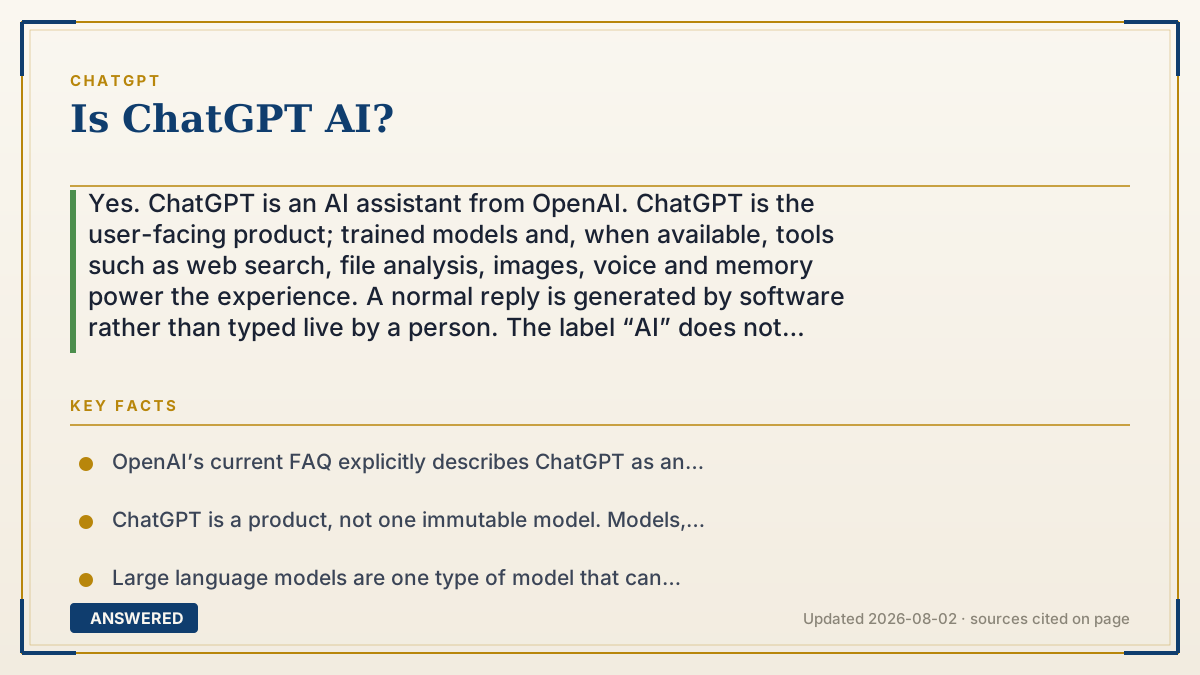
Yes. ChatGPT is an AI assistant from OpenAI. ChatGPT is the user-facing product; trained models and, when available, tools such as web search, file analysis, images, voice and memory power the experience. A normal reply is generated by software rather than typed live by a person. The label “AI” does not guarantee accuracy, consciousness, one fixed model, live sources or that no authorized human can ever review content.
Why — the first-principles explanation
The direct answer is yes. NIST describes an AI system as an engineered or machine-based system that, for a set of objectives, generates outputs such as predictions, recommendations or decisions that influence real or virtual environments. OpenAI describes ChatGPT as an AI assistant and an artificial-intelligence-based service that responds to instructions and performs tasks. ChatGPT clearly fits that broad definition: software receives an input, applies trained models and product logic, and produces an output.
The useful distinction is between AI, models and products. AI is the broad field and category. A model is a trained system that has learned patterns from data. A large language model is a model specialized in language. ChatGPT is the product through which a person uses one or more models plus context, instructions, safety systems and optional tools. OpenAI’s AI Fundamentals guide expresses the same hierarchy: AI contains models; LLMs are language-focused models; ChatGPT is a user-facing product. That is why “ChatGPT” and “a GPT model” are related but not interchangeable names.
ChatGPT is also generative AI because it can create new text and other content from learned patterns. But that narrower classification belongs to a different question. Calling ChatGPT generative AI does not mean every step is generation: the product can search the web, inspect a file, run code for data analysis, work with an image or use another connected tool, then generate an explanation around the result. The detailed category boundary is covered on the linked Is ChatGPT generative AI? page.
Is a person answering in real time? A normal ChatGPT response is generated automatically by the service; there is not a person privately typing each reply. OpenAI explains that its language models learn relationships in data and generate text from learned weights, predicting successive tokens in context. That mechanism is enough to explain why a response can sound conversational without a live human author. Exact parameter counts, hardware, elapsed time and the model selected for a particular account should not be guessed: they can be undisclosed or change by plan, workspace and rollout.
Automated generation does not mean that no person can ever access a conversation. OpenAI’s consumer-data FAQ says a limited number of authorized personnel and confidentiality-bound service providers may access user content when needed for abuse or security investigations, support, legal matters or model improvement when the user has not opted out. Access is described as need-to-know, controlled, monitored and logged. So the accurate boundary is: a person is not composing your ordinary response live, but limited authorized review can occur separately. Do not enter sensitive information that you would not want handled under the applicable service terms.
Modern ChatGPT is not one “next-word tool” wearing many costumes. Text generation is an important model mechanism, but the product currently documents broader capabilities: search, deep research, file and image analysis, image creation, data analysis, voice, memory, projects, scheduled tasks and custom assistants. Which model or capability is actually available can depend on subscription, workspace, settings, region and current limits. Ask what was used for the answer instead of inferring it from the ChatGPT name alone.
The label AI also does not settle the philosophical or reliability questions people attach to it. AI is not a synonym for a human mind, artificial general intelligence or consciousness. A fluent first-person sentence is output behavior, not evidence of a private experience. At the same time, it is safer to avoid pretending that a short product interaction can prove every claim about an internal state. For practical decisions, the important facts are observable: the service can produce errors, can use or omit tools, may remember information when memory is enabled, and requires human judgment where mistakes matter.
Likewise, ChatGPT is not limited to an offline answer generator and it is not identical to a conventional search engine. OpenAI’s current FAQ says ChatGPT can search the web and cite sources. A response without search or citations may still come from model knowledge rather than a current lookup. When freshness matters, confirm that search or another authoritative source was actually used, open the cited page and check that it supports the claim.
The practical conclusion is simple. “Is ChatGPT AI?” has a firm yes answer. “Should I rely on this output?” remains a separate decision. Check the current model and tools shown in your account, the evidence behind the response, the data controls and retention rules, the failure cost, and performance on representative examples. Use the AI label to understand the product category—not as a warranty of truth, privacy or suitability.
An example that makes it click
Suppose you ask ChatGPT whether a flight is delayed. In both cases the reply comes from an AI assistant, but two very different workflows are possible. Without a live source, the model may generate a plausible answer from prior patterns. With web search or a connected travel source, it may retrieve current information and generate a cited summary. “It is AI” is true in both cases; only the second workflow has evidence suitable for a current-status decision. You still need to open the airline or airport source before acting.
How to do it
- Name the task and its failure cost. Brainstorming, current facts, calculations, confidential analysis and consequential advice require different evidence and controls.
- Check the current ChatGPT surface, plan and workspace. Confirm which model and tools are actually available instead of relying on an old model name or review.
- Ask whether the response used search, files, code, images or another tool. Look for tool indicators and sources rather than assuming every answer is live or grounded.
- Open and verify primary sources for current or consequential claims. Run calculations and code, and compare important outputs with independent evidence.
- Set data controls before sharing content. Minimize sensitive information, review whether conversations can improve models and understand any connected service’s separate policy.
- Test the workflow on representative examples and known edge cases. Measure correctness, omissions, edit time, latency, limits and total cost.
- Keep a qualified human accountable for medical, legal, financial, safety, employment, education or reputation-sensitive decisions.
- Record the date, relevant model or feature, sources and settings when reproducibility or an appeal path matters. Product behavior can change over time.
Key facts
- OpenAI’s current FAQ explicitly describes ChatGPT as an AI assistant, and its model-development guidance calls it an artificial-intelligence-based service.
- ChatGPT is a product, not one immutable model. Models, tools, limits and availability can vary by plan, workspace, settings and rollout.
- Large language models are one type of model that can power ChatGPT; the product can wrap them with context, safety systems, memory and tools.
- ChatGPT is generative AI, but that category describes a core content-generation capability rather than every retrieval, calculation or tool step in the product.
- Ordinary replies are generated automatically rather than typed live by a hidden person.
- OpenAI says limited authorized personnel and confidentiality-bound service providers may access consumer content for specified support, safety, legal or model-improvement purposes, subject to settings and controls.
- ChatGPT can search the web and cite sources in supported experiences, but a response is not necessarily based on a live search unless the tool was actually used.
- When enabled, memory can use information from chats, files and connected apps to personalize later responses; users can review or disable memory.
- Fluency is not an accuracy guarantee. An AI-generated answer can be wrong, incomplete, outdated or unsupported.
- The word AI does not by itself imply consciousness, AGI, human-level ability, privacy, source grounding or fitness for a high-stakes decision.
Open the official product site and confirm the current access, plans and terms.
Use ChatGPT by task, evidence and data controls
The AI label answers what ChatGPT is, but not whether its current model, tools, sources, limits or privacy settings fit your job. Check the actual product surface, test representative work and keep verification proportional to the cost of an error.
▶ The 60-second explainer (script)
Is ChatGPT AI? Yes. OpenAI describes ChatGPT as an AI assistant. But keep the layers straight: AI is the broad category, a model is a trained system, a large language model works with language, and ChatGPT is the product that combines models with context, safety systems and tools. A normal reply is generated by software, not typed live by a hidden person. That does not mean no human can ever access a chat: OpenAI says limited authorized reviewers may access consumer content for specific safety, support, legal or model-improvement reasons, depending on settings. ChatGPT can also search the web, analyze files, run data analysis, work with images, use voice and remember context when those features are enabled. So “AI” does not mean one fixed model, always online, conscious or automatically correct. For an important answer, check which tool was used, open the sources, review your data controls and verify the result. The category answer is yes; the trust decision still depends on evidence and task fit.
What authoritative sources say
People also ask
Is ChatGPT really artificial intelligence?
Yes. OpenAI calls ChatGPT an AI assistant and AI-based service. It uses trained models and product logic to generate outputs from user instructions, which fits the broad NIST definition of an AI system.
Is a human typing ChatGPT’s answers?
No, not in an ordinary chat. The response is generated automatically by the service. This is separate from limited authorized access to some content for safety, support, legal or model-improvement purposes under OpenAI’s policies and your settings.
Can a human read my ChatGPT conversation?
Potentially, in limited circumstances. OpenAI says authorized personnel or confidentiality-bound service providers may access consumer content on a need-to-know basis for specified reasons. Do not upload sensitive material without reviewing the relevant plan and data controls.
Is ChatGPT an AI or an LLM?
ChatGPT is an AI product and assistant. A large language model is one type of trained model that can power the product. Calling the product an LLM is common shorthand, but it hides the interface, tools, memory and safety layers around the model.
Is ChatGPT generative AI?
Yes. It can generate new text and other content from learned patterns. ChatGPT can also use retrieval, analysis and tools, so generative AI describes a core capability rather than every step in the product.
Is ChatGPT artificial general intelligence?
The fact that ChatGPT is AI does not establish that it is AGI. It has broad useful capabilities but also material limits, and neither an AI label nor a fluent conversation is a valid AGI test.
Is ChatGPT conscious or self-aware?
A conversational answer is not evidence of consciousness or self-awareness. ChatGPT is designed to generate useful responses; first-person language can be produced from learned patterns. Do not infer a private experience from style alone.
Is ChatGPT a search engine?
ChatGPT is an AI assistant, not simply a list of retrieved webpages, but it can use web search and cite sources in supported experiences. Check whether search actually ran before treating an answer as current.
Does ChatGPT remember previous conversations?
It remembers context within a chat, and when memory is enabled it can use information from past chats, files or connected apps for personalization. Availability and controls vary, and Temporary Chat does not use or create memories.
Does being AI mean ChatGPT is accurate?
No. AI describes the kind of system, not a truth guarantee. Verify important claims with primary sources, tests, calculations and qualified human review.
The same question, asked other ways
- Is ChatGPT an AI?