Is ChatGPT generative AI?
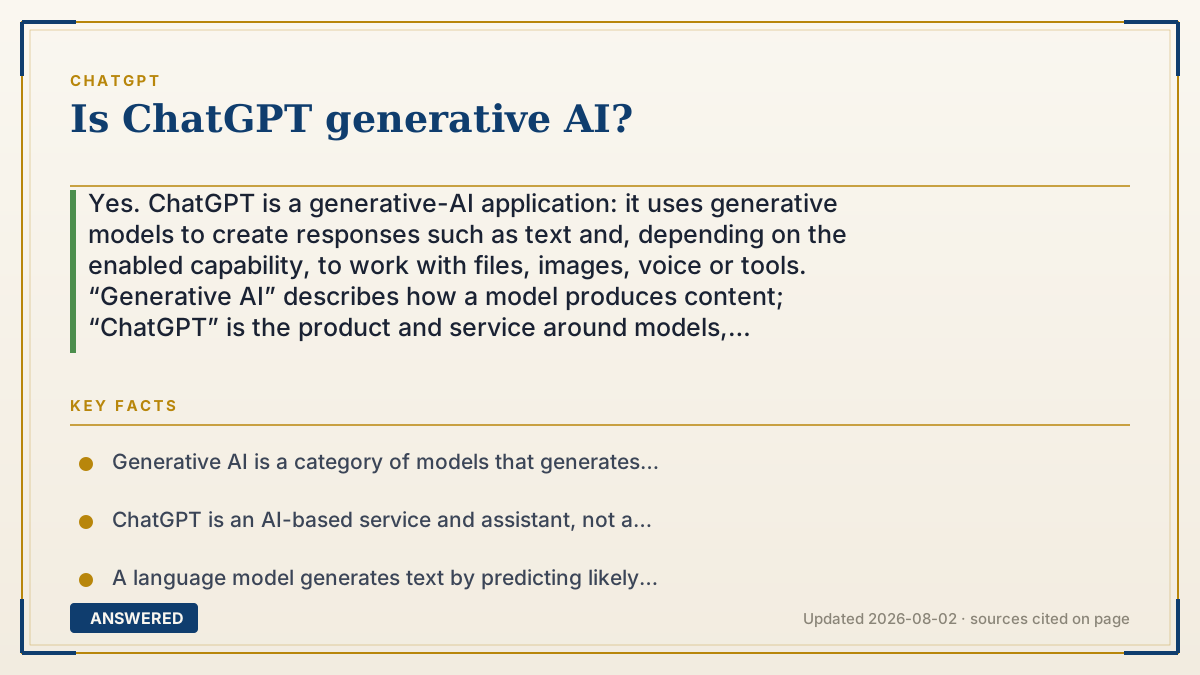
Yes. ChatGPT is a generative-AI application: it uses generative models to create responses such as text and, depending on the enabled capability, to work with files, images, voice or tools. “Generative AI” describes how a model produces content; “ChatGPT” is the product and service around models, instructions, safety layers and tools. The exact models, features, limits and data controls depend on the current surface, plan and settings, and fluent output is not a guarantee of truth.
Why — the first-principles explanation
The direct answer is yes, but the category and the product are not synonyms. Generative AI is a class of models that produces derived synthetic content from patterns learned from data. ChatGPT is an AI service and conversational interface that applies models to a user’s instructions. A ChatGPT reply is usually generated rather than selected from a fixed answer library, so ChatGPT fits inside the generative-AI category.
The word “generative” describes the production method, not the quality of the result. OpenAI explains that ChatGPT learns relationships in text, images, audio and video and uses learned parameters to predict and create content; for text, the process works with tokens and produces a response one token at a time. That can yield a useful draft, explanation, translation, code sample or plan. It can also yield a confident error. Generation is not verification, originality in the legal sense or human understanding.
ChatGPT is also more than one bare model. The product can combine a model with conversation context, instructions, safety systems, memory, file analysis, image generation, voice and other tools. OpenAI’s capability and FAQ pages describe availability as dependent on the current subscription, settings and limits. Therefore, “ChatGPT is generative AI” does not tell you which model answered, whether a tool was used, whether the answer was grounded in a source, or what data policy applied.
This matters when you compare ChatGPT with search or automation. A search or retrieval step can fetch an existing page; a tool call can calculate, browse or transform a file; the model may then generate a natural-language response that combines those results. The surrounding workflow can contain retrieval and deterministic operations even though the final explanation is generated. Calling the whole product generative AI is accurate, but calling every step pure generation is too simple.
Privacy is a separate question from the taxonomy. OpenAI’s current Data Controls guidance says users can turn off “Improve the model for everyone”; chats can remain in history while not being used to improve models. Temporary Chats do not appear in history, do not create memories and are not used to improve models, although a safety copy may be kept for up to 30 days and third-party actions can have their own policies. Check the setting that applies to your account before uploading confidential or personal material.
The practical decision is not “is it generative?” but “is this product surface suitable for this task?” For a low-risk brainstorm, generation may be the point. For a current claim, use sources or retrieval and verify them. For code, run tests. For a consequential decision, keep a qualified human accountable. Compare the model and tools available to you, limits, latency, total cost, data handling, correction path and evidence on representative work—not a polished demo.
That distinction is the SEO and product lesson behind this page. The query asks for a category answer, so the page should answer “yes” immediately, define the boundary, link to the broader “is ChatGPT AI?” explanation, and then move readers toward a measurable tool or workflow decision. It should not repeat a fixed model name or promise that the label predicts accuracy, privacy or value.
An example that makes it click
Think of AI as the whole workshop, generative AI as the machines that make new objects, and ChatGPT as a staffed counter that can choose a machine, read your brief, use tools and hand you a result. The object handed back may be newly made, but the counter may also fetch a source or run a calculation. The product is generative-AI powered; the label alone does not prove the result is true or fit for your job.
How to do it
- Define the task and the acceptable output. Decide whether you need a draft, a transformation, a sourced answer, a calculation, a classification or an action.
- Choose the product surface: ChatGPT chat, a connected tool, an API workflow or another application. Do not assume that a feature available in one surface is available in another.
- Check the current model, tool access, plan, rate limits and file or modality support shown in your account. Product names and entitlements can change.
- Decide what must be grounded in an external source. Provide authoritative material or use an appropriate retrieval tool when freshness, attribution or auditability matters.
- Set data controls before sharing content. Turn off model-improvement sharing or use Temporary Chat where appropriate, and check the privacy terms of any connected action or third party.
- Give the model constraints, examples and an explicit instruction not to invent missing facts. Keep sensitive data to the minimum the task requires.
- Test a representative sample, including ambiguous and failure cases. Measure factual accuracy, edit time, latency, cost and the amount of human review required.
- Verify the output proportionately: run code, check calculations, open cited sources and have a qualified person review medical, legal, financial, safety or reputation-sensitive claims.
- Record the model or feature, settings, source material and date when the output matters. This makes a later correction or reproducibility check possible.
- Keep a fallback and a correction path. If the workflow cannot detect or repair important errors, the generative label is not a sufficient reason to automate it.
Key facts
- Generative AI is a category of models that generates derived synthetic content from patterns in input data; NIST’s definition covers text, images, audio, video and other digital content.
- ChatGPT is an AI-based service and assistant, not a single immutable model name. Its current capabilities can include text, files, images, voice, memory and tools depending on the product surface, settings and plan.
- A language model generates text by predicting likely token sequences in context; a product can wrap that model with retrieval, tools, safety controls and human review.
- A generated answer can be fluent and useful while still being wrong, incomplete, outdated or unsupported. The generative label is not an accuracy guarantee.
- Generation does not by itself settle originality, authorship, copyright, licensing or provenance. Preserve sources and check the rules that apply to the output.
- OpenAI says users can turn off “Improve the model for everyone”; conversations can remain in history while not being used to improve models.
- OpenAI’s Temporary Chat FAQ says Temporary Chats do not appear in history, do not create memories and are not used to improve models; a safety copy may be kept for up to 30 days.
- Third-party actions or connected services can apply their own privacy policies, even when a conversation uses Temporary Chat.
- Model, feature and usage limits can vary by plan and change over time, so a current account setting is stronger evidence than an old review.
- The useful comparison is task fit plus evidence, privacy, cost, limits and human accountability—not whether a tool carries the phrase “generative AI.”
Open the official product site and confirm the current access, plans and terms.
Choose ChatGPT by task, model access and data controls
ChatGPT is generative AI, but the label does not tell you which model, tools, limits or privacy settings apply. Define the task, check the current plan and controls, test representative outputs and keep human verification where the cost of an error matters.
▶ The 60-second explainer (script)
Is ChatGPT generative AI? Yes. Generative AI is a category of models that creates new content from learned patterns. ChatGPT is the product and service around those models: a conversation interface, instructions, safety systems, context and—depending on your plan and settings—files, images, voice and other tools. OpenAI explains that text generation works with tokens and learned patterns, but that does not make every answer true or every product step pure generation. ChatGPT may retrieve a source, run a tool or analyze a file, then generate a natural-language explanation. So keep the categories separate: generative AI describes the capability; ChatGPT describes the product surface. Before using it, check the current model and tools, limits, data controls and third-party policies. Use sources for current claims, tests for code and human review where errors matter. The right question after 'is it generative?' is whether the workflow is fit for your task.
What authoritative sources say
People also ask
Is ChatGPT generative AI?
Yes. ChatGPT uses generative models to produce responses and other content. The product can also use retrieval, file analysis and tools, so “generative” describes a core capability rather than every operation in the workflow.
Is ChatGPT the same thing as generative AI?
No. Generative AI is a broad category; ChatGPT is a product and service that uses generative models along with context, instructions, safety systems and optional tools.
Is ChatGPT a large language model?
ChatGPT is the user-facing service, while a large language model is one kind of model that can power it. The service may expose different models and tools over time, so do not treat ChatGPT as one fixed model.
Does ChatGPT create original content?
It generates new output from learned patterns, but “new” does not guarantee human-style originality, copyright clearance, licensing rights or lack of similarity to existing work. Check sources and applicable rules before publishing.
Does ChatGPT retrieve information or generate it?
It can do both in one workflow. A tool may retrieve a page, inspect a file or perform a calculation, and the model may then generate an explanation. Ask which sources and tools were actually used when that distinction matters.
Can ChatGPT browse the web?
Browsing or other connected tools depend on the current product surface, account settings and availability. Do not assume a generated answer used live web sources; check for the tool and citations, then verify important claims.
Are ChatGPT answers reliable because it is generative AI?
No. Generative models optimize for a plausible response, not a universal truth guarantee. Use primary sources, calculations, tests and qualified review for claims where an error has meaningful consequences.
Does ChatGPT use my conversations to train models?
Settings and plan matter. OpenAI says you can turn off “Improve the model for everyone,” while Temporary Chats are not used to improve models and do not appear in history. Connected third parties may have separate policies.
Is ChatGPT free?
ChatGPT has different plans and feature limits, and those details can change. Check the current plan information in your account rather than treating an old comparison or a generic “generative AI” label as a pricing answer.
How should I choose ChatGPT for work?
Start with the task and risk, then compare the available model and tools, data controls, retention, limits, cost, evaluation evidence and human review path. Run a representative pilot before relying on it for consequential work.
The same question, asked other ways
- Is ChatGPT generative AI?